When you need to break a topic into smaller parts, you can create a concept map to see how those parts fit into the big picture. Concept maps allow you to convey a large amount of information clearly and succinctly. Think of concept mapping as brainstorming with a purpose.
Here’s an in-depth look at concept maps, including key features, use cases, tips for creating your own concept maps, and more.
What is a concept map?
A concept map is a diagram or graphical tool that visually represents relationships between individual ideas, images, or words. Most concept maps depict ideas as boxes or circles (also called nodes), which are structured hierarchically and connected with lines or arrows (also called arcs). These lines are labeled with linking words and phrases to help explain the connections between concepts.
Key features of concept maps
Concept maps are also referred to as conceptual diagrams. While other types of diagrams may look similar, concept maps have specific characteristics differentiating them from other visual tools.
Concepts
Concepts are defined as "perceived regularities or patterns in events or objects, or records of events or objects, designated by a label" and are depicted as shapes in the diagram.
Linking words/phrases
Linking words or phrases are located on the lines connecting objects in a concept map, and these words describe the relationship between two concepts. They’re as concise as possible and typically contain a verb. Examples include "causes," "includes," and "requires." Other common linking verbs you’ll see in strong maps include terms like “provides” or “encompasses,” chosen to precisely match the relationship being claimed.
Propositional structure
Propositions are meaningful statements made up of two or more concepts connected with linking words. These statements are also known as semantic units or units of meaning. Concepts and propositions are the foundation for the creation of new knowledge in a domain. Essentially, a concept map visually conveys a set of propositions about a certain topic.
Hierarchical structure
A key element of the concept map is its hierarchical structure. The most general and inclusive concepts are positioned at the top of a concept map, with the more specific and exclusive concepts arranged hierarchically below. As such, a concept map is designed to read from top to bottom.
Focus question
A focus question defines the issue or problem the concept map needs to solve. Developing a focus question allows you to design with a context in mind, helping guide and maintain the direction of your concept map. Within the hierarchical structure, the focus question should be at the very top of the concept map and serve as a reference point. When choosing a focus question, keep the scope narrow enough that the map stays organized and usable.
Parking lot
Before beginning your concept map, it can be helpful to come up with a list identifying the key concepts that need to be included. Establish a rank-ordered list from the most general concept to the most specific. This list is referred to as a parking lot, as you will move the items into the map as you figure out where they fit in. As a practical guideline, many concept maps start with roughly 15–25 key concepts in the parking lot, and are then expanded or refined as the map evolves.
Cross-links
Cross-links are relationships between concepts in different domains of the concept map, allowing you to visualize how ideas within these different domains are connected. Both the cross-links and the hierarchical structure facilitate creative thinking, and these cross-links often indicate moments of creativity. After you’ve built the basic structure, cross-links can also be used to show relationships between concepts at the same level of specificity, not just across distant parts of the map.
Why use a concept map?
The brain processes visuals 60,000 times faster than it processes text. Designed as a tool to organize and represent knowledge, concept mapping can help you visualize relationships between various concepts and test your understanding of complex subjects. Thinking through and visually representing relationships between ideas forms mental connections that allow for better retention of knowledge.
The concept map is a popular way to capture understanding of a topic for work, school, or personal study. It's used most frequently in academia, but the process can be easily applied to other fields.
Concept maps are ideal for developing logical thinking, dissecting complex systems, and contextualizing specific ideas within larger topics—but they offer benefits for any learning process. Use concept maps to:
-
Facilitate comprehension, meta-cognitive and lexicon development, as well as memory retention.
-
Synthesize information by integrating new and old concepts to better grasp the big picture.
-
Encourage brainstorming and high-level thinking.
-
Foster discovery of new concepts and their connections.
-
Clearly communicate complex ideas.
-
Promote collaborative learning.
-
Spark creativity and encourage out-of-the-box thinking.
-
Snapshot your current knowledge to assess understanding.
-
Identify areas that need further knowledge or review.
-
Create training materials and official documentation.
Potential disadvantages of concept mapping
Concept maps aren’t suitable for every scenario. Here are some potential disadvantages of using a concept map:
-
They can become visually overwhelming or messy when used to explore large concepts.
-
They limit users to keywords, which can lead to vague concept maps.
-
They can be more time-consuming than other visualizations.
When to make a concept map
Concept maps are an optimal learning tool for students and educators, whether the contributors are enrolled in school, teaching or tutoring a subject, or developing new skills on their own. The process of connecting ideas in a tangible space can solidify your topical knowledge, as well as clarify which areas need work.
Making a concept map can be helpful when:
-
Presenting concise overviews of a field
-
Absorbing information while studying for an exam
-
Assessing a student's grasp of a particular topic
-
Consolidating knowledge during the learning process
-
Demonstrating an acceptable level of understanding of a subject
-
Defining knowledge that exists in your head but hasn't been formally documented
Concept maps are similar to other node-linking mapping methods, such as topic maps or UML diagrams. However, concept maps differ in their philosophical basis, which holds that concepts and propositions are the foundation for new knowledge and meaning.
Keep in mind that concept maps aren’t the same as mind maps, though they're frequently confused (see below for more details). Concept maps aren't the best tool for visualizing new ideas, organizing meetings, or managing tasks and projects. You may want to try mind maps or another type of diagram in these scenarios.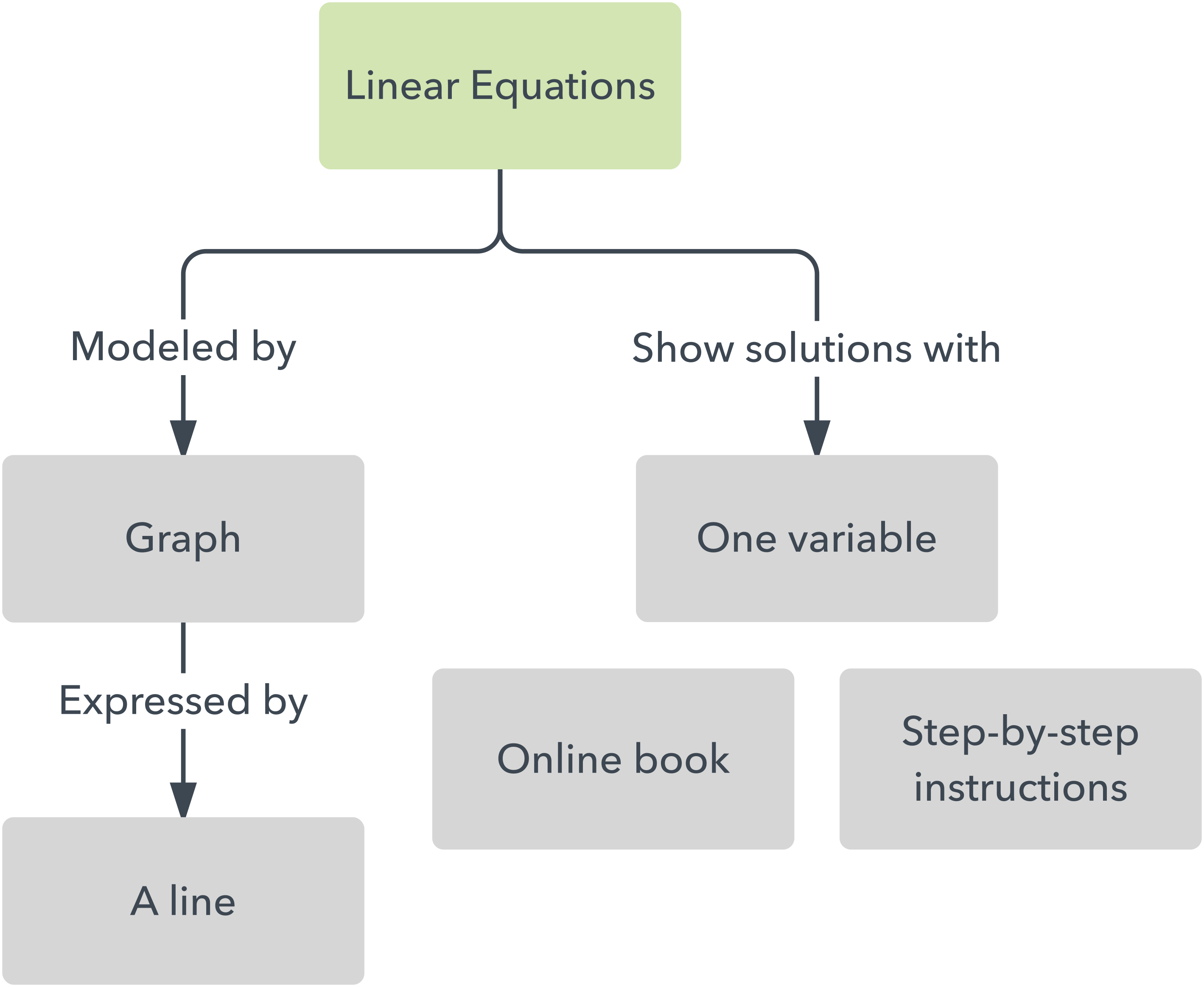
Concept maps vs. mind maps
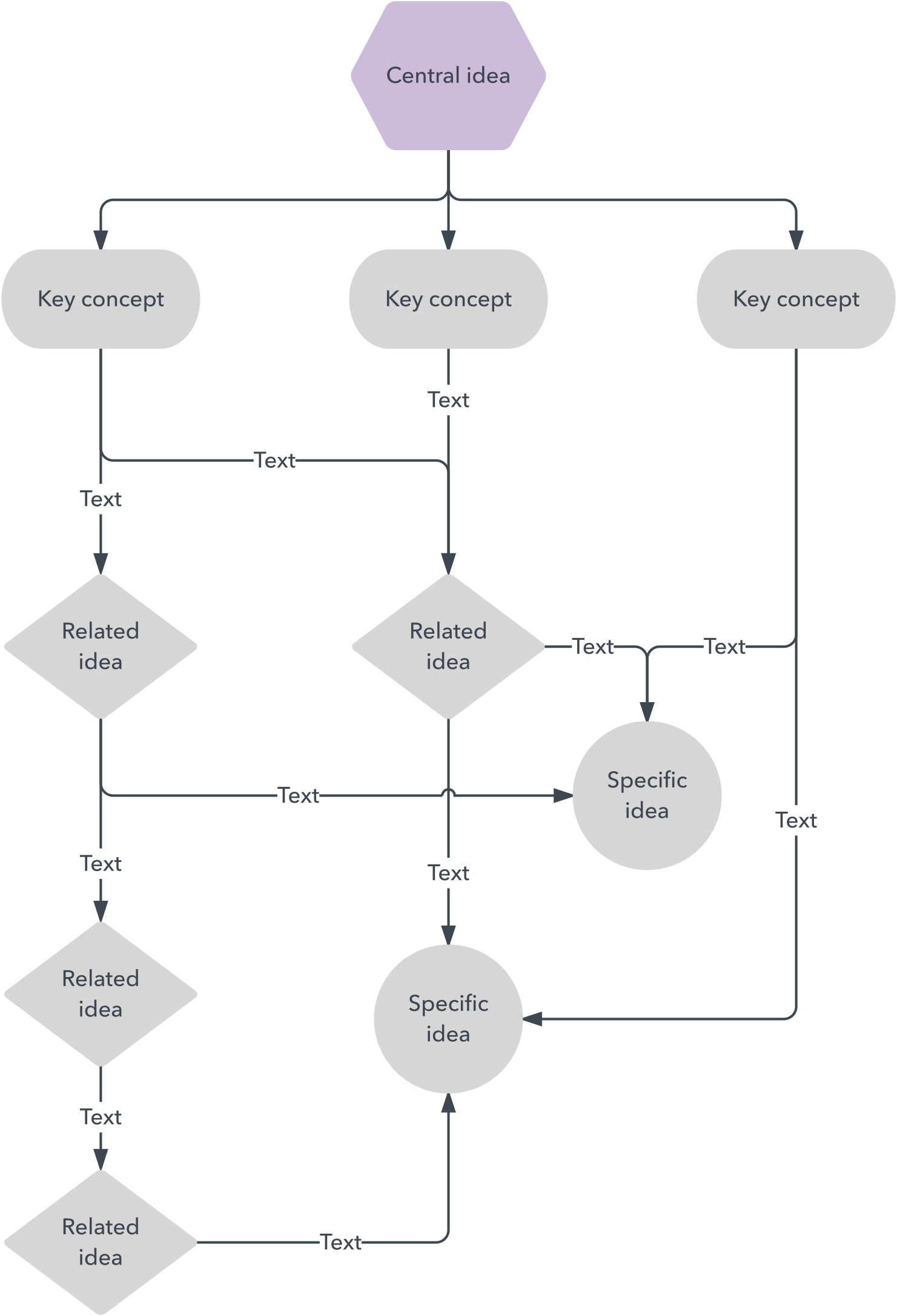
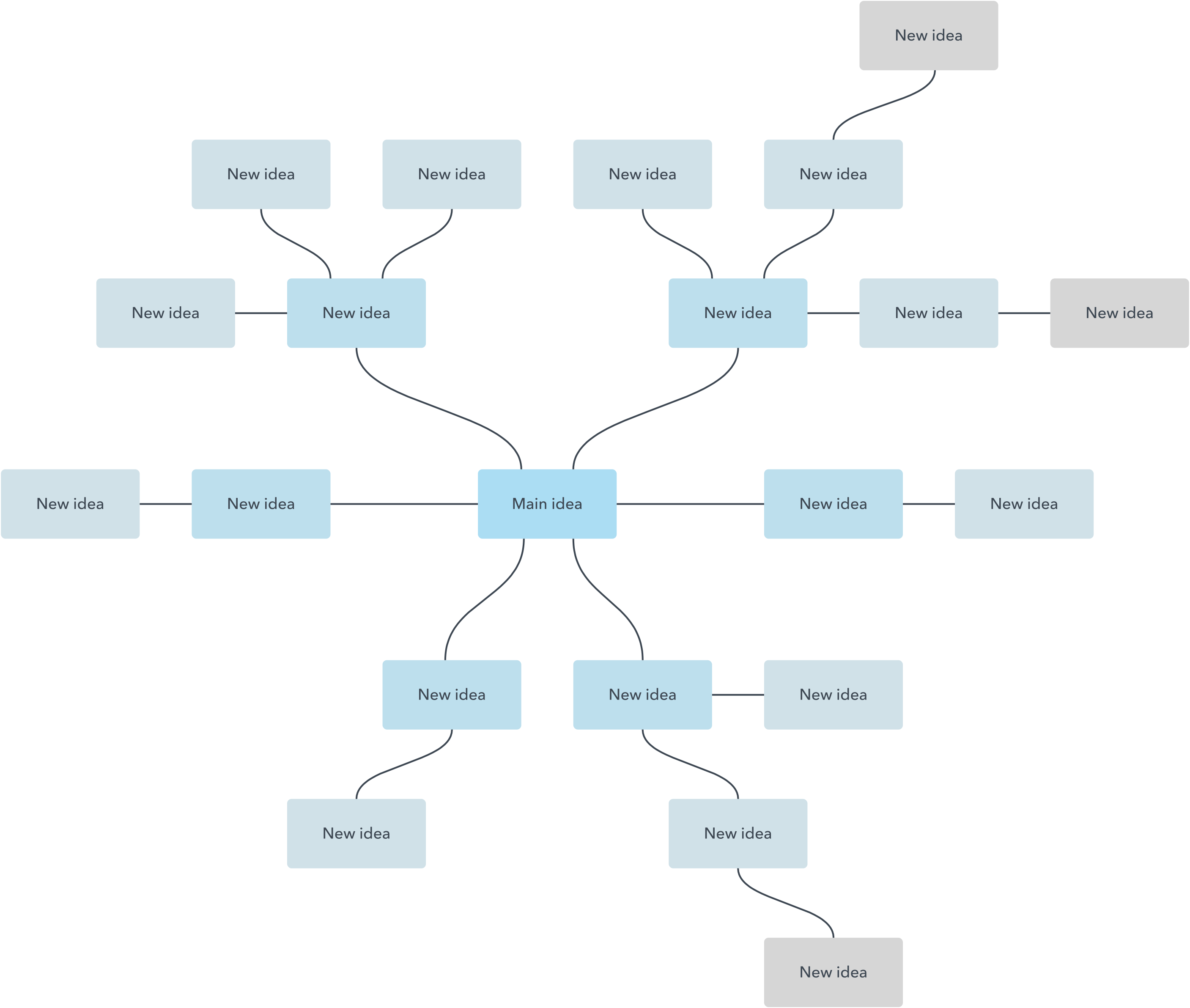
Many people have trouble telling concept maps and mind maps apart. Concept maps are more varied in how they depict relationships, while mind maps are typically limited to radial hierarchies and tree structures. Here's how to determine if you're dealing with a concept map or a mind map:
Concept maps
-
Are used to represent tacit knowledge, like an existing theory or concept, with ideas that are usually generated externally
-
Tend to represent academic knowledge, so their application is more formal
-
Contain general knowledge near the top of the map, with related concepts arranged hierarchically below
-
Show topics with cross-linking and multiple relationships
Mind maps
-
Are used to flesh out a set of ideas, which are often generated internally
-
Tend to represent a greater variety of tasks and concepts, so their application is more flexible
-
Contain a single word, phrase, or image in the center of the map, with related ideas radiating outward in all directions
-
Show topics with a single parent and several children
Concept mapping for education
Concept mapping can be a powerful tool in education, helping students perform at higher cognitive levels and helping teachers explain complicated subjects and assess student understanding.
Students can use concept mapping to:
-
Organize and structure new material.
-
Increase learning by relating new and old knowledge.
-
Map out relationships between things such as vocab words, characters in a story, and events in history.
-
Plan and outline writing projects.
-
Design their own representations of knowledge.
-
Brainstorm new ideas.
-
Take notes.
-
Create study guides.
-
Design complex structures.
Teachers can use concept mapping to:
-
Plan curriculum.
-
Assess understanding or diagnose misunderstanding of students.
-
Explain complex ideas.
-
Assist struggling readers.
As educators incorporate concept maps into their teaching methodology, they can provide aids to help facilitate the process for students:
-
Give a focus question to get the wheels turning.
-
Create a parking lot (list of key concepts) to help students determine what to include in their map.
-
Provide expert skeleton maps so students have a structure to follow. These are small concept maps started by an expert on the topic that students can then expand upon.
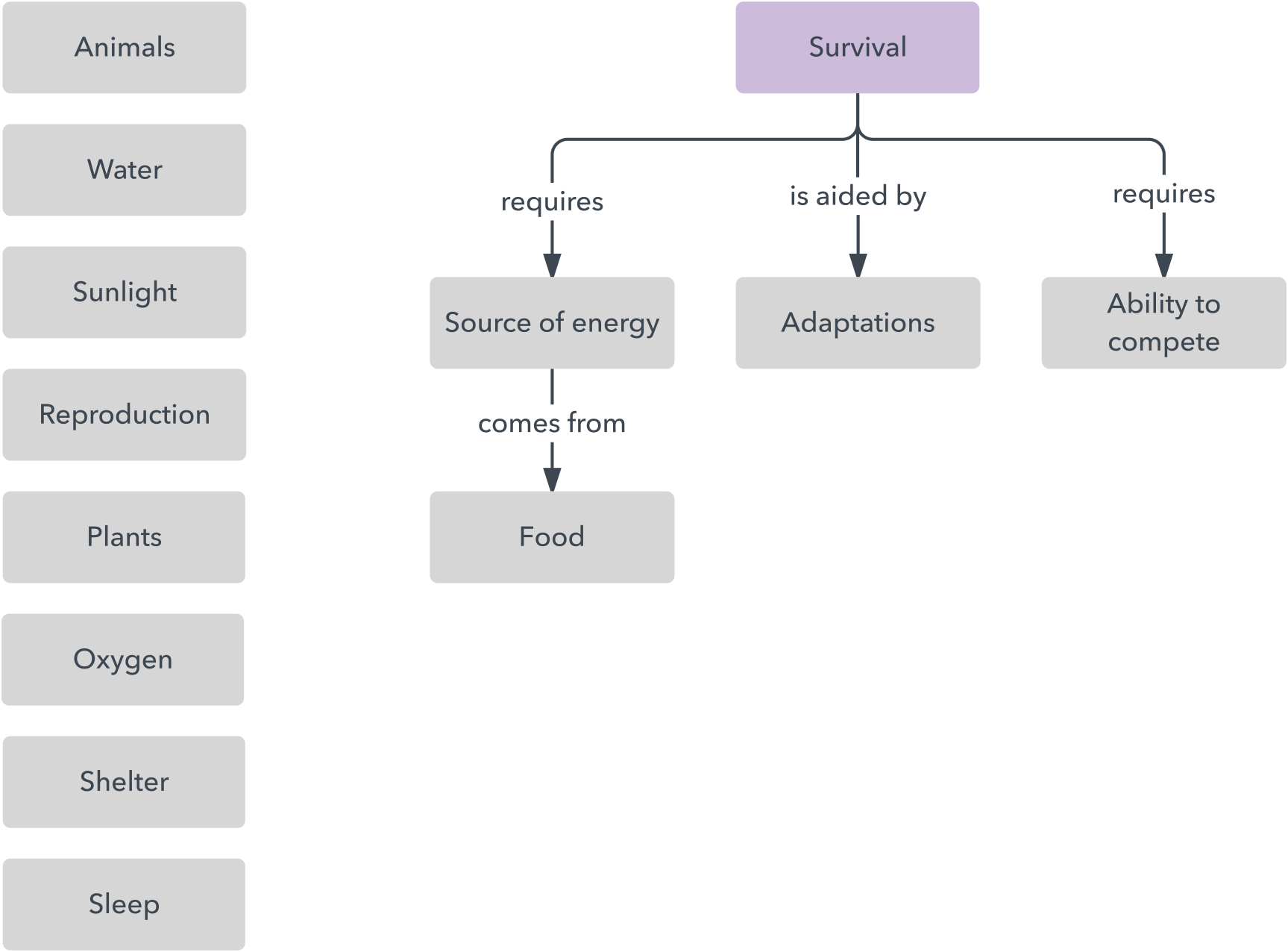
Concept maps are especially useful as evaluation tools. For example, instructors can have students create a concept map at the beginning of the semester to assess existing knowledge. Students can then repeat this activity throughout the semester so both students and teachers can evaluate what is being learned. It helps to assess cognitive ability, as deciding what cross-links are most important to include requires high cognitive performance. This activity can also be used to identify and remedy misconceptions students might have.
Research indicates that working in small groups and cooperating while learning results in positive cognitive and affective outcomes for students. Concept mapping enables this productive small group work among students and teachers in any subject matter, and can help develop a student’s strategic-thinking skills.
Concept mapping for business
While widely used in education, concept maps have expanded to the business world. Concept maps communicate ideas well and prompt intuitive visual thinking that aids business analysis for operations, marketing, product design, and more. Concept mapping is a group process, making it an ideal activity for teams or groups of stakeholders, especially when solving problems.
Through a creative and results-oriented approach known as design thinking, concept maps can be used for inspiration, ideation, and implementation. These diagrams are excellent storytellers, helping in the ideation and inspiration phases. When it comes time for implementation, concept maps help with instruction, documentation, and communication.
Concept mapping can enable experts within a business to document and share their knowledge for the purpose of:
-
Promoting company-wide understanding of business requirements
-
Spotting gaps and contradictions
-
Identifying complex relationships among ideas
-
Learning the "language" of a client
-
Establishing a consistent language for a project
-
Identifying potential requirements dependencies
-
Modeling inventory flows, cash flows, and relationship flows
-
Product development
-
Market analysis
-
Decision-making
-
Formulating research projects
-
Mapping team knowledge
-
Archiving expert knowledge
-
Training new employees
-
Software design
-
Ontology-building
In many business contexts, concept maps are also created as part of broader documentation workflows, where teams need to insert a clear visual into existing deliverables. In those cases, teams often prefer digital tools that make it easy to embed, update, and share the map alongside the rest of the work.
Concept mapping for healthcare
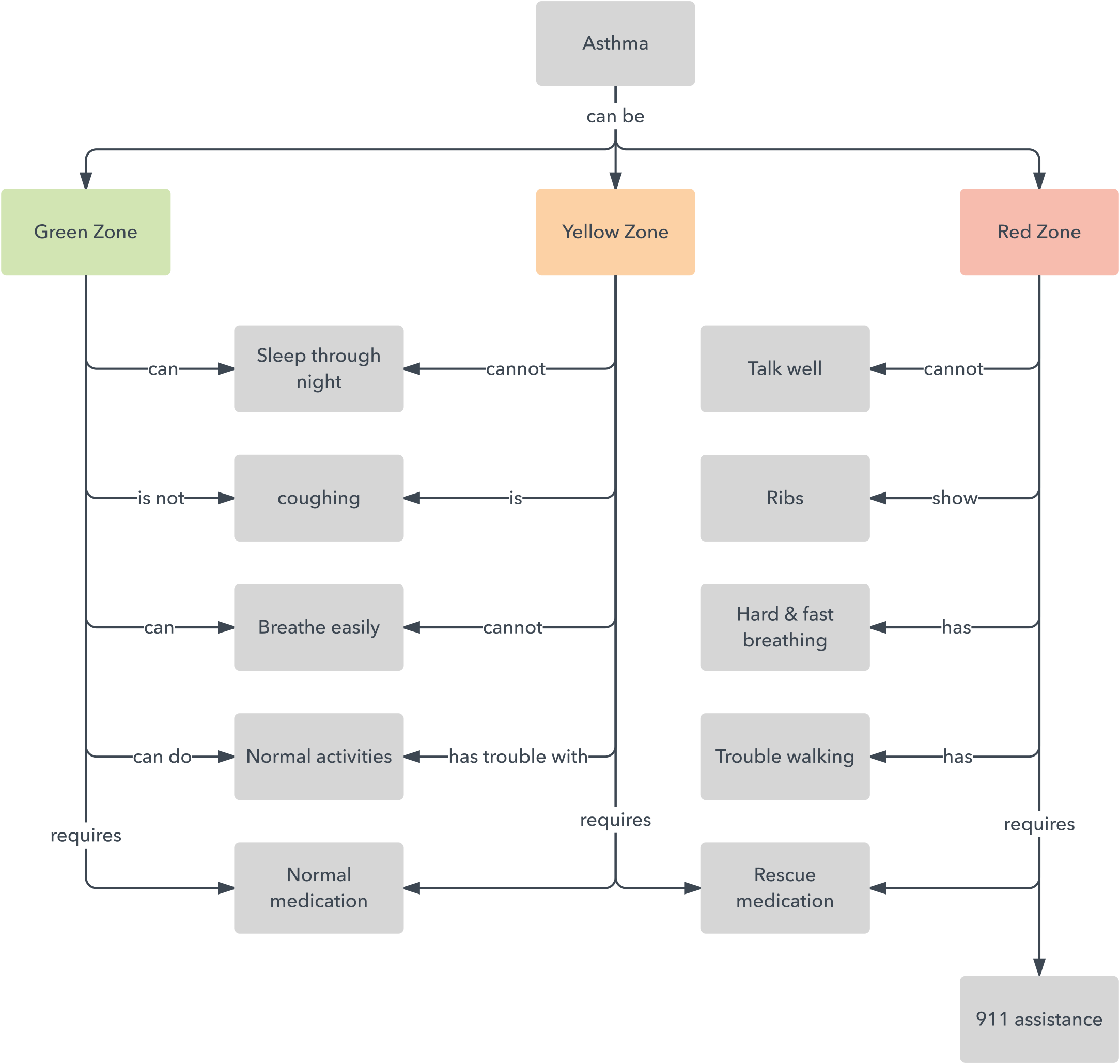
Within the healthcare industry, concept mapping allows for prioritizing ideas, evaluating consensus, identifying gaps, and creating improved action plans. It allows the various stakeholders of an organization to come together and formulate effective plans by creating a shared representation of the patient's condition and determining the proper next steps.
Applications of concept mapping within healthcare include:
-
Organizing workloads
-
Prioritizing patient assignments
-
Critically thinking through abnormal assessments
-
Mapping out plans of care
-
Identifying relationships between symptoms
-
Revealing diagnosis
-
Training medical staff
History of concept mapping
Concept mapping as a method was developed by Joseph Novak and a team of researchers at Cornell University in the 1970s. Dr. Novak was searching for a new tool to describe explicit changes in children's conceptual understanding.
Both he and his colleagues at Cornell had studied psychologist Jean Piaget's theories on cognitive operational stages. Piaget and other experts assumed that children weren't capable of comprehending abstract concepts, such as the nature of matter, before the age of 11. Dr. Novak launched a research project that would observe minute changes in the way children learned new ideas.
The result was a new tool developed by the Cornell team during their longitudinal study: the concept map. These maps were simple—just one or two words to represent the main idea, with lines showing linking words that created a meaningful statement. The most general concepts were grouped at the top of the map, and the most specific terms were at the bottom.
Since then, concept mapping has become extremely popular, as specialists across fields from education to healthcare realize its unique benefits.
Theoretical foundation
Concept maps are based on Ausubel's Assimilation Theory and Novak's Theory of Learning, which explain how people learn new information by integrating it with knowledge they already have. Novak stated, "Meaningful learning involves the assimilation of new concepts and propositions into existing cognitive structures."
Through meaningful learning, discussed more below, the integration of new concepts into our cognitive knowledge structure occurs by linking new knowledge to concepts already understood. A concept map provides a visual demonstration of the connections between concepts in our cognitive structure. The origin of concept maps is based in constructivism, which discusses how learners actively construct knowledge.
Physiological foundation
Children acquire concepts from birth to three years as they begin identifying labels or symbols for regularities they observe in the world around them. This early and autonomous learning is known as the discovery learning process. After age three, the reception learning process begins, where new meanings are formed by asking questions and understanding the relationships between old and new concepts. Concepts are no longer defined by the learner but described by others and transferred to the learner.
In addition to exploring these two learning processes, Ausubel also differentiates between rote and meaningful learning. Rote learning occurs when there is little or no relevant knowledge to the new information being presented and no internal commitment to incorporate new and existing knowledge. As a result, information is easily forgotten.
Meaningful learning can only occur under the following three circumstances:
-
The new material being presented must be clear and relatable to the learner's prior knowledge. Concept maps are helpful here, as they identify general concepts held by the learner that can be built upon.
-
The learner needs to have relevant prior knowledge, especially when trying to understand detailed and specific knowledge in an area.
-
The first two conditions can be controlled directly by the instructor, but the third requires the learner to make an effort to assimilate new and old information rather than just memorizing it.
The distinction between rote and meaningful learning is a continuum, as individuals possess different amounts of relevant knowledge and different motivation levels for knowledge assimilation. Creativity is a very high level of meaningful learning on this continuum.
Concept mapping is powerful for meaningful learning because it acts as a template to help organize and structure knowledge, even though the structure must be built piece by piece with small units of interacting concepts and propositions. This process allows for the use of knowledge in new contexts and for increased retention. In addition, research shows that our brain prefers to organize information in the hierarchical structure characteristic of concept mapping.
Epistemological foundation
Epistemology is the branch of philosophy dealing with knowledge and new knowledge creation. The growing consensus is that new knowledge creation is a constructive process that involves our knowledge and our emotions.
Concept maps are associated with constructivist theories of learning in which learners are active participants rather than passive recipients of knowledge. Learners must make an effort to bring new meaning to information they already know. Building concept maps is a creative process, as concepts and propositions are the foundation for knowledge in any domain.
Types of concept maps
While many concept maps share the same core features (nodes, linking phrases, hierarchy, and cross-links), you can choose different layouts depending on what you’re trying to show:
-
Spider mapping: A spider concept map is organized by putting the central theme or idea in the center of the document, with subtopics branching out from the center theme. It’s typically the easiest type of concept map to make and understand.
-
Flowcharting: A flowchart concept map presents information in a linear format.
-
System mapping: A systems concept map presents information in a flowchart-like format with the addition of inputs and outputs throughout the diagram. These types of concept maps are considered the most thorough presentation of data.
-
Hierarchy mapping: In a hierarchy concept map, information is presented in descending order of importance from top to bottom. General data is placed at the top and becomes more specific as it moves down.
How to build a concept map
Here are the basic steps in constructing a concept map:
-
Identify the focus question or main topic. Think about the problem or issue you want the concept map to resolve. This idea should connect to all others on your map and will guide the hierarchical structure. If your topic feels too broad to map cleanly, narrowing it into a single focus question can make the rest of the process much easier.
-
Identify all the key concepts that relate to the main idea you identified. Order them with the most general concepts first and the more specific concepts last. This list is referred to as the parking lot. Aim to keep concept labels short (often one or two words) so the diagram stays readable rather than turning into a block of text.
-
Create a preliminary concept map that links the concepts together. Remember to add linking words or phrases on the lines to demonstrate how the concepts are related.
-
Add cross-links to connect concepts in different domains. Once the basic links are in place, look for additional cross-links, especially between concepts at the same level of specificity, to surface non-obvious relationships.
-
Continually revise your concept map as needed. As you revise, it can help to pressure-test the map by checking whether each concept is in the best location and whether each linking phrase is the most accurate description of the relationship.
Practical tips for drawing and refining your map
Beyond the core steps above, a few practical choices can make concept mapping easier to get started and maintain over time. As you add links to every concept, be sure to carefully examine the relationships you're illustrating. Ask yourself questions such as:
-
What tools will I use to create my concept map?
-
Does every element fit well in its respective place?
-
Is there a better position for this idea or group of ideas?
-
Can I use a more accurate linking word to represent this relationship?
Remember, this is a preliminary map that will likely need revising. Treat early drafts as working models: The value often comes from iterating until the structure matches what you actually mean. Digital tools can make revision, sharing, and presentation formatting much simpler, especially when the map will be reused.

Everything you need to whiteboard online
Get the ultimate online whiteboard for teams. Brainstorm, plan projects, and collaborate virtually on Lucidspark’s infinite canvas.
Sign up free