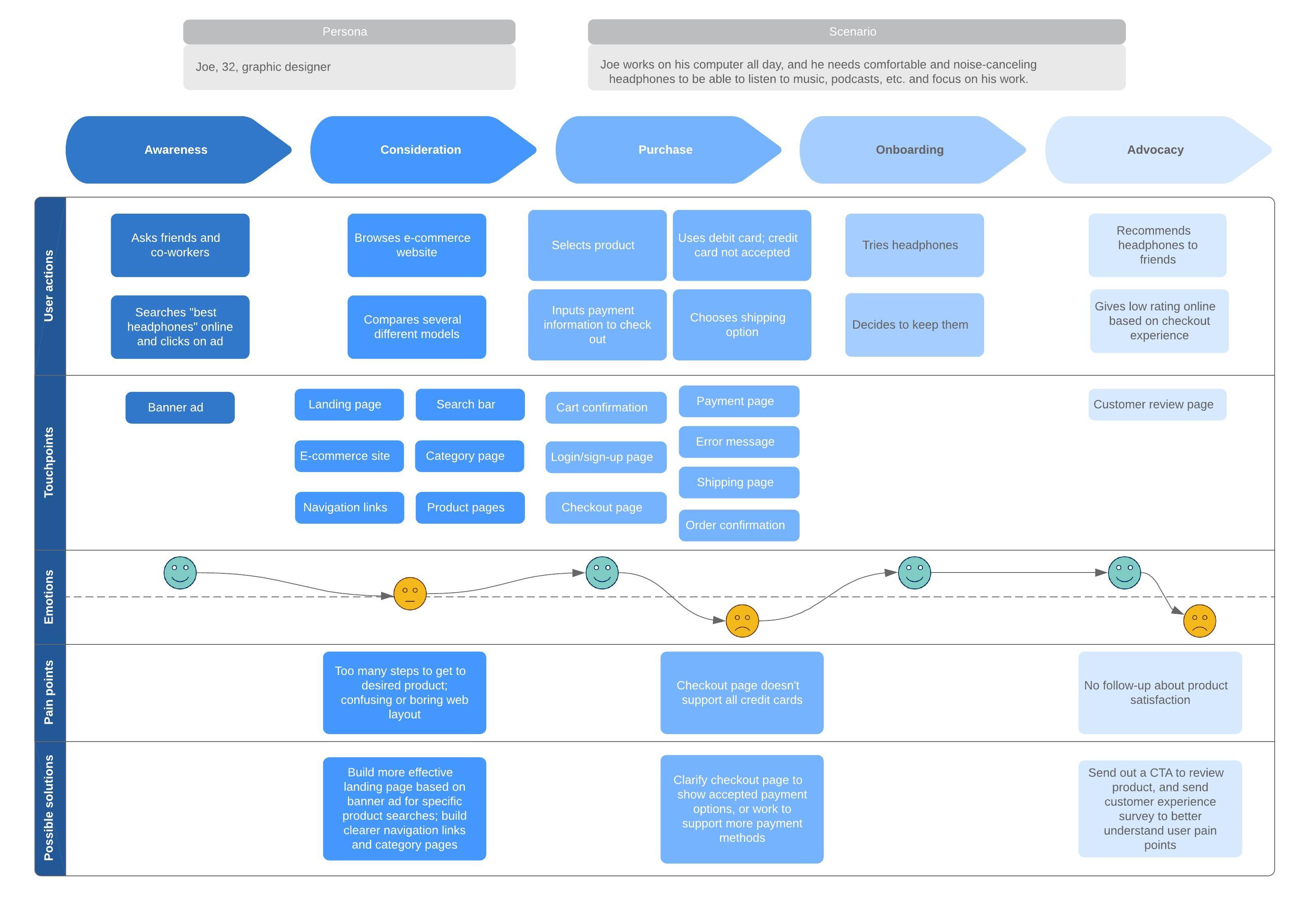
A customer journey map is a diagram that illustrates how your customers interact with your company and engage with your products, website, and/or services. It visualizes the customer's experience with your brand step by step, from introduction to point of sale. Depending on your business, the user experience might be purely digital (like a website or in-product flow), entirely in person (like a retail visit), or a mix of channels and interactions.
Think back to the last time you went on a trip. How was the experience? Did you have a good flight? Was it easy to find delicious food and comfortable lodging? Maybe you got lost along the way, found yourself stuck in bad weather, or had unexpected delays.
Customer journeys are like any trip: They can be marked by positive experiences and interactions or riddled with bad service, frustrating wait times, or confusing directions.
The goal is to understand and optimize your customers' journeys with your brand so that they want to make a return trip and tell all their friends about their experience.
Enter: The customer journey map.
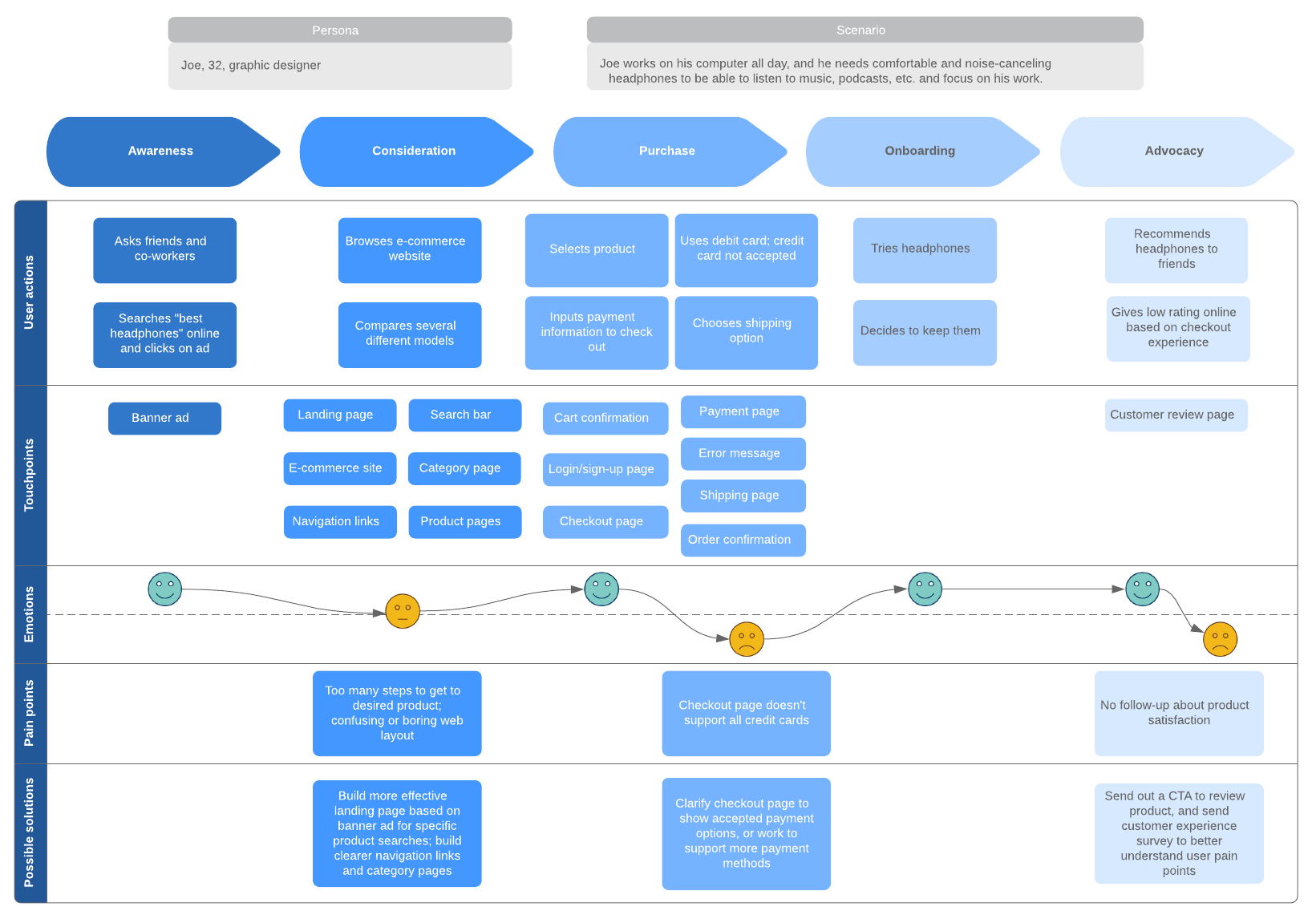
What is the customer journey, and why is it important?
Have you ever wondered what your customers are thinking? Chances are that customers and prospective clients have left you scratching your head at their behavior more than once. When you don't know how your customers engage with your brand or why they make certain decisions, it’s hard to be strategic in your approaches to sales, marketing, product, or UX design.
But you might be surprised just how much you can anticipate and understand your customers' needs and motivations with a customer journey map.
As Steve Jobs famously put it, you need to start with the customer experience and work back toward the technology—not the other way around. In practice, that means getting clear on the interactions you want customers to have (and how you want them to feel) before refining the systems, tools, and processes that support them.
What is customer journey mapping?
Customer journey mapping is the process of outlining and visualizing the customer's experience with your brand. You can use multiple types of customer journey maps depending on your goals and the specific buyer persona you're focused on. For example, you could create a customer journey map focused on current and future states to compare where you are now and where you want to end up with your customer experience.
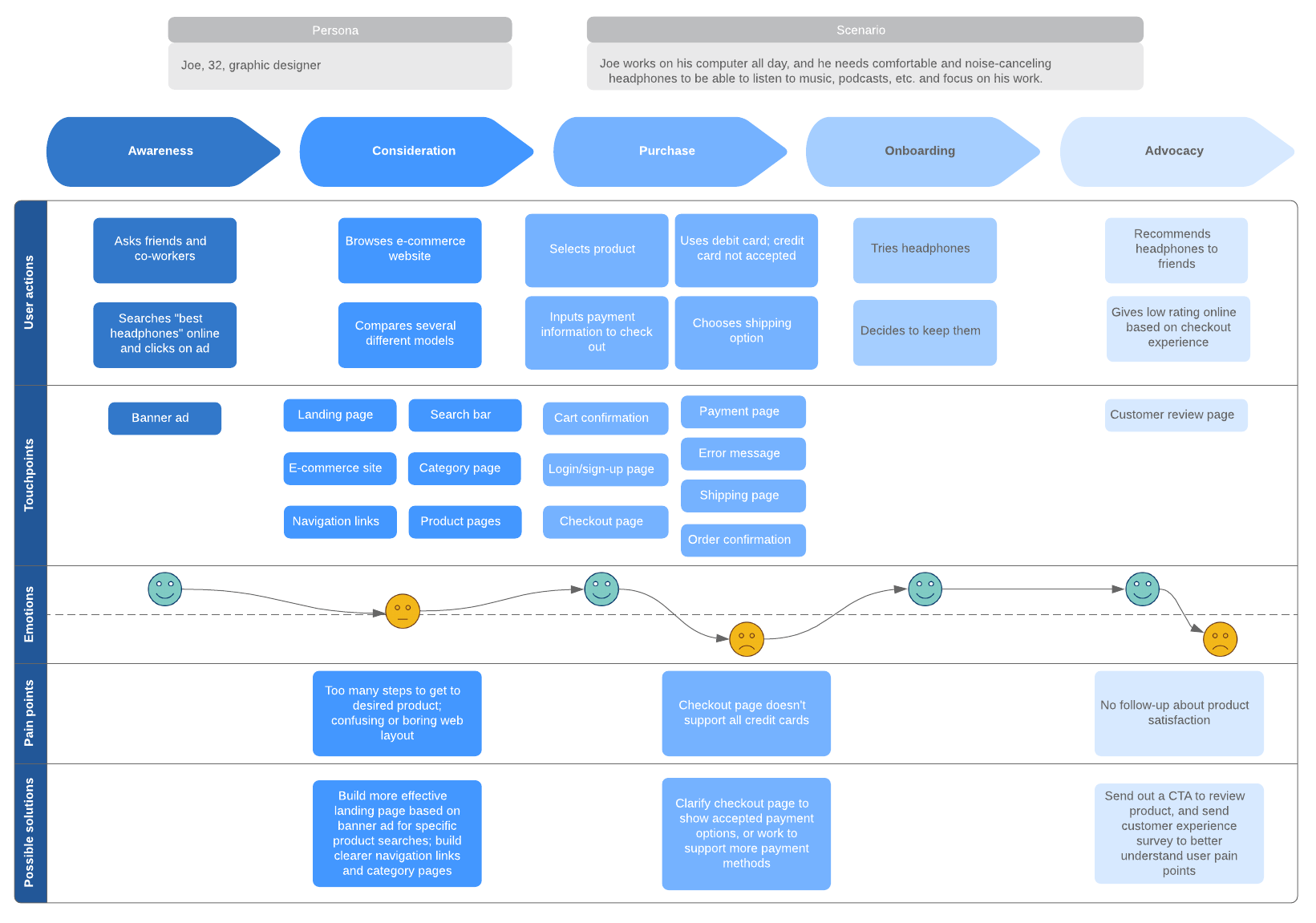
Whatever your focus, you will typically want to outline several common customer journey stages within your map. Many teams structure the map as a timeline of key events—such as a customer's first website visit, their first in-product experience, purchase, onboarding emails, and even renewal or cancellation—so it reads like a story of the end-to-end experience.
Benefits of customer journey mapping
A customer journey map helps you put yourself in your customers' shoes and understand their motivations, needs, and experiences with your brand.
When you know what they want and what's holding them back, you can tailor their experience, remove obstacles, and create solutions that speak directly to their needs.
A customer journey map helps you:
- Optimize the customer journey: Identify friction points, eliminate ineffective touchpoints, and improve onboarding to increase engagement and retention.
- Align cross-functional teams: Break down departmental silos and assign clear ownership of touchpoints to ensure marketing, sales, and UX stay focused on the customer.
- Personalize your strategy: Use qualitative insights to understand buyer personas and deliver targeted, high-impact campaigns across every channel.
- Measure and improve ROI: Bridge the gap between quantitative data and the customer experience to justify future investments and drive business value.
Journey mapping is also widely used as a practical input to business strategy and product planning. In fact, a Hanover Research report found that 94% of businesses said their customer journey maps help them develop new products and services that better meet customer needs. Another 91% said their maps drove sales.
And because customer behavior can shift quickly, many organizations also use journey maps to remain resilient as markets change. In fact, 1 in 3 businesses used customer journey maps to help them navigate the changing landscape during the pandemic. Yet, according to Hanover Research, only 47% of companies currently have a process in place for mapping customer journeys.
Customer journey stages
If you're mapping a typical buyer's journey, you'll want to include the following stages:
- Awareness: The prospect identifies their problem or pain point.
- Consideration: The prospect researches options to solve their problem.
- Decision: The prospect chooses a solution.
- Retention: Once the customer has purchased, they need a good experience with your brand and solution to stick around.
- Advocacy: The happiest customers will turn into brand advocates, promoting your solution to others.
These stages are the typical progression a customer goes through when deciding to make a purchase. For each stage, you should consider:
- What is the customer thinking or feeling?
- Why do they feel this way?
- What action is the customer taking, or what is the customer's touchpoint with the business?
- How will you move the customer along to the next stage?
Who uses customer journey maps?
Customer journey maps are powerful tools that multiple teams can use to gain insight into their core customers.
Specifically, for sales professionals, customer journey mapping helps you understand how customers progress through the buying process, what pain points keep them from purchasing, and when those obstacles arise. This makes it easier for sales reps to address customer needs and help them reach their goal.
Marketing can use customer journey maps to understand the questions customers have and how they feel at different stages and touchpoints. This makes it easier to craft compelling copy and provide the right content at the right time.
Additionally, customer journey maps can help UX designers put the customer experience into context. When you understand what actions customers are taking and why, you can design better experiences that meet customer needs directly.
In other words, creating customer journey maps helps teams across the organization make strategic decisions, clarify ownership, and align projects and initiatives for a more effective and cohesive customer experience.
How to create a customer journey map
Use these steps to learn from your users and design a powerful customer journey map.
1. Set clear objectives
Before you start mapping, ask yourself what your goal is. Based on your objectives, you can determine the type of customer journey map you need and the elements to incorporate.
There are three main types of customer journey maps:
- Current state: This is the most common customer journey map. Current state maps help you see how your customers interact with your brand right now, so you can identify pain points and improve the customer experience.
- Day in the life: This map gives you insight into the broader lives of your customers, including their actions and emotions, regardless of whether they interact with your brand. This helps anticipate and address customer needs.
- Future state: This visualizes where you want the customer journey to end up. Use this in tandem with current state maps to identify gaps between where you are now and what you want the customer experience to be.
To make those objectives actionable, involve the people who touch different parts of the journey, and agree on how you'll measure improvement.
2. Understand your buyer persona
Once you know what your goals are and which map you'll need, you can identify and outline your buyer persona.
A buyer persona is a fictional representation of a segment of your customers. By using data and research from your existing customer base, you can ensure your personas accurately reflect your users’ needs and behaviors. These profiles serve as the foundation for your customer journey maps, illuminating how specific groups interact with and experience your brand.
If your persona details are currently thin, start with the records you have and refine them over time. You can validate and enrich these profiles by conducting additional research and drawing on insights from customer-facing teams. As your business matures, use these findings to transition from preliminary drafts to comprehensive maps that guide your strategy.
How to research your persona
The most insightful data you can collect is from real customers or prospective customers—those who have actually interacted with your brand. Gather meaningful customer data in any of the following ways:
- Conduct interviews.
- Talk to employees who regularly interact with customers.
- Send a survey to existing users.
- Scour customer support and complaint logs.
- Pull clips from recorded call center conversations.
- Monitor discussions about your company that occur on social media.
- Leverage web analytics.
- Gather Net Promoter Score (NPS) data.
Look for information that references:
- How customers initially found your brand
- When or if customers purchase or cancel
- How easy or difficult they found your website to use
- What problems your brand did or didn't solve
Using both qualitative inputs (like interviews and support logs) and quantitative inputs (like analytics and NPS) helps ensure your map reflects what customers actually do, not just what you assume they do.
3. Outline your customer touchpoints
Use Lucid’s library of customer journey map templates to get started. By housing your research in a collaborative space, you ensure that every stakeholder has the context they need to drive improvements.
To keep your map focused and actionable, visualize the journey for one buyer persona at a time. A customer's specific path from awareness to purchase will differ across buyer types.
List every touchpoint where customers engage with your brand, from organic search results to marketing emails. Research the specific actions they take, such as reading a blog post or clicking a pricing page. If you need to generate ideas, use an affinity diagram template in Lucid to brainstorm with your team.
For each touchpoint, document more than just the channel. To truly understand the experience, identify:
- Actions: What the customer is doing
- Emotions: How the customer feels at that moment
- Obstacles: What might block them from moving forward?
Pro tip: Walk through the journey yourself. Putting yourself in your customer’s shoes reveals the subtle friction points and emotional shifts that data alone might miss.
4. Identify bottlenecks and pain points
With your list of touchpoints and actions, it's time to investigate where customers experience pain points or obstacles.
Consider the following questions:
- Are customers achieving their goals?
- Where are the main points of frustration?
- At what stage do customers tend to abandon purchases, and why?
These pain points can help you identify what emotions your customers experience during the journey and when obstacles appear, so you can take steps to address those issues.
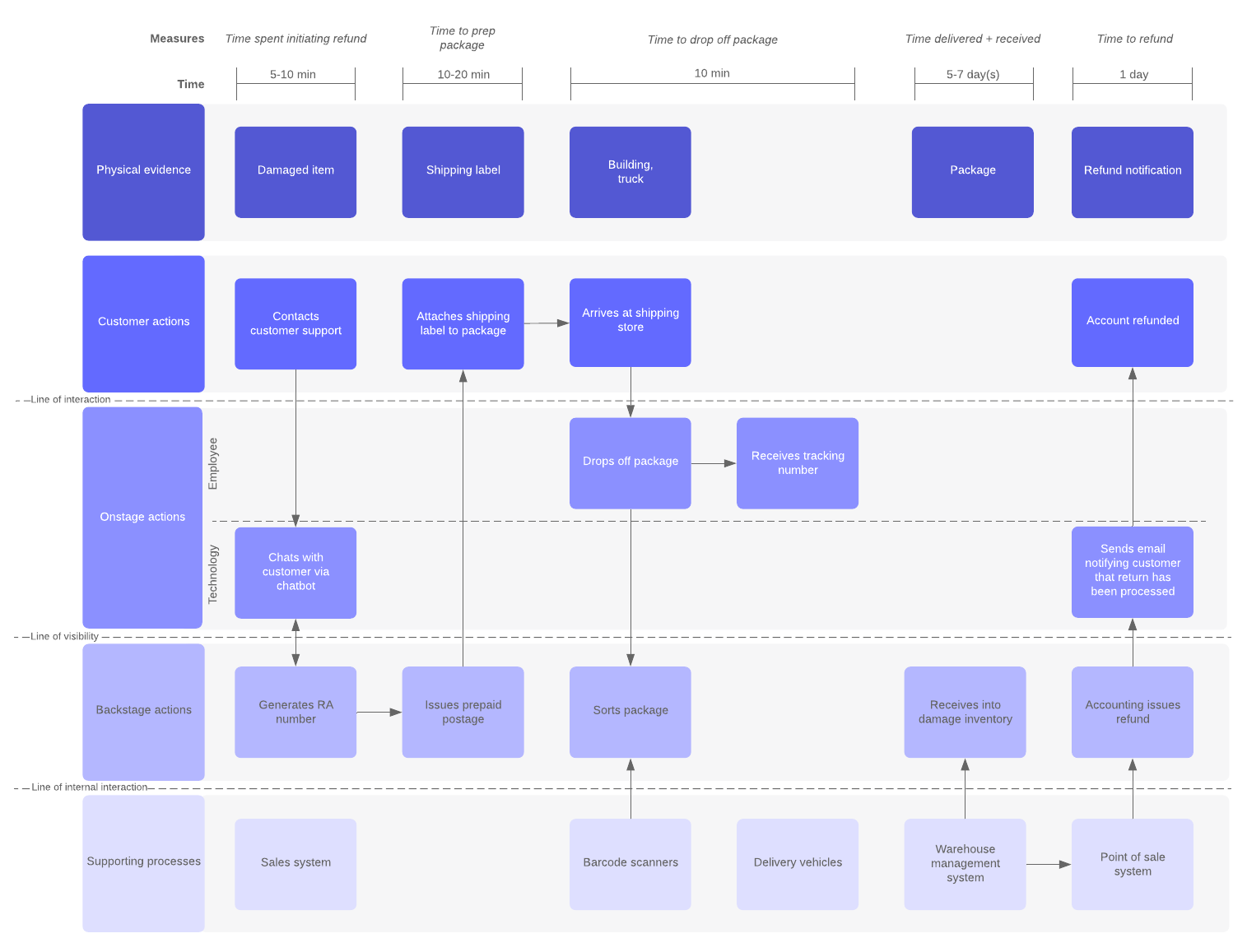
One practical way to surface bottlenecks is to first map the "as-is" journey (your current state), then review it with stakeholders to spot gaps, poor handoffs, and confusing transitions between stages.
Once you’ve visualized these friction points, mapping the future state allows you to define actionable improvements and compare potential solutions using features like layers. This transition from current to ideal state provides a clear roadmap for change, ensuring every stakeholder understands their role in evolving the customer journey and delivering a seamless experience.
5. Continuously update and improve
Once you've mapped out your customer journey, you can begin optimizing the customer experience at every stage. But don't stop there. Keep updating and refining your customer journeys to continuously improve your buyer experience.
The beauty of customer journey mapping is that it helps teams understand the customer experience from multiple angles and encourages collaboration and alignment across the organization. Customer journey mapping shouldn't be done in a vacuum. Every aspect of your business affects the customer experience, so teams need to work together to optimize and streamline it.
To make journey mapping a continuous part of your workflow, revisit the map as you add channels, change messaging, ship product updates, or see shifts in customer behavior—and keep ownership clear so improvements don't stall between teams.
Customer journey map templates and tools
Once you know what you want to include, the next challenge is arranging it in a way that's easy to scan and share. You now have all the right information for a customer journey map, but it can be difficult to know exactly how to start arranging the information in a digestible, visually appealing way. These customer journey mapping examples can help you easily build a customer journey with your team.

Everything you need to make a diagram
Make a polished, professional diagram for free with Lucidchart. No matter what you have in mind, we have the tools you need to build it. Make an account and start diagramming today.
Sign up free