We've all had those flashes of entrepreneurial inspiration—that brief moment when you think, "Hey, that would make a great business." Most of the time, that's as far as it goes. But what if you want to take it a step further?
Before you spend hours drafting a 50-page business plan, you'll want to determine if your business model is viable. This is where the Business Model Canvas comes in. It’s a framework for trimming down business plans into a one-page template that only includes the crucial elements of your business model. And because it’s visual and easy to revise, it’s also useful well beyond the “napkin idea” stage. Teams often refer back to the one-page summary as a living snapshot of how their business is supposed to work.
Keep reading to learn more about the elements of a Business Model Canvas and how to create one.
What is a Business Model Canvas?
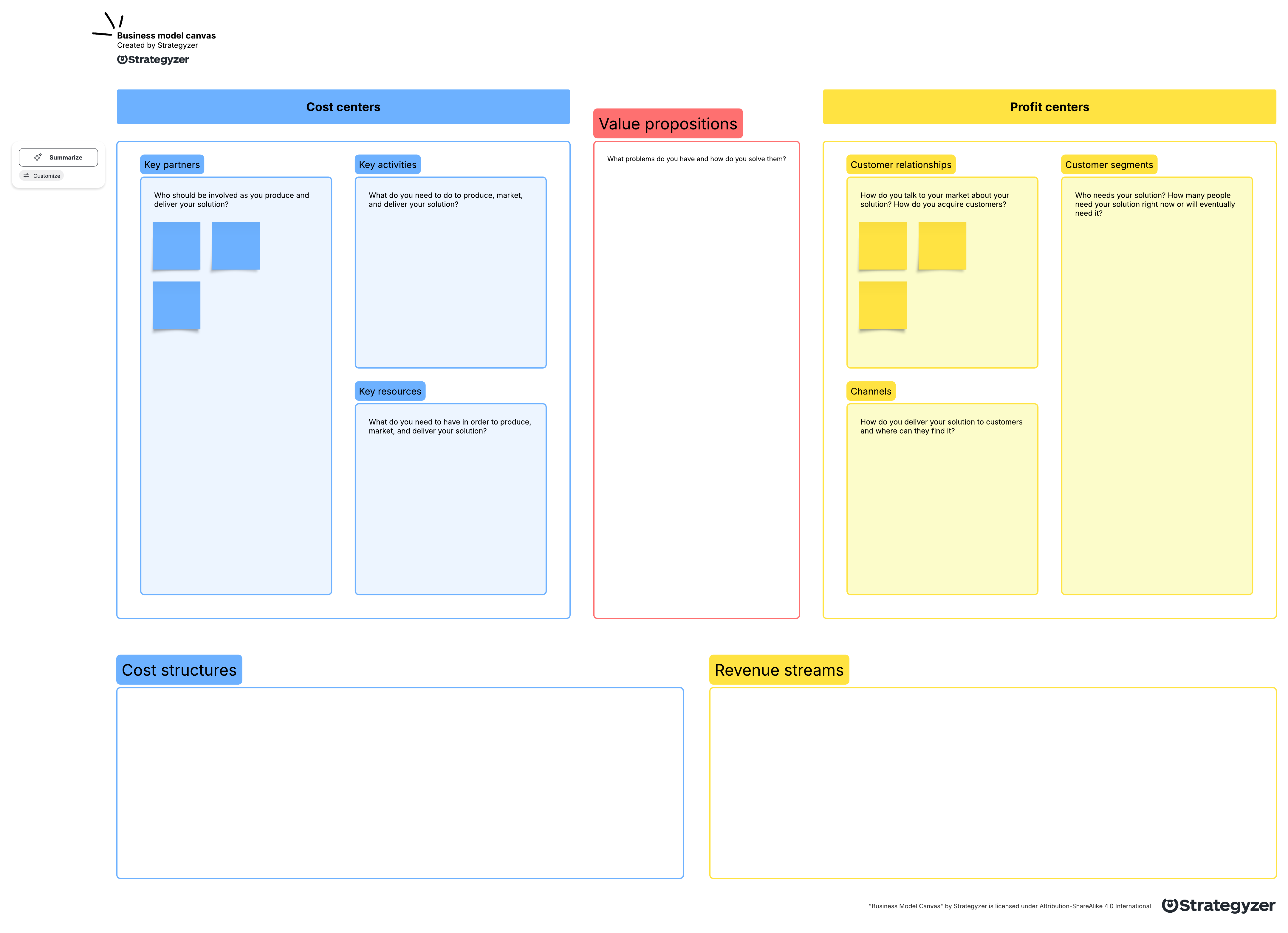
The Business Model Canvas is a one-page visual summary of the high-level strategic details needed to develop, maintain, and market your business. It’s intended to be a living document that you can easily update as you test theories and assumptions. Alexander Osterwalder of the consulting firm Strategyzer developed the framework as a way for businesses to quickly visualize and map out a business model.
At the center of the Business Model Canvas is your value proposition: What do customers get from your product? That's your starting point. From there, you'll fill in the template with additional information about your company and your customers. That information should be treated like a hypothesis: Under the conditions presented, could your business survive? It's a quick and easy way to determine the viability of your model.
Another way teams use the framework is to map out a competitor’s business, then compare strengths, weaknesses, and gaps. This allows you to build a model that addresses the areas where the competition is lacking.
Elements of the Business Model Canvas
As mentioned above, the Business Model Canvas is a template, and every canvas includes the same nine elements:
-
Value proposition
-
Key partners
-
Key activities
-
Key resources
-
Customer segments
-
Customer relationships
-
Channels
-
Cost structure
-
Revenue streams
Each element is represented by a box on the page, and the boxes are always organized in the same way. Everything related to business infrastructure (partners, activities, and resources) falls on the left side of the page. Customer-related elements (segments, relationships, and channels) go on the right. Finance-related elements are on the bottom. In the center of the page, the value proposition ties everything together.
Layout is the easy part—it's already done for you. So let's talk a little bit more about content: What do you actually include in each section of your Business Model Canvas?
Value proposition
What are you offering customers? What problem or pain point are you solving? How are you going to do it? Answer those questions as succinctly as possible (one sentence is best!) and there's your value proposition. Treat your value proposition like a guiding star: It should inform every other aspect of your business plan.
Key partners
It's unlikely that you'll be able to provide your product or service all on your own. Whether it's suppliers or distributors, a parent company, or other partners, someone else is going to be involved.
Think about a neighborhood lemonade stand: The kids running the stand aren't growing their own lemons—they rely on a grocery store. Similarly, they probably get the table and pitchers from a parent. Both would be key partners. To determine if a partner is a key partner, ask this simple question: Could the business model function without them? If the answer is no, they're a key partner.
Key activities
Activities are the actions required to actualize your value proposition. Going back to the lemonade stand scenario: Someone needs to make the lemonade, pour it, and take money from customers. These are all key activities. To determine if an activity is "key," ask the same question as before: Could the business model function without that action being performed?
Key resources
As you list your resources, be sure to consider more than just physical resources. You'll likely also require human resources (employees), intellectual resources (know-how), and financial resources.
Customer segments
Who is your solution for? A lemonade stand employee doesn't have any need for a product developed for software engineers. (At least not your average lemonade stand employee.)
Your customer segments are the people and companies who would receive value from your product. As you list your customer segments, it might be helpful to think in terms of buyer personas.
Customer relationships
Now that you've established who your customers are, you need to decide how you’ll communicate and interact with them. Will customers require support after the sale? For best results, use a customer journey map to document the buyer's experience. This will help you identify points of contact and track how those relationships develop.
Channels
Think about how you’re first reaching potential buyers: Is it through social media? SEO? Conferences? These methods of contact are your channels. Whereas sales teams are typically responsible for building and maintaining customer relationships, channels are, for the most part, the responsibility of the marketing teams.
Cost structure
As you operate your business, you'll have to spend money. To maintain your key activities, resources, and partners, you’ll need to pay employees and cover material costs. These expenses make up your cost structure.
Revenue streams
For your business to be successful, you have to generate revenue. Your revenue streams refer to the ways in which you bring money in or how you’re converting your value proposition into revenue. Perhaps you offer a subscription-based service, or maybe customers pay a one-time fee. Whatever model you use, be sure to list all of your revenue streams.
Business Model Canvas vs. Lean Canvas (when to consider an alternative)
If you’re still validating a customer problem and exploring the right solution, you could consider using the lean Business Model Canvas or Lean Canvas, a variation of the Business Model Canvas developed by entrepreneur Ash Maurya. When Maurya adapted the Lean Canvas, he was looking for a faster way to develop and build successful products that address and solve customer problems. The Lean Canvas is more focused on entrepreneurs starting a new business.
Both canvases fit on one page and include nine elements, but the Lean Canvas swaps several business-model elements for problem/solution and traction-focused ones. The key differences are noted below:
-
Problem (replaces key partners)
-
Solution (replaces key activities)
-
Unique value proposition
-
Unfair advantage (replaces customer relationships)
-
Customer segments
-
Key metrics (replaces key resources)
-
Channels
-
Cost structure
-
Revenue streams
If your goal is strategic planning and communicating how the whole business works, the Business Model Canvas is usually the better fit. If your goal is to pressure-test a startup idea around a specific customer problem, Lean Canvas can be a faster starting point.
How to create a Business Model Canvas
Now you're ready to fill out a Business Model Canvas with your specific business plan. Here are the steps to help you get started.
1. Gather stakeholders and materials
Whether you're creating a digital or physical Business Model Canvas, you'll need to be able to fill in the boxes on the template. This could mean typing your info into a digital template or drawing the Business Model Canvas on a whiteboard or paper.
To create a Business Model Canvas for an existing business, you'll likely need input from marketing, sales, and other teams. For a startup, you may need to do some research.
2. Fill out the canvas
Do you have your blank template and required information? Good. You're ready to start filling out the canvas. Remember: Your goal is not to create an exhaustive business plan. You're trying to clarify the essential aspects of your business model and make any adjustments you feel necessary.
Start with your value proposition and work from there. If you need a refresher on any specific element, review the list above!
3. Test your assumptions
Your Business Model Canvas is a plan, but it's not set in stone. As your team gathers information and offers insights, you may realize certain aspects of your model need to be changed. Perhaps you've listed a supplier as a key partner, only to find a different supplier with more competitive pricing. Or maybe you decided that a subscription model wasn't the best payment plan after all. The Business Model Canvas is meant to help you identify such adjustments—don't hesitate to change things around!
If you’re using the canvas competitively, this is also the point where you can check your assumptions against what you know about alternatives in the market, adjusting your model to better address gaps competitors leave open.
4. Adapt and maintain
The Business Model Canvas is often thought of as a planning tool, but its uses extend beyond the planning stages. As you adapt your business model based on insights from your Business Model Canvas, update the canvas to reflect those changes. If you make drastic adjustments, you might consider creating a whole new Business Model Canvas.
An up-to-date Business Model Canvas is a valuable asset, regardless of where you are in your business plan. Whether it's to show stakeholders your business model to gain buy-in or to onboard new employees, the simple format of the Business Model Canvas makes it a flexible and versatile resource.
And if you discover you need a more problem/solution-driven view for a new product or startup concept, you can complement your Business Model Canvas with a Lean Canvas, using the same one-page discipline but with boxes tailored to validating customer problems, solutions, and traction.
Start a free Lucid account and create your Business Model Canvas faster.
Sign up for free