Are you an effective brainstormer? Does the process of brainstorming feel like an opportunity or more like a chore? Chances are if you don’t enjoy the process of brainstorming, you’ve probably been using the wrong brainstorming technique.
That’s right—there are distinct brainstorming methods.
Just as there are different learning styles and different workflow preferences, each of us has a method of brainstorming that works best for us. Whether or not you’re a veteran brainstormer, this article will help you unpack different brainstorming tools, learn the advantages and shortcomings of each, and select a technique for yourself and your team.
12 popular brainstorming methods
With every method of brainstorming, the most important thing to remember is to follow the rule of quantity over quality. Brainstorming is aided by accepting all ideas, however seemingly unrealistic or irrelevant they might be. The goal is to create a large enough pool from which to pull the best ideas or combine ideas for the best solution or strategy.
Brainwriting
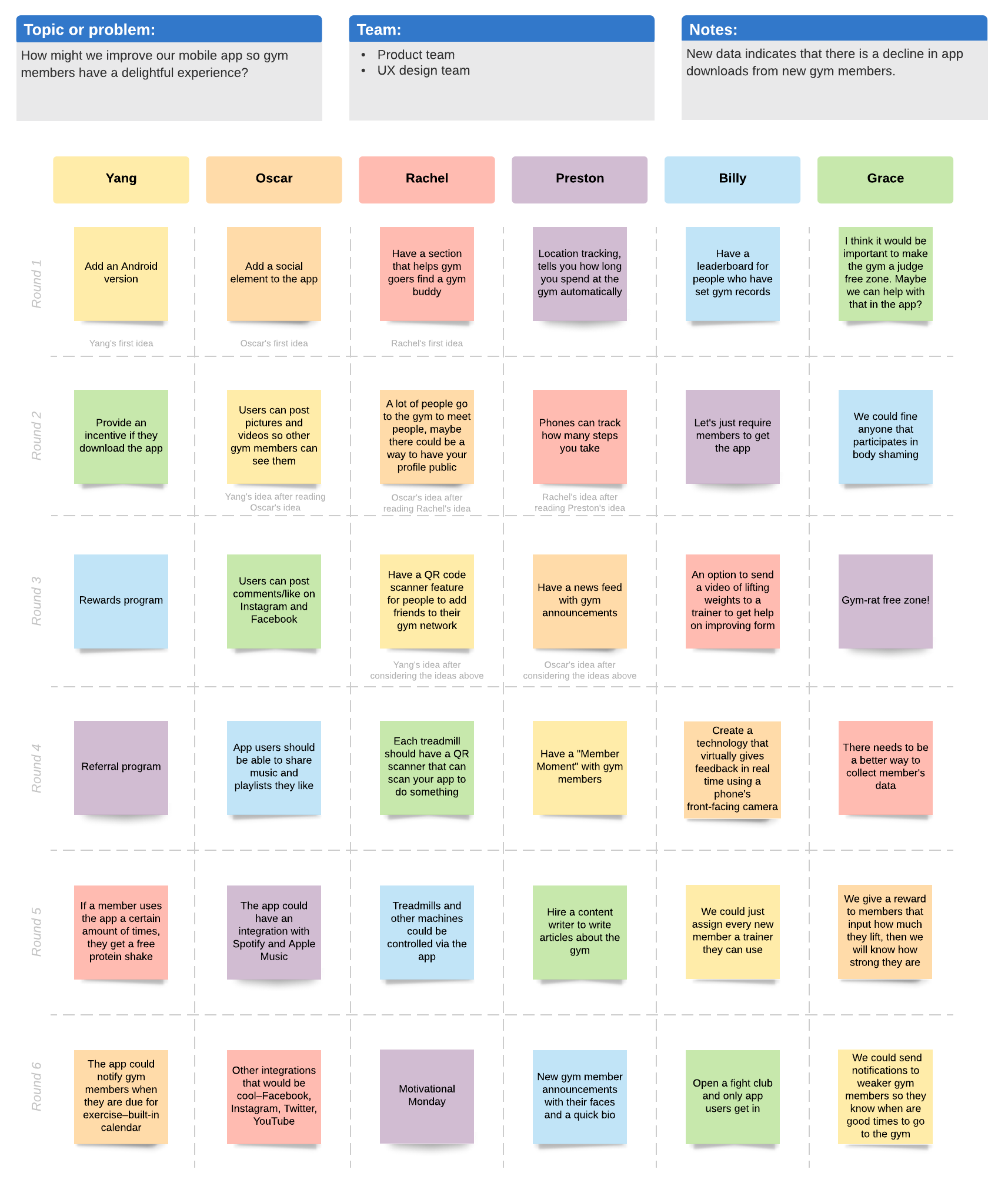
When brainwriting, each group member is told to anonymously write down several ideas on post-it notes or index cards. Keeping ideas anonymous serves two important purposes: First, it prevents idea anchoring and any personality bias that may arise. Second, it provides a way for more introverted teammates to still contribute to ideation.
The result is a broader range of ideas that may not have surfaced if teammates were to brainstorm collectively. Ideas are then shared at random with the rest of the group, who offer feedback and critique each idea. As an alternative, ideas can also be collected and sorted by a team leader or management team. The overlying goal of brainwriting is to separate idea generation from discussion.
5 Whys analysis
If you’ve ever been interrogated by a toddler, you know what the 5 Whys might sound like. You give an answer to a question, only for it to be followed by an increasingly urgent series of “Why? Why? Why? Why? Why?”
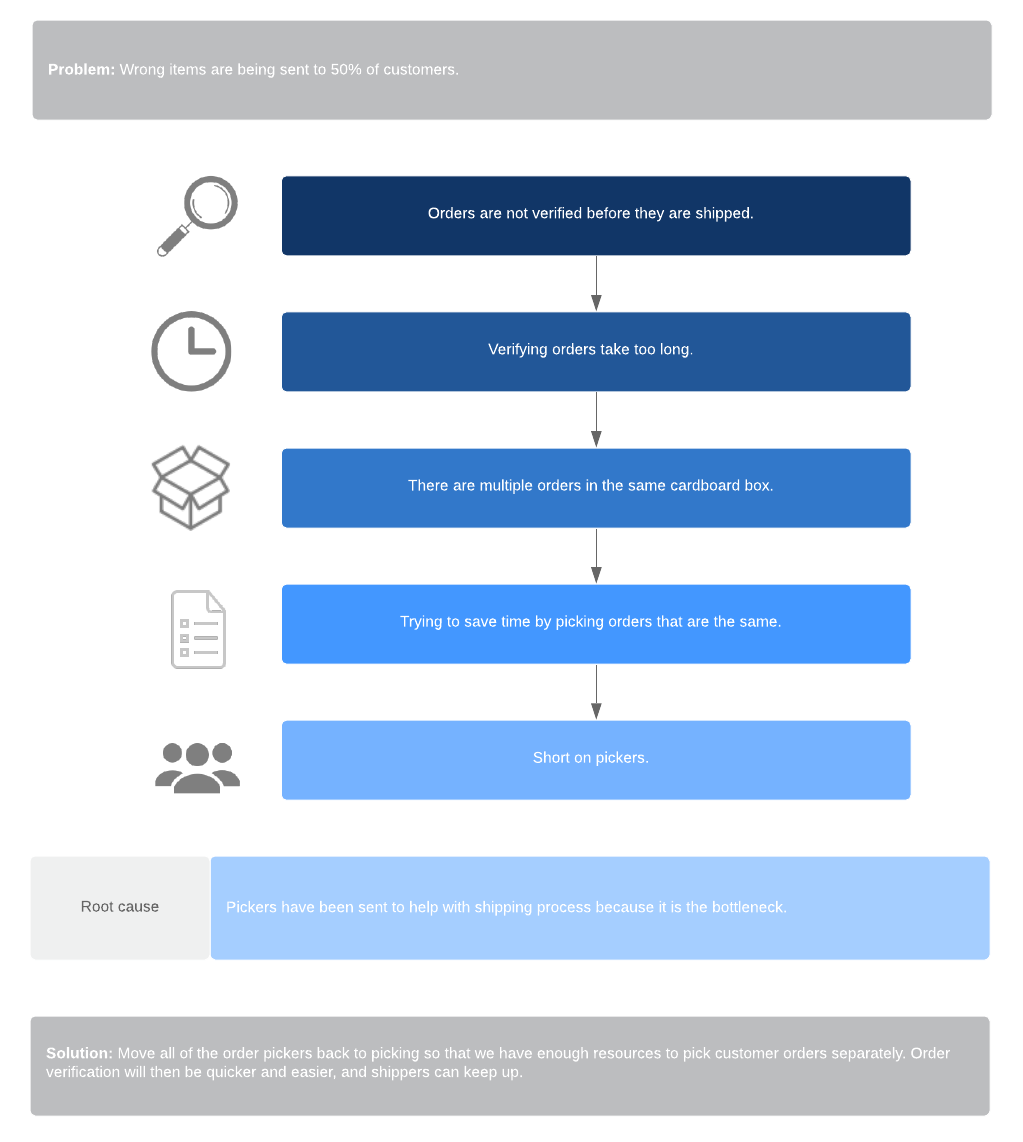
Truth be told, that toddler is onto something. Created by Taiichi Ohno, the 5 Whys analysis was made popular at Toyota as a standard process for root cause analysis—getting to the heart of a problem.
Less structured than other more traditional problem-solving methods, the 5 Whys is simply what it sounds like: asking why over and over to get to the root of an obstacle or setback. This technique encourages an open dialogue that can trigger new ideas about a problem, whether done individually or with a group. Each why piggybacks off the answer to the previous why.
Both flowcharts and fishbone diagrams can help you track your answers to the 5 Whys.
Starbursting
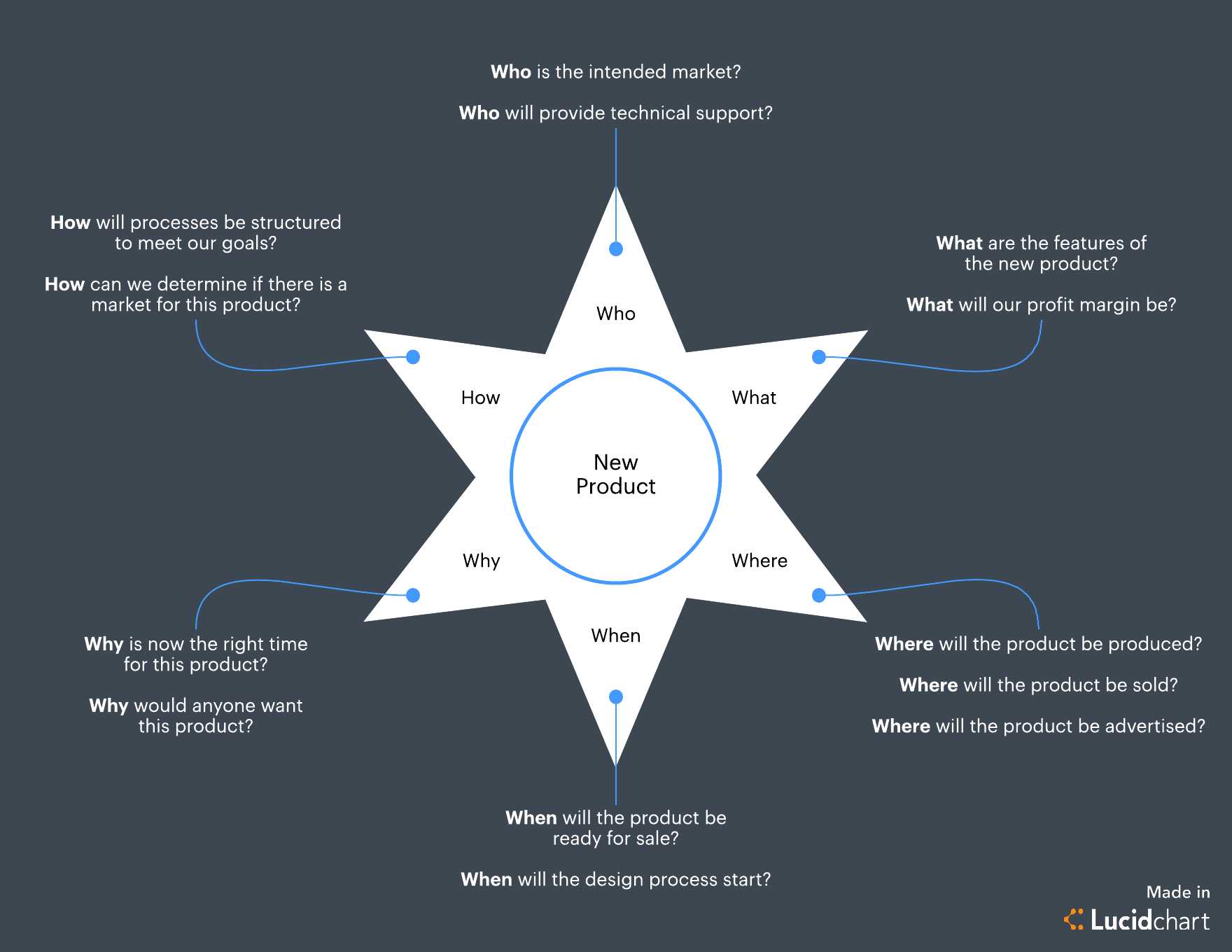
Like a reporter trying to discover the pivotal information to a story, the starbursting method of brainstorming requires you to think about the who, what, where, when, why, and how for any new idea.
Place your main idea at the center of a star diagram, labeling each point of the star with those 5WH questions.
Next, develop a series of questions about your idea for each point. Starbursting is popular among brainstorming methods because of its exploratory nature: One question triggers another question, and before you know it, you have the beginnings of a solid strategy within the answers to those questions.
Mind mapping
Part of the challenge of brainstorming is trying to catch every idea swirling through the air. Mind maps are a creative, non-linear diagram used to capture that influx of ideas so you don’t miss anything. Start with a topic or question in the center of the mind map, and branch off to include every participant’s thoughts. Then use Collaborative AI to generate more in seconds for expanded ideas and an expanded mind.
To create your own mind map online, open the template below or browse through our gallery of additional mind map templates.

Rolestorming/figure storming
Sometimes it’s best to consider someone else’s point of view. Considering how someone else might approach a challenge is the central concept behind rolestorming. A related practice, figure storming asks you to put yourself in the shoes of a famous historical figure.
For example, a legal advocacy group might have teammates ask “How would Mahatma Gandhi solve this problem?” Rolestorming has even made its way into pop culture: Anyone who has ever purchased or even seen the popular rubber WWJD (what would Jesus do?) bracelets has witnessed rolestorming in daily life. Rolestorming or figure storming works best for teams who find themselves coming up with the same ideas for repeating projects.
Gap filling
Gap filling, also known as gap analysis, requires you to identify your current state and your end goal and then find gaps between the two states. It asks the question, “How do we get from here to there?” Gap analysis is especially helpful when it comes to problem solving because it requires you to find workable solutions.
Flowcharts or mind maps can help you grid out your gap analysis. Mark the current state on one end and the ideal state on the other. Then team members will understand what they're working toward and start contributing ideas in the middle to fill the gap.
Brain-netting
Brain-netting has become a popular brainstorming technique in the modern workspace, where virtual collaboration and remote teams are much more common. Email communication can be effective but can take too much time and can be more formal than needed.
With brain-netting, participants use virtual collaboration software to share ideas in real time and can save ideas to a cloud-based storage platform or within the collaboration software itself. The way teams go about virtual collaboration can vary—team leaders may ask a general question like “What do we want our customers to experience?” and have teammates contribute their responses, or teams may engage in other techniques mentioned in this piece including rolestorming, reverse brainstorming, and rapid ideation.
Round robin brainstorming
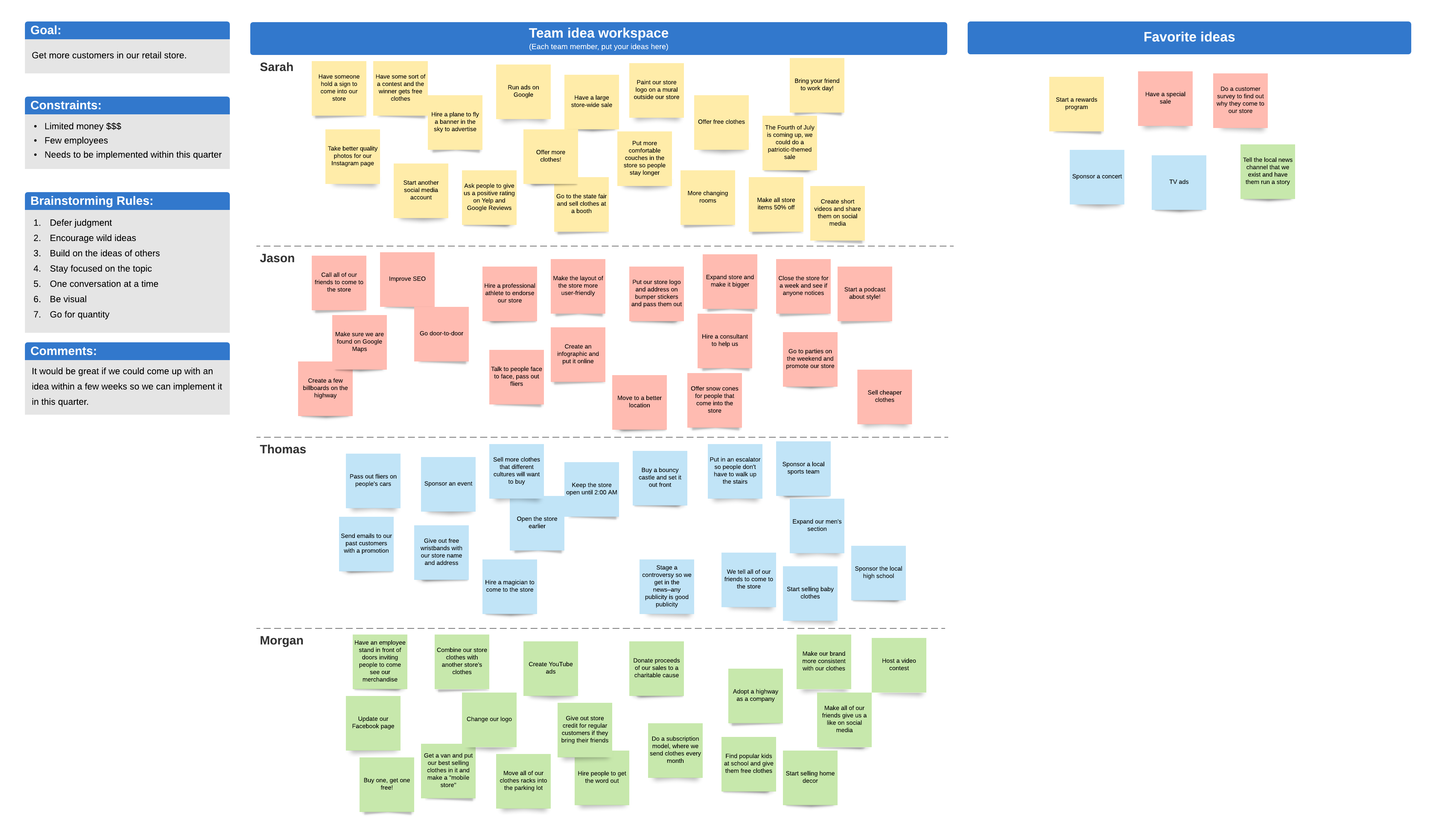
To engage in this brainstorming technique, begin with having everyone sit in a circle. A team leader or facilitator will then pose a question or offer a request for ideas and have everyone in the circle contribute one by one.
This strategy is great for middle- to large-sized teams who may have quieter team members or for any team with noticeable imbalance in creative contribution. The most important rule for this technique is to treat all ideas with equal weight—give each teammate the same time and attention as they share, and avoid developing any ideas until everyone has had a chance to contribute. If and when a team member says that “Person X already said my idea,” offer them time to come up with a new idea while completing the round robin.
Rapid ideation
Operating within a time limitation can often produce higher quality work. Indeed, Parkinson’s Law teaches us that “work expands so as to fill the time available for its completion.” Rapid ideation uses this phenomenon to its advantage: By setting a time limit on team members to contribute as many ideas or solutions as possible, team managers can maximize productivity and results.
Rapid ideation works well for a few different types of workers—for teams who dislike meetings, or who tend to get sidetracked, rapid ideation is a great way to approach the brainstorming stage of project execution.
A helpful tip to remember: Get silly! Research shows that teams who share funny or embarrassing stories about themselves reported 26% more ideas shared across 15% more categories over teams who kept meetings more formal. Having the space to let down certain social barriers reduces overthinking and produces a greater flow of ideas.