
When it comes to organization-wide change, leadership is one of the most determining factors as to whether or not the shift will be successful. Take, for example, organizations attempting to build a business agility capability—this represents a significant change in mindset, strategy, and structure for most organizations. Leadership is cited as the second most significant barrier to increasing business agility, according to the 2021 Business Agility Report.
It’s a glaring paradox: Senior leaders are the ones pushing for increased agility, innovation, and other changes to improve the bottom line—yet they're also the ones standing in the way of actualizing these initiatives. Why?
To find out what’s holding leaders back—and how they can transform from inhibitors of change to catalysts of change—we talked to Pete Behrens, founder of the Agile Leadership Journey. With over 30 years of experience as a leader and coach, Behrens provided insights on how leaders can use one of the most impactful communication techniques—visuals—to effectively lead their organizations through change.
What causes ineffective change leadership?
Put simply: Many leaders don’t realize their behaviors are getting in the way of change. It’s not ill-intended—in fact, it’s not intentional at all.
“It’s merely a gap in awareness,” said Behrens. “There’s a disconnect between how many leaders view themselves versus how others perceive them.”
This is not a phenomenon unique to leadership. In a series of surveys, organizational psychologist Tasha Eurich found that 95% of people think they’re self-aware, but only 10-15% truly are. The difference is that when leaders who hold great influence lack self-awareness, the impact is much further reaching than it is for most people. Far enough reaching, in fact, that leaders are unintentionally holding their organizations back from achieving their goals.
Fortunately, there are ways for leaders to become more self-aware. One of the most impactful ways to do this is through visuals.
The power of visuals in igniting change
If you’re not aware of your own biases, behaviors, and blindspots, you can’t change them. This is where visuals come in: As the saying goes, seeing is believing.
“Visualization is the most powerful force of the human brain. It has the power to bring something from unconscious to conscious,” said Behrens. “And when you go back to the root cause of not improving, it's a lack of consciousness.“
Visuals are a well-known way to help humans understand and make sense of information. Research shows that visuals not only help people communicate information faster and retain it longer, they also trigger a stronger emotional response, a key driver of taking action.
Oftentimes, though, we think of visuals only as a way to communicate information to others (e.g. A PowerPoint Deck or Information Poster), not to ourselves. But if visuals can help others understand information, they can certainly help leaders understand their own biases and behavioral patterns.
Leaders that do use visuals in this way will be better equipped to change their behavior and adopt agile leadership styles that propel organizational change forward, not impede it.
How to use visuals as a leadership tool for change
How exactly can leaders use visuals to increase awareness and drive change in themselves and their organizations? Behrens provided a few examples:
1. Use visuals as a way to highlight certain habits and behaviors
Leaders are inundated with advice on how to become better leaders—the kind of leaders who can successfully lead change initiatives. Visuals can help leaders reveal discrepancies in how they view their leadership style versus how it actually is, so they can act on recommended best practices.
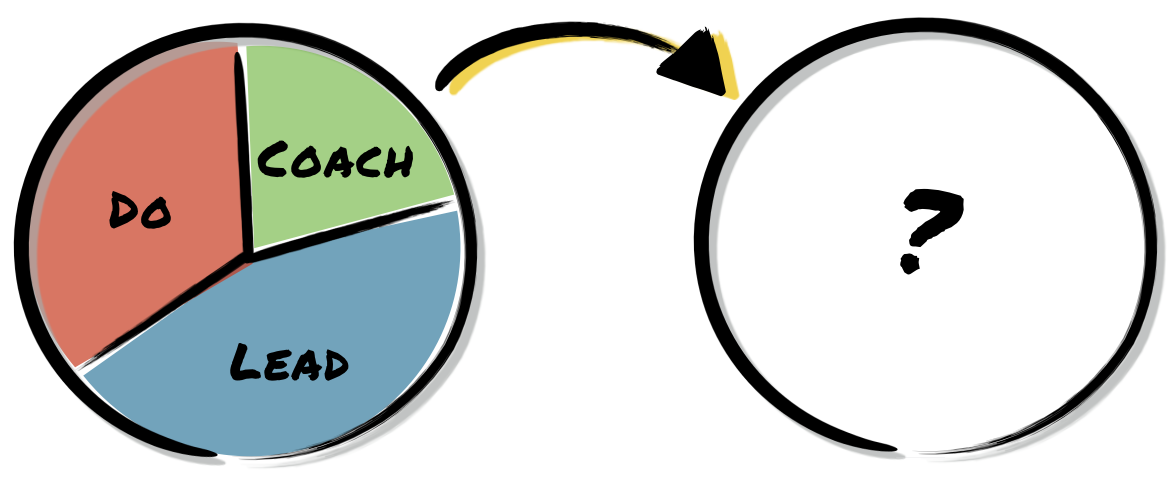
One way Behrens recommends leaders bring these discrepancies into awareness is by visualizing how they spend their time. How a leader spends their focused activities and time signals their values and correlates directly to organizational impact. While there is no right balance for any particular leader, knowing your biases and visualizing a new version of yourself is the first step to becoming a better leader.
Visualize: What do you do? What do you lead? What do you coach?
Leaders may think they’re spending time developing and coaching their team when in actuality most of their time is spent leading meetings. By making this information visible, leaders can change their behavior and adjust how they spend their time. In this case, a leader may realize that they need to pass off some of their meetings if they wish to spend more time coaching.
Visualize how you spend your time in conversations
Visuals are an incredibly useful way for leaders to understand their natural tendencies in conversation and improve their communication skills.
For instance, some leaders have a tendency to dominate conversations and don’t spend enough time asking questions or getting input from team members. Other times, leaders try to be overly accommodating, asking too many questions and making the conversation feel more like an interrogation than a collaboration.
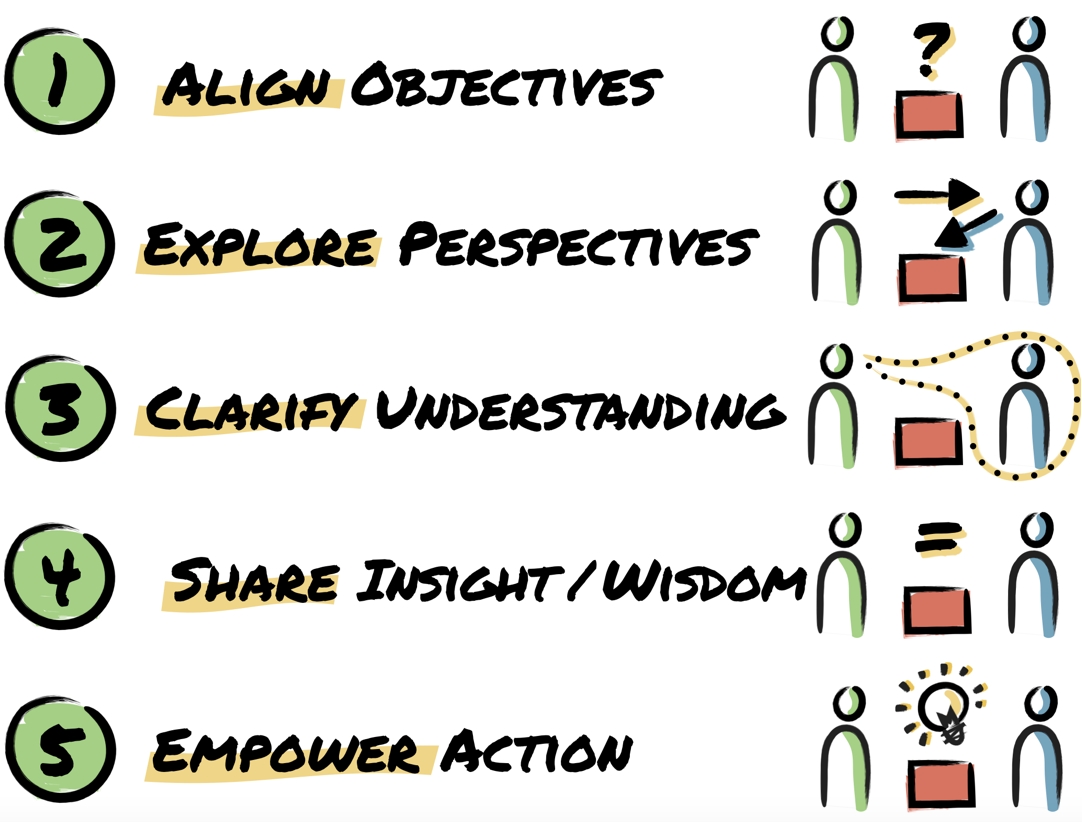
“Conversations are much like dancing,” said Behrens. “Sometimes we lead, sometimes we follow, and sometimes we mirror where it is hard to tell the difference. Effective conversations, just like a great dance, are well-balanced.”

By visualizing the flow of a conversation, leaders can see where their communication style lands and identify opportunities to improve.
The Agile Leadership Journey uses a tool called the Catalyst Conversation to help leaders visually navigate conversations.
“Utilizing the Catalyst Conversation tool requires practice and often represents a different way of communicating than most leaders are accustomed to,” said Behrens. “Keeping a visual representation of the conversation flow front and center helps leaders improve their communication, even in the moment,” explained Behrens.
Check out Behrens’s podcast, (Re)Learning Leadership, to receive more insights on evolving your mindset and accelerating change.
2. Use visuals as a reminder—and inspiration—to sustain change
As much as we don’t want to admit it, humans are notoriously bad at sticking with change (ask anyone who has struggled with keeping New Year’s resolutions). Considering how important internal transformation is for leading an organization effectively, it’s clear how this natural tendency could be problematic for leaders.
Luckily, visuals not only help increase awareness, they’re also a powerful way to create action plans and stay on track after identifying areas of change.
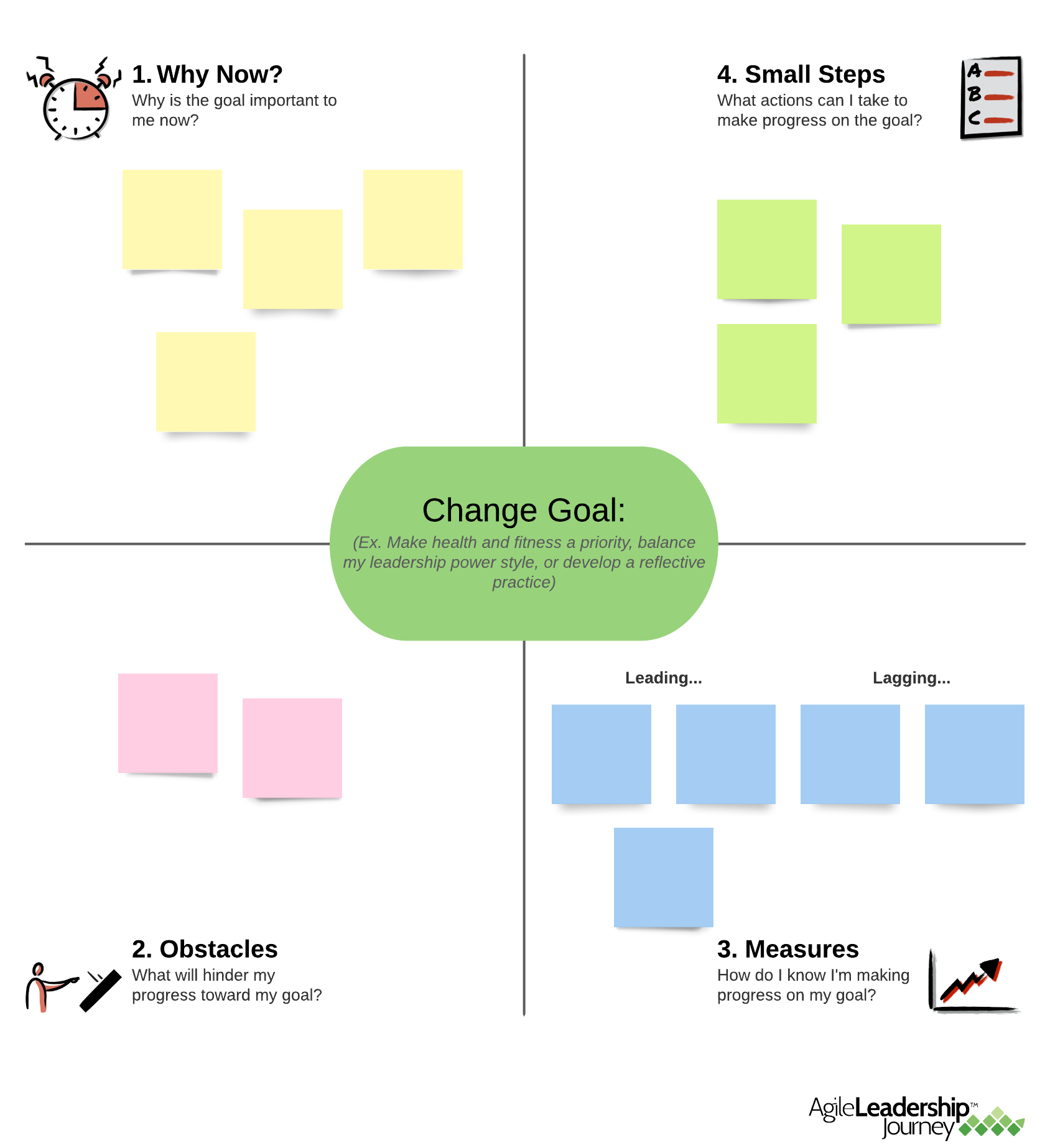
Visualize how you’ll reach your change goals
Once leaders have identified that a change is needed, they can create a visual action plan to determine just how they’re going to execute on that change. To ensure the change goal is actionable, Behrens recommends that leaders record:
- Why the goal is important now
- Potential obstacles that could hinder progress
- Small steps they can take to move the goal forward
- Measurements they’ll use to gauge success
“While most leaders set goals, many fail to successfully implement them,” said Behrens. “By visually breaking down the goal into these sections, leaders will formulate a well-thought-out approach that can guide their efforts to change.”
Use visuals to trigger certain behaviors
Many people already create daily reminders in their life and workspace. These could look like keeping a sticky note on your monitor with the words “Take a deep breath” written across it, posting your to-do list in a place you visit frequently, or color-coding time on your calendar for activities you’d otherwise forget.
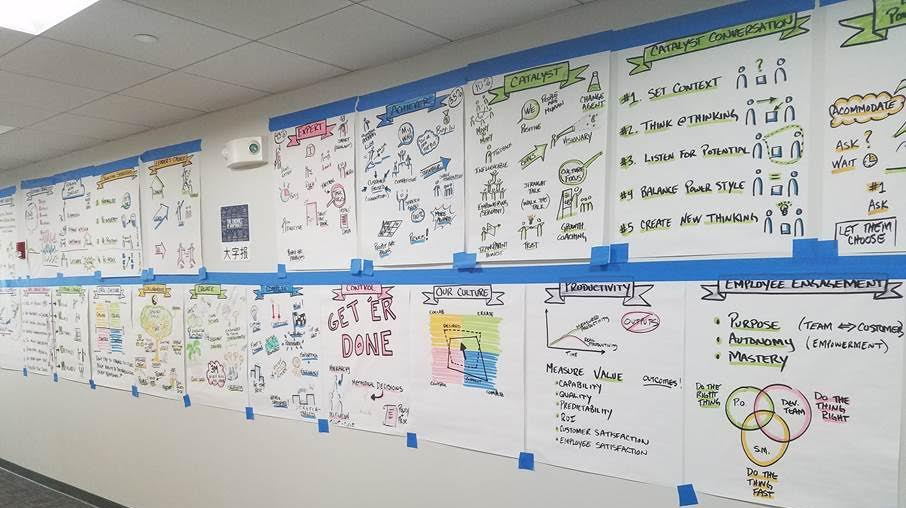
Similarly, simple visual cues can help leaders remember how they wish to spend their time or act in certain situations. For instance, Behrens encourages his clients to keep the visuals they create in workshops in a clearly visible place after the workshop is finished. These visuals serve as daily reminders to inspire leaders to maintain new mindsets or behaviors and continue on their internal transformation journey.
“As soon as we start to visualize the material, it triggers a deeper level of engagement and connection that people feel to the material,” said Behrens. “Now, these visuals act as reminders of an experience that stays with them constantly.”
3. Use visuals to align leadership focus for organization-wide change
In addition to increasing awareness and inspiring behaviors for individuals, visuals also have the power to help align the focus of leaders across an organization. When a leadership team is aligned and working together on common behaviors and goals, they are in a much better position to lead an organization through change.
“When you multiply the number of leaders working together on change, you start to get a real cultural influence,” explained Behrens. “This is where you can pull the bigger levels of organizational change.”
After all, organizations are made up of people, and all people have biases. Much like increasing awareness of personal biases is key to changing individual behaviors, creating awareness of organization-wide biases is key to changing company culture. Visuals can help shed light on these biases—and any discrepancies in perception across the organization.
As a 2021 PwC survey reveals, many organizations experience a “perception chasm,” in which individuals below management view the culture significantly different than those in leadership positions. Visuals can help leadership see just how wide this perception gap is.
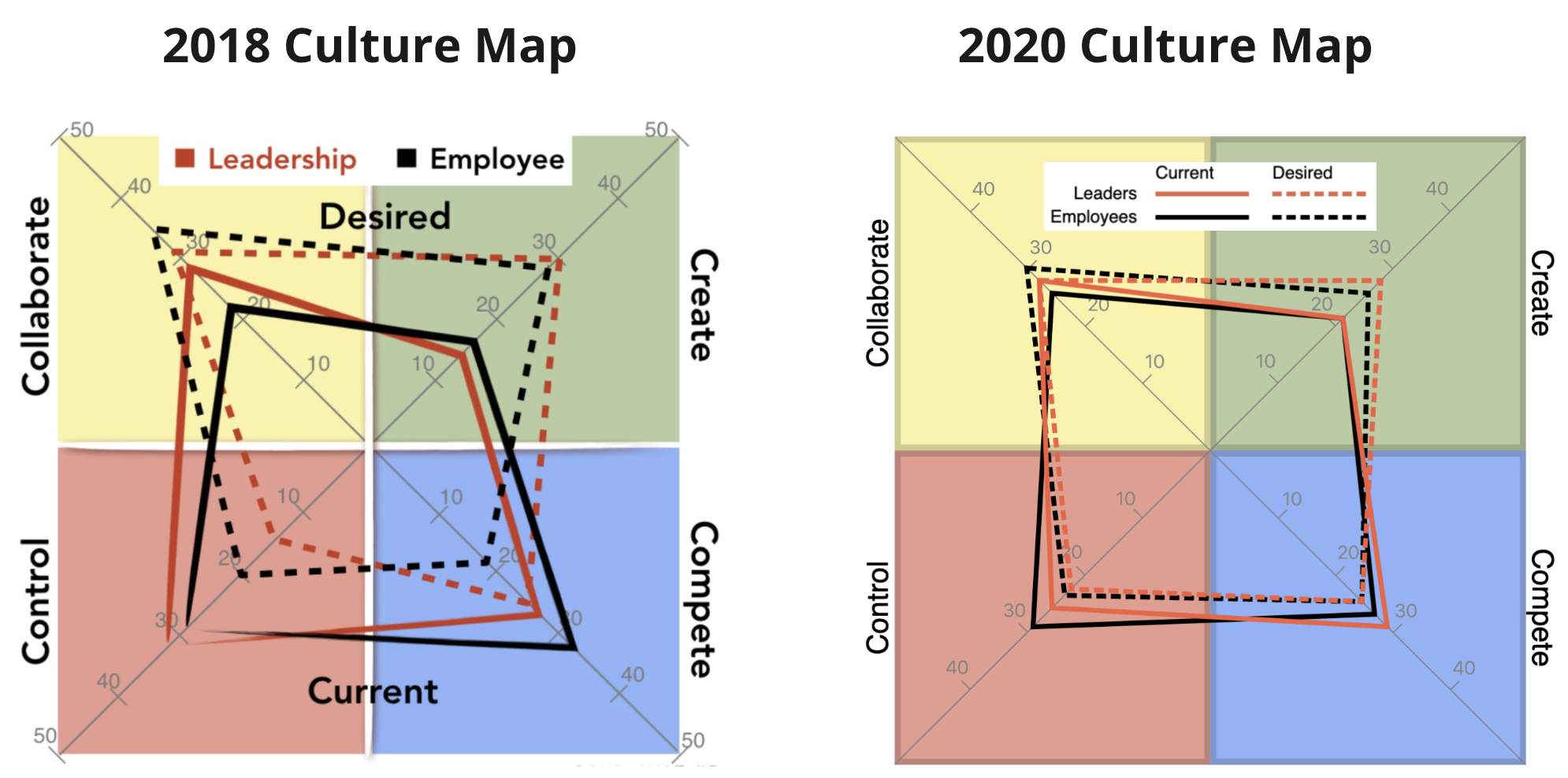
For example, the visual above, created as part of Agile Leadership Journey’s Culture Values 360 Assessment, shows the difference between how one organization’s leadership viewed their culture (and what they desired in the culture) and how their employees viewed the same culture. By making this gap visible, leadership was better able to focus their efforts on closing the gap—and two years later, leadership and employees were much more aligned.
“By regularly visualizing this information, organizations can see how efforts to shape and improve culture have helped close the chasm, as well as areas they could focus on even more,” said Behrens.
From increasing awareness to sparking motivation and aligning organizations, visuals are a powerful leadership tool for change initiatives.

For more guidance on leading your organization through change, check out the e-book on agile leadership.
Get a copy