Key takeaways
- Enterprise agility is the ability to adapt at scale as organizations respond to market shifts with speed and intention while maintaining coordination.
- Achieving org-wide agility enables shorter feedback loops, faster time-to-market, enhanced cross-functional coordination, and improved ability to pivot.
- Successful agility transformation requires leadership to set a clear vision, practice flexible change management, increase visibility, and manage large-scale coordination.
- Using a visual collaboration solution provides a central place for large enterprises to track progress and enhance alignment while teams work together to increase responsiveness.
For large organizations that have been traditionally siloed, responding to change was like trying to turn a cargo ship: slow, painful, and filled with resistance. Recently, however, enterprise-level adaptability has become necessary for survival. Aligned responsiveness is more critical than ever as organizations face unprecedented pressure, tech disruption, and shifting customer expectations.
Enterprise agility transforms your organization from a slow-moving cargo ship into a fleet of speedboats that move in coordination. When you scale adaptability, your business meets customers’ needs sooner while your cross-functional teams are aligned and ready for anything.
Here’s what you need to know about enterprise agility, as well as a breakdown of the strategies you can take to implement a culture of adaptability and preparedness.
What is enterprise agility?
Enterprise agility is the ability to adapt at scale, responding to change at the organizational level with speed and intention while maintaining coordination and momentum.
With enterprise agility, organizations can successfully pivot in response to market shifts thanks to an established culture of responsiveness, preparedness, and flexibility. Multiple factors can trigger the need to pivot, such as a poor product-market fit, diminishing returns from a product direction, or shifts in technology.
“Enterprise agility is an approach to work that allows for quick, frequent adaptations in a business. It provides a safe place for creativity and risks to live, fail, and rise beyond what was previously thought possible. Enterprise agility keeps businesses from going down the wrong path for too long and ensures that their strategy is always reflecting the signals that may be coming to them either internally or externally.”
—Alyssa Craig, Senior Manager of Program Management, Lucid
Unlike traditional Agile, opens in a new tab approaches that improve adaptability within individual teams, enterprise agility aligns leadership and strategy to achieve organization-wide goals. To guide organizations on scaling resilience and adaptability, the PMI Agile Alliance created a Manifesto for Enterprise Agility, opens in a new tab. In the Manifesto, leaders can find the values and principles that help them create conditions for agility and better prepare their organization for change.
Benefits of enterprise agility
Becoming a more agile enterprise offers a wide range of benefits for businesses, including:
- Faster time to market due to enhanced responsiveness and quicker time to completion
- Enhanced cross-functional coordination with better connection from strategy to execution across teams
- Increased customer satisfaction since teams are more in tune with customer needs and work with shorter feedback loops
- Continuous improvement, as enterprise agility uncovers regular opportunities to proactively identify and solve process inefficiencies
- Greater ability to pivot to market shifts or signals due to a change-ready culture, opens in a new tab
7 strategies for enterprise agility transformation
Remember, enterprise agility is about strategic responsiveness. If leadership can’t pivot its strategy quickly in response to incoming data, team-level agility has little impact.
The following strategies can help you implement enterprise agility and ensure your strategy is effective at the organizational level.
Strategy #1: Set the vision and objectives
Before leaders ask people to change how they work, they should clarify why the change is necessary. Since trying to implement agility for the simple sake of agility often falls apart, success should be tied directly to strategic business outcomes. Leaders should identify what they’re trying to improve and focus on being built for change while connecting enterprise agility transformation to the company's future.
Objectives should be made absolutely clear and available to everyone, so employees can establish a clear roadmap, opens in a new tab that connects their roles to the overall business strategy. An effective roadmap outlines goals, deadlines, and other expectations for each team, helping people align their day-to-day actions with the broader vision. Ensure the roadmap is easily accessible to both employees and stakeholders.
Strong leader sponsorship upfront is necessary for scaling agility across your organization. Leaders need to let go of control and adopt a more sense-and-respond approach, crafting a North Star that aligns the organization while leaving room for teams to exercise some decision-making power. Select a few core strategic objectives, and work with teams on how you’ll accomplish them.
Strategy #2: Practice effective change management
Successful change management during enterprise agility transformation is a unique challenge. You aren’t just changing a system or a process; you’re changing your organization’s culture and mindset, as well as the tools you're used to using to manage the organization or set direction. Traditional change management frameworks, opens in a new tab often fail to support enterprise agility because they view change as linear and fixed in duration, when enterprise agility is an ever-evolving endeavor.
For enterprise agility, leaders must adopt an agile approach to change management, opens in a new tab itself, constantly learning, iterating, and pivoting based on feedback. Some practices that leaders should implement include:
- Creating new dashboards to measure progress and using them to validate results as they practice new methods of success
- Modeling agile behaviors such as embracing feedback loops and making it safe to fail
- Establishing a culture of experimentation to gain insight into what’s working before scaling that success to other teams
- Training employees on new practices or behaviors
- Focusing on continuous improvement while empowering employees to share their ideas and improve their work
Strategy #3: Create a shared source of truth
When you’re implementing enterprise agility, it’s beneficial to have a central place to host resources, conduct planning, and get updates on progress. With a single source of truth, opens in a new tab, you can increase visibility and alignment with your team. By using a visual collaboration solution, leaders can create a digital hub that has all the documentation and information their teams need as they connect strategy to execution.
Collaborative software like Lucid helps agile teams enhance alignment, visibility, and connection. With Lucid, organizations can conduct both team-level and program-level planning, track progress, and visualize work. Teams have the tools they need to make informed decisions and can pivot more quickly when changes are on the horizon.
“Lucid acts as a digital nervous system for the entire organization by making work visible. When strategy is moved out of static documents and into a shared visual space, it creates a single source of truth that ensures everyone stays aligned. This transparency allows teams to collaborate and pivot in real time, turning the idea of adaptation into a daily practice.”
—Janie Leddy-Jones, Director of Program Management, Lucid
Strategy #4: Conduct large-scale strategic planning
Since enterprise agility involves scaling adaptability, it’s essential to connect work across teams and ensure visibility and alignment throughout the whole organization. If you’re practicing agility successfully, you’ll be able to pivot as an enterprise without chaos, ensuring your business doesn’t just react but is built to thrive sustainably on change.
Leaders can use value stream management, opens in a new tab to visualize and optimize the flow of value, and to understand which high-value areas to allocate resources to. Analyzing the steps required to provide value to customers enhances cross-functional alignment toward business goals.
Conducting large-scale planning, such as PI planning, opens in a new tab, is also a great way to coordinate teams and account for change. Involving teams across the business consistently makes it easier to align strategic planning with budget cycles, so you can fund outcomes, opens in a new tab rather than fixed projects.

If you conduct program-level planning in a visual collaboration solution like Lucid, you can also use enhanced planning features to estimate work and plan potential pivots. Capacity planning is a useful practice for estimating the amount of work teams can take on. Scenario planning lets you test potential scenarios and see how specific changes may impact your business.
Taking change into account during your planning sessions helps you build a business strategy that’s ready to pivot—not locked in until the next quarter.
Strategy #5: Manage risks and dependencies
Enterprise agility involves complex execution that needs to be continually updated and monitored. Dependency mapping is a highly useful practice that visualizes the relationships between tasks, making it easier to manage cross-functional work and to adapt quickly to changes.
By mapping dependencies, teams can manage, mitigate, or eliminate potential blockers. You can see whether one team’s work is dependent on another, and enhance visibility and pattern recognition. Factoring dependencies upfront into your planning further connects strategy to execution and empowers teams to make decisions based on real-time data.
Dependency mapping in Lucid
Lucid makes it easy to map dependencies across your organization and offers bi-directional syncing with existing systems of record. Thanks to integrations with Jira, Azure DevOps, and airfocus, any change you make in Lucid will be automatically updated across platforms, so your boards reflect the most up-to-date information.
Strategy #6: Use OKRs and metrics to determine success or progress
As you implement enterprise agility, it’s important to communicate the vision and have everyone aligned on objectives. But how do you know when those objectives are being met?
OKRs, opens in a new tab connect larger objectives to team tasks, provide clarity into progress, and improve employee engagement. By housing your OKRs in the same place where your team tracks tasks, you can enhance visibility into progress. Use an OKR template, opens in a new tab to track performance and make informed decisions, and share your OKRs with your team.
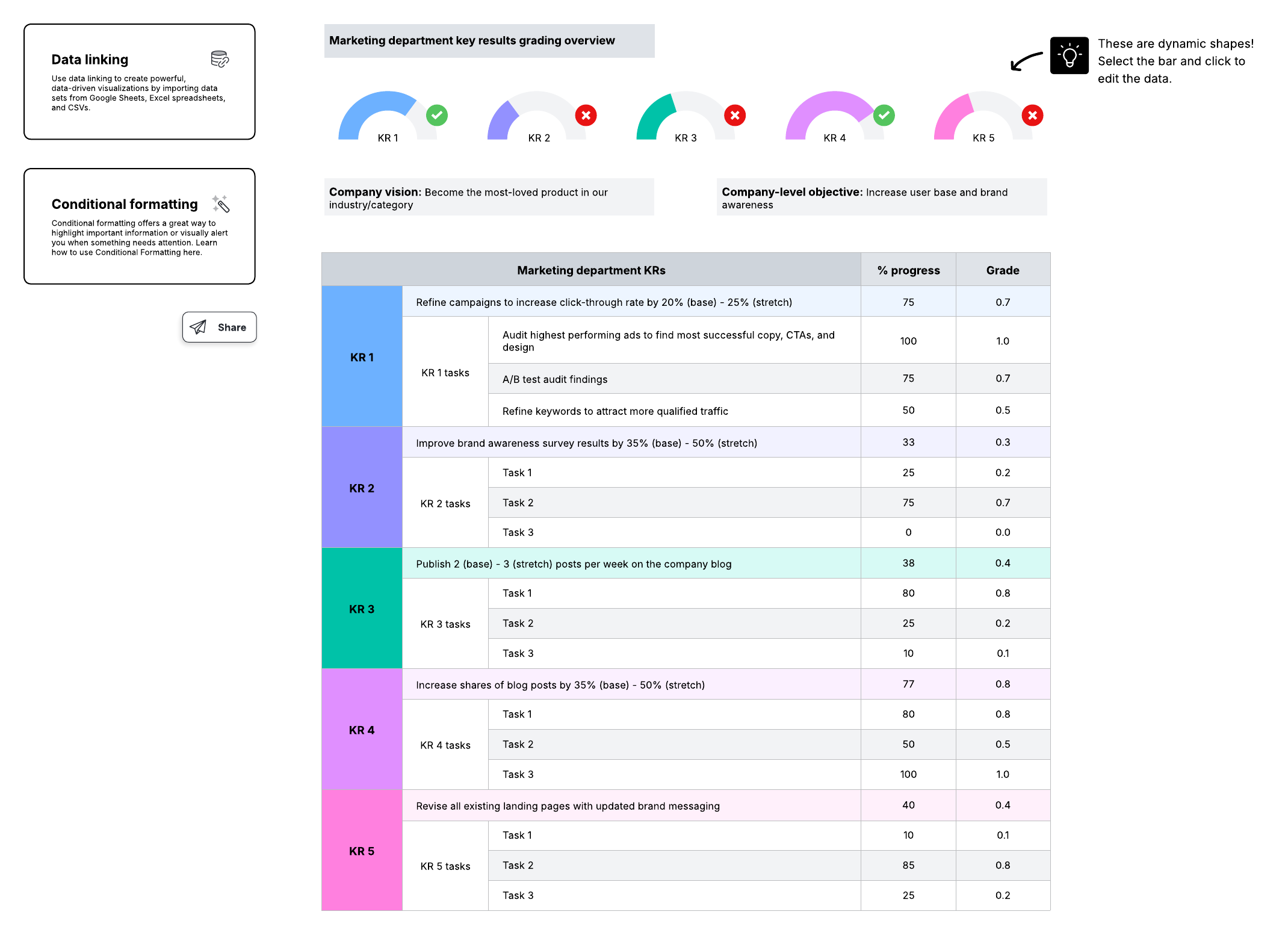
When the relationship between strategy and business results is more explicit, it’s easier to identify gaps and determine priorities. For enterprise agility OKRs, track metrics such as:
- Customer satisfaction
- Time to value
- Employee engagement
- Pivoting frequency and speed
Strategy #7: Continue to adapt and improve
Enterprise agility isn’t a one-time goal or achievement; it’s an ongoing process that will evolve as you learn through continuous change. Implementing agility throughout your organization is a daily practice and mindset that should be exemplified by leaders, especially during challenging times.
Psychological safety, opens in a new tab is important; there will be moments when your organization tries to pivot and fails. Even in failure, employees should be encouraged to try again. Focus on the learnings, remain open to feedback from both internal and external sources, and iterate on your approach to scaling agility. Retrospectives, opens in a new tab are a great way to reflect on what’s gone well and what could be improved.
What worked last quarter may not work again—but determining what to do next instead of simply repeating the same process is the whole point of enterprise agility.
Enhance enterprise agility and effectively plan for change
Building an agile enterprise is about more than just scaling Agile principles; it’s about cultivating a mindset of responsiveness and preparedness across every level of your organization. By having leadership drive the vision for change and leveraging visual collaboration to improve alignment, you can ensure your business behaves as a nimble fleet, not a slow-moving cargo ship. Ultimately, enterprise agility ensures your organization is actively built to thrive sustainably on change.
Fostering an adaptable culture is just the beginning. Your strategic planning processes must be just as dynamic to support org-wide agility. Check out how Lucid helps companies successfully navigate unexpected shifts, so you can increase responsiveness and be ready for whatever comes next.

Respond to change with flexible planning in Lucid
Discover Lucid’s unique planning features and intelligent capabilities made to help companies withstand change.
Read more