Key takeaways
Scaling AI enterprise-wide requires documenting workflows, facilitating change management, and planning governance rather than just investing in technology.
Focus on high-impact opportunities by evaluating business metrics, data feasibility, and operational risk profiles across departments.
Map, audit, and redesign processes intentionally before introducing automation to avoid automating broken workflows.
Establish clear ownership, risk categories, and operational boundaries to build a strong AI governance plan.
Execute a cross-functional rollout paired with structured change management, then track continuous outcome metrics such as cycle time and reclaimed hours.
Scaling AI isn’t simply a matter of more or better AI tools. If it were, far more companies would have scaled—but according to McKinsey research, opens in a new tab, only 7% of organizations have done so.
What separates the few who have scaled from the many who are stuck in the pilot phase? To find out, we asked Jeff Rosenbaugh, Sr. Director of Professional Services at Lucid, who helps organizations prepare for AI transformation.
According to Rosenbaugh, success in AI comes not only from technology but also from the critical layer that makes AI usable at scale: visibility into how work actually happens, well-documented processes, strategic alignment, governance, and change management.
While many organizations try to jump straight from individual AI usage to institutional value, there are necessary steps in between that simply can’t be skipped. In this playbook, Rosenbaugh breaks down each of those often overlooked steps when scaling AI, so you can join the few who are seeing enterprise-wide returns.
Roadblocks on the journey to scaling AI
Deloitte research, opens in a new tab reveals a glaring investment gap: 93% of AI investment is allocated strictly to technology, leaving just a small fraction of the budget for process redesign, workforce adoption, or anything else, for that matter.
If you’re debating where the next AI dollar should go, these are the spots to address first:
No visibility into current processes. Pilots succeed because a single employee can manage the process in their head. Scaling across functions expands beyond that individual, often exposing a complete lack of documented workflows. For an agentic use case, a process must be well understood, ideally through documentation that both humans and machines can read and collaborate on. Simply put, you can't scale what you can't see.
Lack of change management. In BCG’s case work, opens in a new tab across hundreds of companies, they found that only 10% of the value from AI comes from the AI algorithms themselves and only 20% comes from the tech required to implement the algorithms. The other 70% comes from rethinking the people component—for example, upleveling skills, communicating a vision, and aligning incentives.
Unusable data foundations. In many ways, AI transformations suffer from the same root cause that limits agile and digital transformations: a neglected data foundation. If an organization lacks a clear data strategy or a unified understanding of how to connect these systems for cross-company visibility, it operates at a massive disadvantage and can no longer be ignored. “An LLM is only as good as the context you can provide it,” said Rosenbaugh.
Fear surrounding operational risk. AI agents, unlike generative AI, execute actions autonomously, introducing major risks such as security issues, compliance gaps, or irreversible actions. Without proactive guardrails to manage that exposure, fear of what could go wrong will keep even the most promising pilots grounded.
"The AI models are actually good enough to do what we want today. The real gap isn't technical; it's organizational and leadership readiness."
—Jeff Rosenbaugh, Senior Director of Professional Services, Lucid
How to scale AI across the enterprise
Institutional AI ultimately means that AI agents are connected to your organization’s system of record—including process documentation, architecture, and enterprise data—often enabled by a Model Context Protocol (MCP). This connection is what transforms isolated individual tools into coordinated, AI-first workflows.
Making the leap from individual to institutional AI requires shifting your focus from raw model capabilities to operational readiness.
Follow these steps to bridge the gap and scale AI across your enterprise.
Step 1: Prioritize the most impactful opportunities for AI
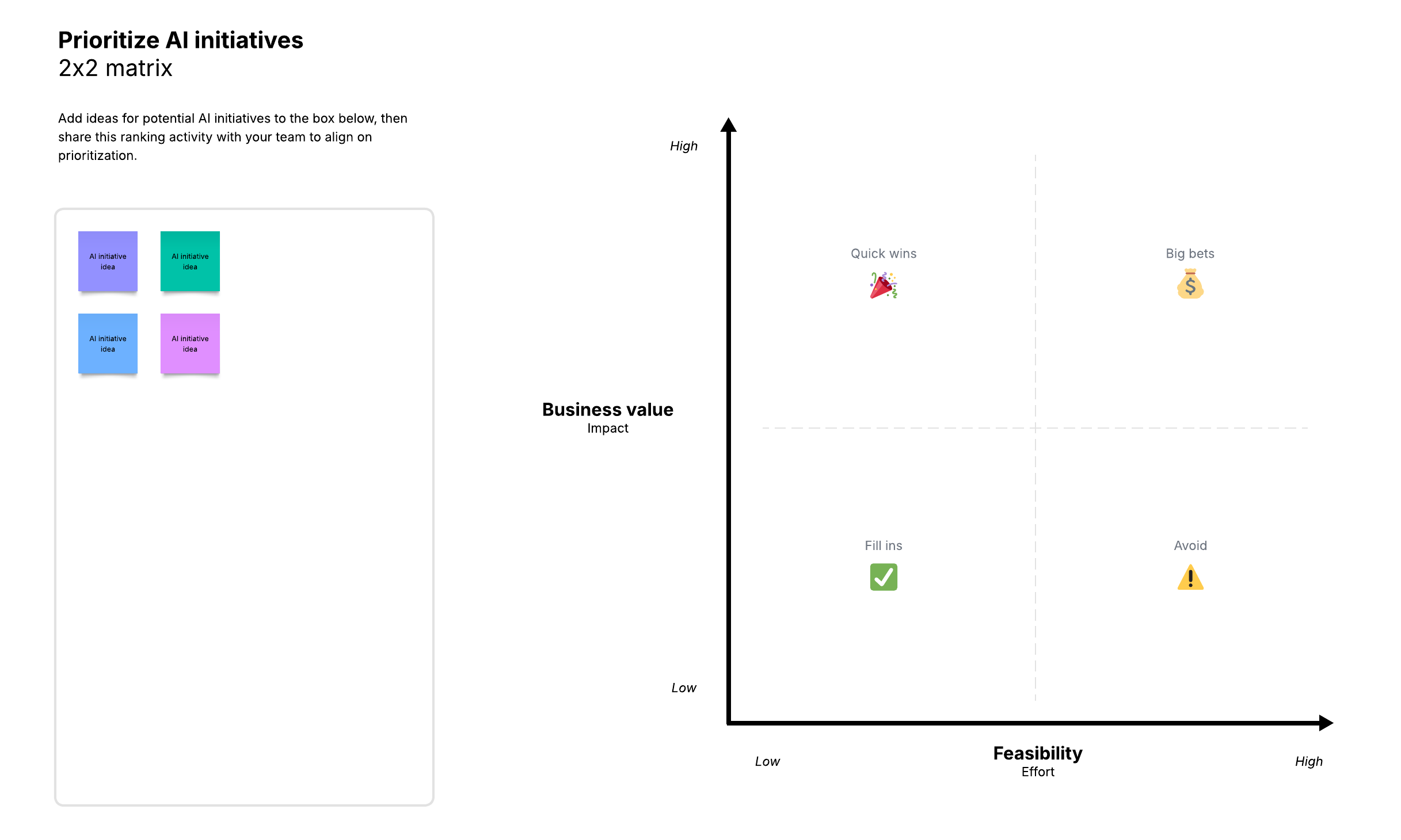
Avoid spreading resources thin across dozens of uncoordinated departmental initiatives. Instead, use the learnings from your early pilots to select a single, high-value workflow to scale first.
You can evaluate potential initiatives by:
Business impact: Would the AI opportunity move a core metric such as revenue, cycle time, or cost efficiency?
Feasibility: Do you have the proper data (structured in a usable way), integrations, or skills to implement the AI initiative?
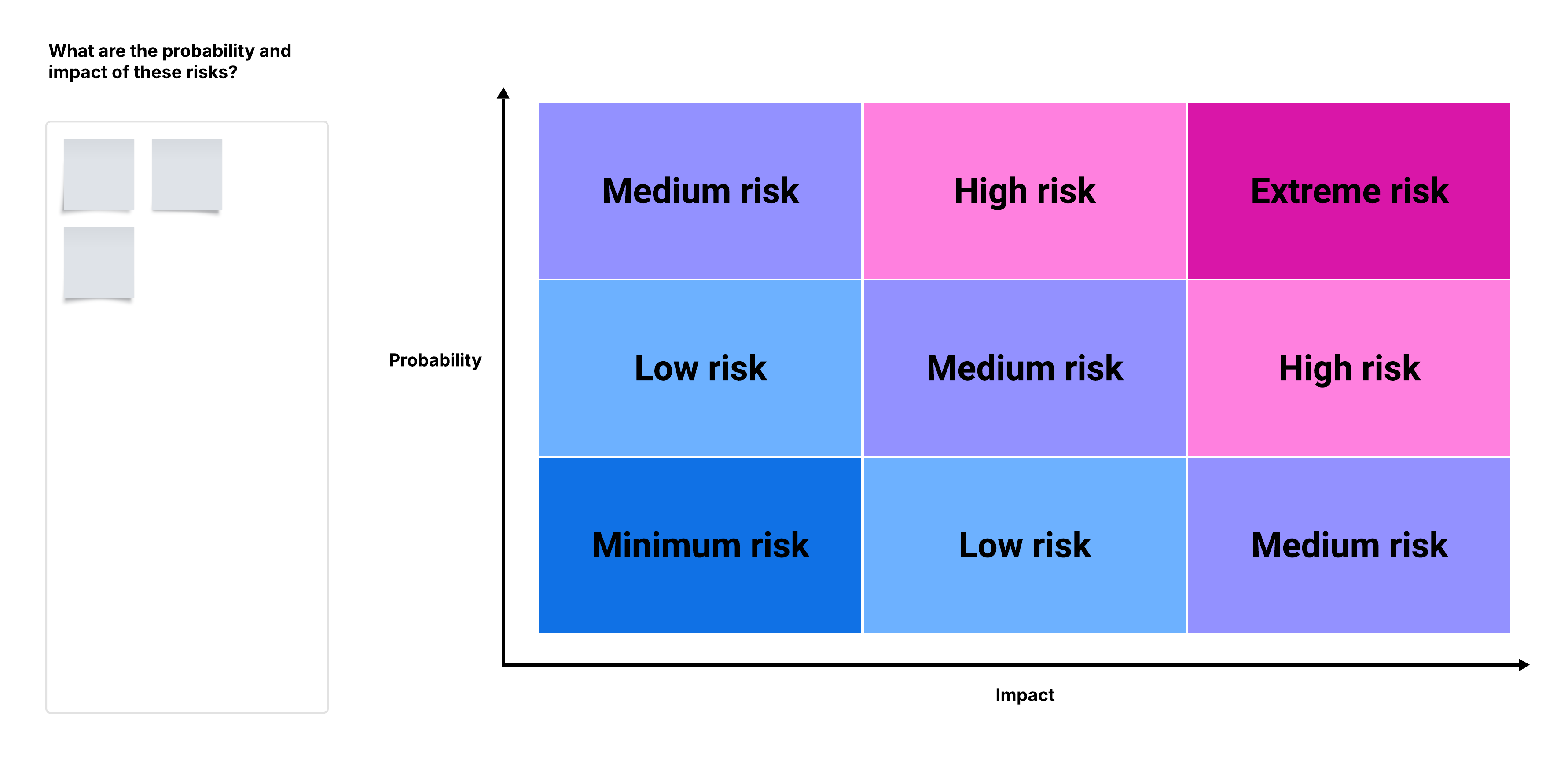
Risk profile: What are the potential risks—whether that’s security, financial, or productivity related—if the AI executes incorrectly?
To prevent blind spots, loop in cross-functional stakeholders, including business unit leaders, IT, compliance, and frontline staff. Identifying who actually touches the process early ensures your prioritization reflects real-world operations rather than executive assumptions.
Step 2: Map, audit, and redesign the necessary workflows
Once you’ve selected the high-value workflow to target, resist the urge to start building or buying tools immediately. Instead, take the time to understand, evaluate, and if needed, redesign the workflow so you don’t automate a broken process.
“Just like city planners found that designing roads intentionally using grids created far more efficient routes than simply building streets over animal tracks, organizations are realizing the same with AI,” said Rosenbaugh. “The best results come when you design processes around AI from the start, rather than just layering it on top of what's already there.”
In other words, don’t pave the cow path. Redesign the road.
This step is all about creating the documentation for AI transformation, opens in a new tab, and it’s one that many companies miss. But documentation is non-negotiable when implementing AI. It’s how you truly understand your own operations, maintain alignment, plan effective roll-outs, and create the infrastructure for AI agents to follow.
Plus, process documentation gives you the information you need to invest in the right orchestration tools, opens in a new tab. According to Gartner®, “By understanding how your business operates, what is required to deliver the process outcome, and where an organization’s deliverables and processes reside, application leaders can understand the scale of process orchestration required to deliver the desired business outcomes” (Gartner, Understand Your Processes Before Investing In Agentic Automation, February 10, 2026).
At this step, you’ll want to:
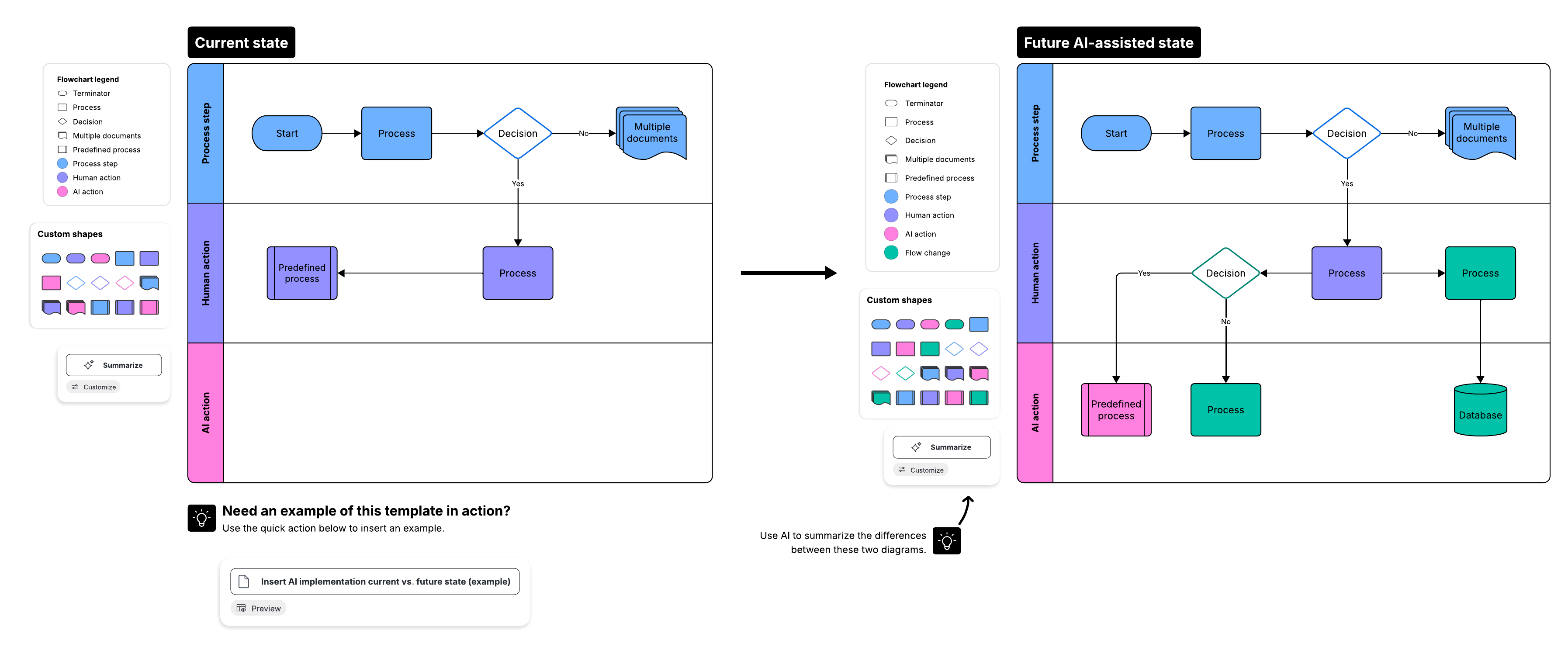
Map the current processes. Get visibility into how work is actually done (not just the processes outlined in the handbook). Capture the unwritten rules, handoffs, and systems involved at a granular level by gathering input from the teams executing each task.
Analyze the process. Once you’ve documented the as-is state, you can identify redundant steps, handoff delays, and legacy workarounds.
Redesign the workflow. Map out what the AI-first workflow looks like. Compare the current and future state process maps to understand the scope of changes required to implement the new workflow.
Step 3: Build an AI governance plan
As you scale your AI initiatives, you will naturally transition from basic generative tools (LLMs used individually by employees) to autonomous AI agents that are integrated into core workflows.
This shift fundamentally changes the nature of governance:
"You are no longer just governing outputs, like evaluating whether a generated summary was accurate. You are governing actions, such as managing an agent that just autonomously updated a CRM or sent an email.”
—Jeff Rosenbaugh, Senior Director of Professional Services, Lucid
Although governance is often seen as something that slows down work, it’s actually the opposite. Without it, you can’t scale AI at all. But with it, you can deploy AI into real-world workflows with confidence. In many ways, governance is what allows you to move faster because it eliminates ambiguity upfront, reduces expensive and time-consuming mistakes, and gives teams clear frameworks for using AI.
Here are a few actions to take as you build your AI governance plan:
Establish ownership. If nobody owns it, nobody governs it. Assign both a business process owner (responsible for the outcome) and a technical owner (responsible for agent development and maintenance).
Categorize by risk. Group both agents and the individual tasks agents will perform according to the operational risk they pose. Evaluate against your organization’s risk tolerance to determine what level of controls they need (e.g., when a human must stay in the loop versus where an agent can act autonomously). High-stakes use cases involving money or customer data will always require stricter controls.
Define boundaries. Establish clear roles, permissions, and data accessibility guidelines, specifying which systems an AI agent can access and which process documentation it should follow.
Build controls and an incident response plan. Implement rate limits, establish manual overrides, and define clear protocols for human intervention when an agent encounters anomalous data or unexpected errors.
You’ll want to revisit your governance strategy after implementation. As your AI agents operate in live environments, you can fine-tune these parameters, layer on additional controls, and confidently expand their reach into more complex workflows.
Step 4: Plan the cross-functional rollout
While an AI pilot might start within a single department, a fully scaled agentic workflow will likely span multiple databases, APIs, and cross-functional handoffs.
Consider, for example, an automated customer refund process that looks like this:
Customer support initiates the intake ticket and handles sentiment evaluation.
An AI agent queries the CRM to verify order history and eligibility.
Finance systems process the actual credit or payout through a payment gateway.
Operations and inventory update live warehouse stock levels and logistics queues.
If any one of those system connections or cross-departmental handoffs isn’t accounted for, the agent could issue inaccurate refunds or fail to update inventory lists. Not only does the workflow have to be well understood and documented, but you also have to make sure the right teams are looped in, the right systems are accessible, and all other moving pieces are in place.
"In practice, the agent reaches these systems through connectors such as MCP, opens in a new tab servers,” said Rosenbaugh. “Linking your process documentation to that system architecture gives AI both the map and the rules it needs to act in accordance with your intent."
To ensure seamless integration:
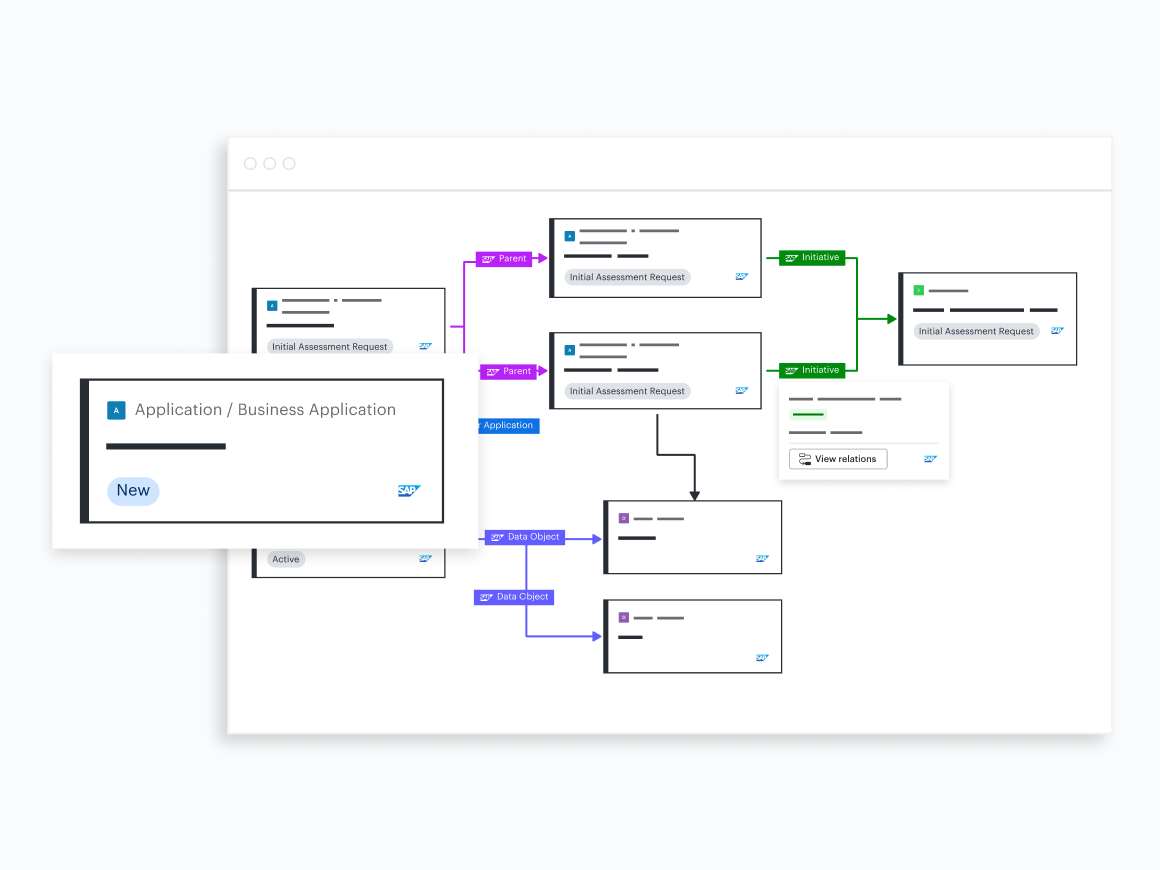
Map cross-functional workflows. Use swimlane diagrams, opens in a new tab to visualize exactly where handoffs are across departments and agents.
Connect process and system architecture. Link your process maps directly to your technical system architecture diagrams. Visual platforms like Lucid allow you to integrate enterprise architecture, opens in a new tab data directly into your workflow diagrams, giving both teams and agents a single source of truth.
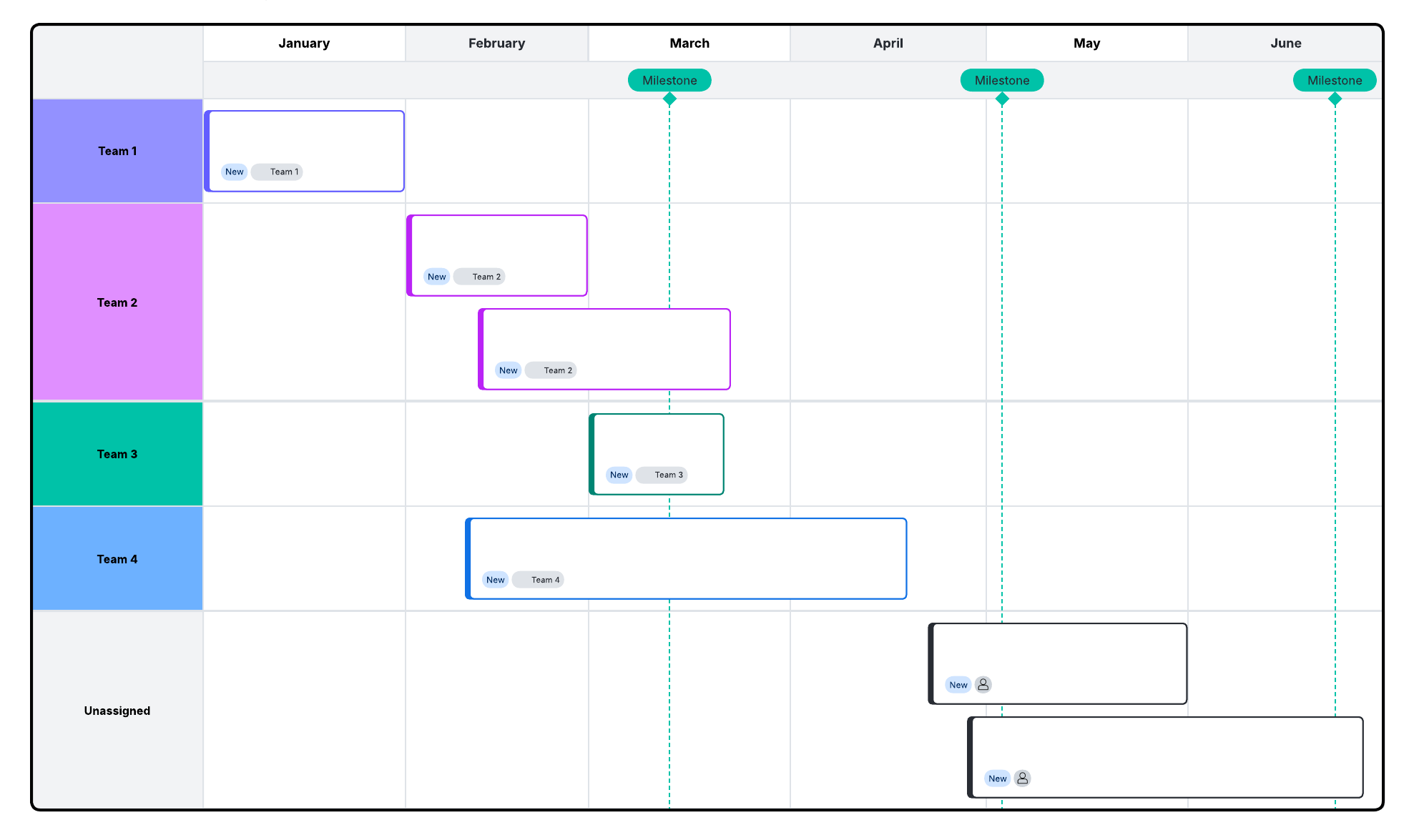
Visualize your deployment. Roll out the solution in structured phases rather than a single release. Use timelines and dependency mapping, opens in a new tab to visualize what changes to your business are needed, who will make the changes, and by when.
Step 5: Provide enablement and change management
Because 70% of AI value depends on your people (as the BCG data mentioned earlier shows), change management cannot be an afterthought.
You can implement these AI change management, opens in a new tab strategies to intentionally improve adoption:
Align incentives. If employees feel that automating a task puts their job security at risk, they will actively resist adoption. Update team KPIs and reward structures so employees are recognized, not threatened, when they use AI to streamline repetitive tasks.
Use transparent messaging. Clearly communicate the benefits, such as reclaimed hours, while acknowledging the inherent uncertainty that comes with change. “Standard change practices are important, but one that is underrated is just telling the truth,” said Rosenbaugh. “This allows people to opt in through their behavior rather than creating a situation where everyone is just anxious.”
Leverage role-based enablement. Provide practical, role-specific training tailored to individual job functions. Take advantage of change champions, or influential employee advocates who can help their departmental peers adapt.
Embrace feedback loops. Create safe spaces, such as dedicated office hours or Slack channels, where employees can share ideas and input, voice concerns, and ask questions.
Step 6: Execute an iterative learning loop
Scaling agentic AI comes with a lot of unknowns, so it’s important to validate whether you’re actually seeing the intended outcomes. For that reason, this step is about measuring real results and making changes to your strategy as needed based on those metrics.
While it can be tempting to track activity metrics—such as number of licenses, token usage, or prompt volume—these metrics don’t reveal anything about impact. You can use tokens all day without moving the business forward.
To understand the success of your AI transformation, you’ll want to track outcome metrics, including:
Cycle time: Track start-to-finish durations across processes and procedures, looking for meaningful reductions as automations take hold.
Error and escalation rates: Monitor how frequently AI agents require human intervention or produce inaccurate outputs. Decreasing error and escalation rates indicate that your context layers and governance guardrails are maturing.
Cost per transaction: Calculate the total operational cost to execute a specific workflow with AI against legacy manual costs to verify any cost savings.
Hours reclaimed: Map reclaimed hours to higher-value strategic initiatives, such as increased customer touchpoints, product innovation, or faster backlog resolution.
Revenue influenced or protected: Measure top-line impact only where a clean line can be drawn, such as churn prevention from lower error rates or higher sales capacity unlocked by faster cycle times. Because revenue moves for many reasons, the most credible path to proving top-line value is demonstrating how it was enabled by the operational gains listed above.
Pilot-to-production conversion rate: Treat this metric as a primary leading indicator of the AI program's overall health. If pilots routinely fail to reach production, your bottleneck is likely workflow mapping or governance (not technical feasibility).
Pro tip: Be sure to map reclaimed hours and ROI across the entire organization to ensure that value isn't trapped inside a single department (e.g., hours saved in marketing) while infrastructure costs are absorbed globally across all functions.
"Prioritize the processes where value compounds across functions, not the ones that look good in a single team's dashboard."
—Jeff Rosenbaugh, Senior Director of Professional Services, Lucid
Step 7: Standardize new operations and repeat
Once you’ve validated ROI on the automated workflows, it’s time to officially codify the new way of working.
At this step, you’ll want to:
Create a living context source. Store governed, machine-readable SOPs in a dynamic repository connected directly to your agents through MCP servers. Creating a central place for all approved documentation ensures your agents aren't acting on static or outdated context, but drawing from a live, real-time single source of truth.
Run retrospectives. Analyze what worked across your people, process, and technical governance layers. Capture feedback from all involved stakeholders to ensure continuous improvement.
Replicate the framework. Apply this standardized scaling engine to the next prioritized pipeline of enterprise pilots.
"A connector is only as good as what it's connected to. Point an agent at ungoverned process sprawl, and you've just automated the confusion. Point it at a governed source of truth, and you've made it institutional."
—Jeff Rosenbaugh, Senior Director of Professional Services, Lucid
Video clip showing repositories within the Process Accelerator. The "logistics" repository is selected and the published documents in that repository are shown. The published documents thumbnails shown are warehouse operations, customer management, transportation management, quality assurance, shipping standards, and network planning.
Scale your AI transformation with Lucid
The reality is that many organizations are stuck in the early, pilot stages of AI transformation. The most effective single action you can take to get unstuck and scale AI is to make your highest-value processes visible, governed, and connected.
Leading organizations, including Carta and Uber,, opens in a new tab are using Lucid for scaling AI by mapping and optimizing workflows in a shared space. With advanced capabilities to accelerate diagramming, visualize the future state, and create governance guardrails, Lucid provides the operational foundation needed to realize true value from AI transformation.

Ready to take the next step?
Discover how Lucid streamlines AI transformation by helping enterprises visualize, govern, and optimize processes from pilot to scale.
Learn moreGartner is a trademark of Gartner, Inc. and/or its affiliates.