Key takeaways
- Product backlogs should be consistently maintained so teams ensure they focus on the right tasks at the right time.
-
Product owners are typically responsible for ongoing adjustments and monitoring of product backlogs.
-
To achieve successful backlog management, have a clear vision and guidelines, prioritize items with your team, and refine your items frequently.
A product backlog can feel quite a bit like the to-do list involved with maintaining an old home. From big repairs like replacing the roof to weekly duties like mowing the lawn, no matter how many work items you seem to get through on your to-do list, there’s always more to do, and the list is never done.
Similarly, it’s easy for product owners or project managers to feel like they’re stuck with a never-ending backlog that demands more and more manpower while becoming increasingly disorganized.
That’s why product backlog management is so important.
A well-prioritized and well-maintained product backlog can improve release planning, streamline development, prevent scope creep, and keep everyone on the same page—leading to better products and fewer headaches.
Learn how to prioritize the items in your product backlog to streamline the process for the future and bring peace of mind to everyone involved.
What is product backlog management?
A product backlog outlines all the work a team needs to do to deliver a product. Teams use the product backlog to prioritize the tasks and make sure they are focusing on the right tasks at the right time. But with complex or long-term projects, product backlogs can quickly get, well, backlogged.
That’s where product backlog management comes in.
Product backlog management ensures that the product backlog is well-prioritized, relevant, and clear so the team can work efficiently and effectively. Product owners are typically responsible for product backlog management, which involves ongoing monitoring and adjustments to determine what the team will work on now, later, or not at all.
Common mistakes with product backlog management
Occasionally, product backlog management is so poor that work gets delayed, the wrong items are prioritized, and teams can even start to ignore the backlog altogether. That’s a massive issue that halts the systematic progression and natural evolution of a product.
Take a look at the common product backlog management mistakes that lead to product backlog chaos.
Unclear prioritization
Priorities need to be defined by stakeholders ahead of time so that items can be objectively grouped into levels of urgency. It’s important these definitions are written down so that there’s no confusion: The highest-impact and most urgent items on the backlog must be addressed first.
When defining prioritization, address:
-
Priority for customers
-
Ease of implementation
-
Relationships between items
-
Resource constraints
-
Business value
The weight of each of these factors contributes to the overall importance of an item and determines its placement of priority in the backlog.
Irrelevant items
A backlog isn’t the place to throw in just any idea. That leads to a cluttered, disorganized backlog. Instead, every item in the backlog should be a purposeful step toward the ultimate goal of the product.
This goal is referred to as the product vision, and if your team doesn’t have one, there’s no way to have an organized backlog. Develop a clear product vision and make sure that every item in the product backlog points toward achieving that product vision.
Not accounting for dependencies
It’s a minor (and sometimes major) disaster when an urgent, highly impactful item rises to the top of the backlog and the dependencies that need to be implemented first are lower on the backlog. This situation leads to greater disorganization and, ultimately, slower product improvement.
7 tips to help you prioritize an overwhelming product backlog
With a few best practices, it’s easy to organize the backlog down to a manageable length.
Use these techniques for effective product backlog management:
1. Have a clear product vision
We mentioned this briefly above, but it’s worth mentioning it again. The product vision is the North Star to which all work items should point. This product vision needs to be clearly defined, updated as needed, accessible by everyone at any time, and referred to often.
Product managers often provide a product requirements document at the beginning to illustrate the product vision and keep everyone involved working towards the same goal, and it’s an easy barometer to use when determining what goes in a backlog and what can be tossed away.
2. Set guidelines for your backlog
Your business needs to decide individual guidelines that dictate what items will and will not be included in the backlog, as well as what weight to give various factors to determine the order of prioritization. Without these standards in place, prioritization becomes arbitrary.
3. Organize items with prioritization scores
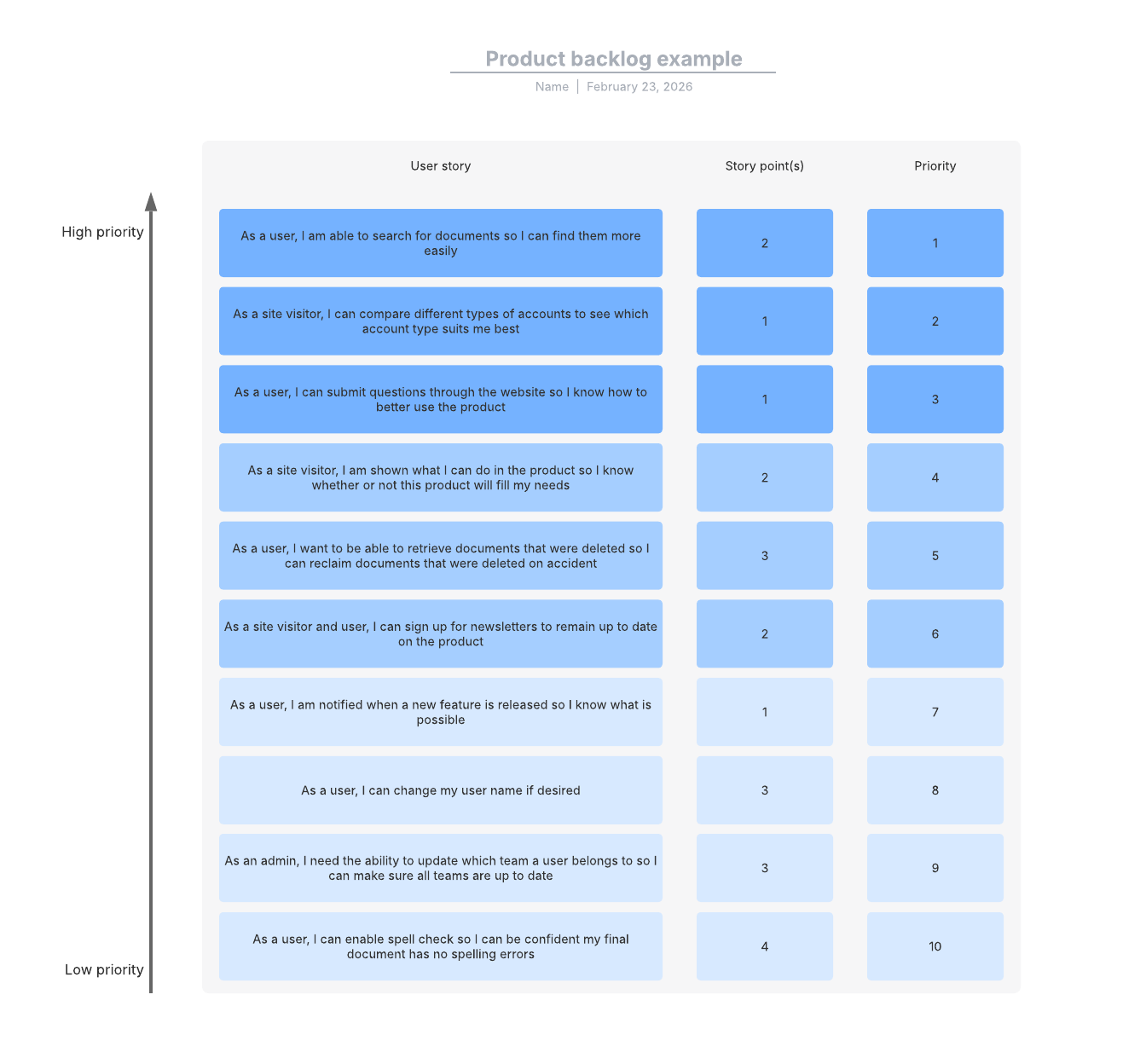
To eliminate bias when addressing prioritization and to determine the most efficient and most strategic approach, it’s smart to use a numerical system that can assist with determining priority.
There are various scoring models that give numerical scores based on factors, such as customer value, implementation costs, and increased revenue; it may take experimenting to determine the best scoring model for your business. The end result, however, should be that your backlog is divided into top priority, medium priority, and longer-term priority.
This strategic approach to organization is a great way to defend and explain the order of items in the backlog to stakeholders, teams, and anyone else involved in the product’s evolution.
4. Use a product management tool
A good product management tool can convert the stress and uncertainty of backlog tasks into smaller, actionable tasks. It can help you visually determine dependencies you may not have noticed and can also improve and maintain transparency. A product management tool converts frustration into progress, and that’s more than worth the price of a software subscription.
5. Refine your list often
There are many reasons why an item in the backlog may no longer be necessary: Customer needs change, resources change, and priorities shift. It’s important to note that the prioritization score initially assigned to an item won’t necessarily remain the same, and as soon as that score changes, it may move up or down the list in priority.
Without consistent product backlog refinement, it’s difficult to keep on top of the most important items. When items become outdated, they should simply be removed from the list. And when items are so low in priority that they won’t be addressed within the next six months, those should also be removed.
Product backlog refinement is a good opportunity for your team to come together and assess the items in your backlog, so items can be reordered or removed as needed.
6. Create an idea list
Timing is everything. An idea that once seemed irrelevant—such as implementing social-distanced delivery options—may suddenly take on new importance overnight. Instead of just throwing away items, move them to an idea list and revisit that idea list occasionally when innovation seems to be lagging.
7. Understand your available resources
Not taking the time to examine available resources when transferring items from the backlog into an upcoming sprint can quickly lead to disaster. Suddenly, one task that seemed relatively simple could end up using all your developers’ time.
Establishing and understanding your team’s velocity, opens in a new tab is a clearer way to measure the amount of work that can be completed in a sprint and ensure more efficient resource management.
Manage your product backlog to enhance your product vision
A product backlog is essential, but instead of viewing it as a disorganized mess, view it as a list of opportunities. This mindset can get people more excited about where your product is going and help teams better understand what they’re working towards. Plus, a backlog is the best way to keep the highest priority, biggest impact items front and center.

Get advice about product backlog management from Agile experts
Read about creating a product backlog and how to avoid common pitfalls in this in-depth guide.
Learn more