All-access Agile
The comprehensive guide to developing and managing a product backlog in Agile

Agile teams are all about adapting to change and delivering on customer value through iterative work. But where does that iterative work begin? How do Agile teams identify work items that will ultimately achieve customer value?
For many teams that practice Agile, accomplishing their vision starts with their product backlog. In a product backlog, teams determine what items they should complete in order to deliver value.
This guide will walk you through what a product backlog is, who is accountable for managing the backlog, how to create one, and how to best prioritize and order backlog items. You’ll also learn tips for avoiding common pitfalls that teams typically encounter when developing backlogs.
What is a product backlog in Agile?
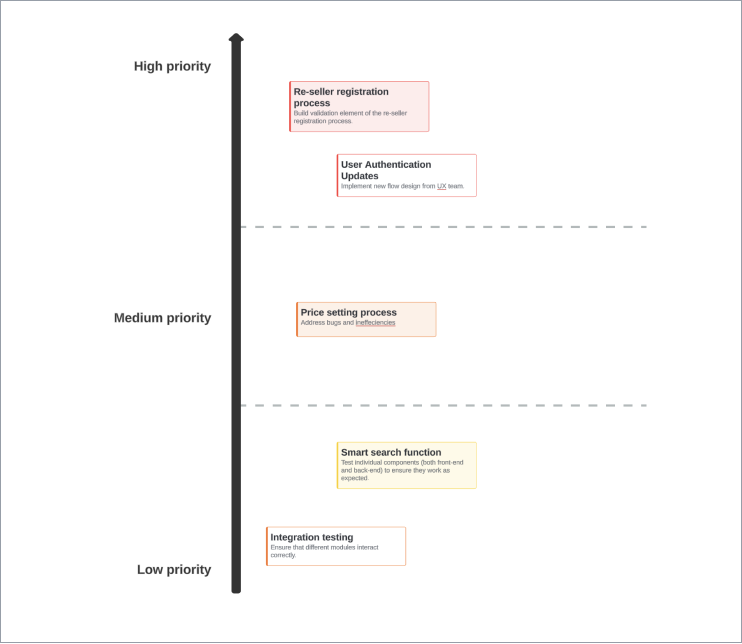
A product backlog, which was initially described within the Scrum framework, has become a core component of many Agile frameworks, opens in a new tab. It is essentially an ordered list of what a team will focus on to deliver value. The list consists of backlog items, which are single elements of work, that are either based on stakeholder requests or what the team itself has decided to accomplish to achieve customer value.
 , opens in a new tab
Use this product backlog template, opens in a new tab in Lucid to prioritize work by value and deliver high-quality products.
For example, in software development, the product backlog is a list of items that the team has been asked to build, such as new features and technical improvements, and items identified by the team itself, such as bug fixes and security updates. Other common product backlog items include:
- User stories
- Usability enhancements
- Changes to existing features
- Knowledge acquisition
- Technical debt management
Each backlog item must be an element of work the team can complete within one sprint. The most impactful items should be completed first, with the ultimate goal of achieving value for the customer as efficiently as possible.
After items are added to the backlog, they’re broken down into smaller items so that items can be realistically completed within an iteration. Think of the product backlog as a funnel: The team starts with a larger product goal, and the ways to accomplish that goal are broken into smaller pieces until they’re narrowed down into backlog items ready for an iteration.
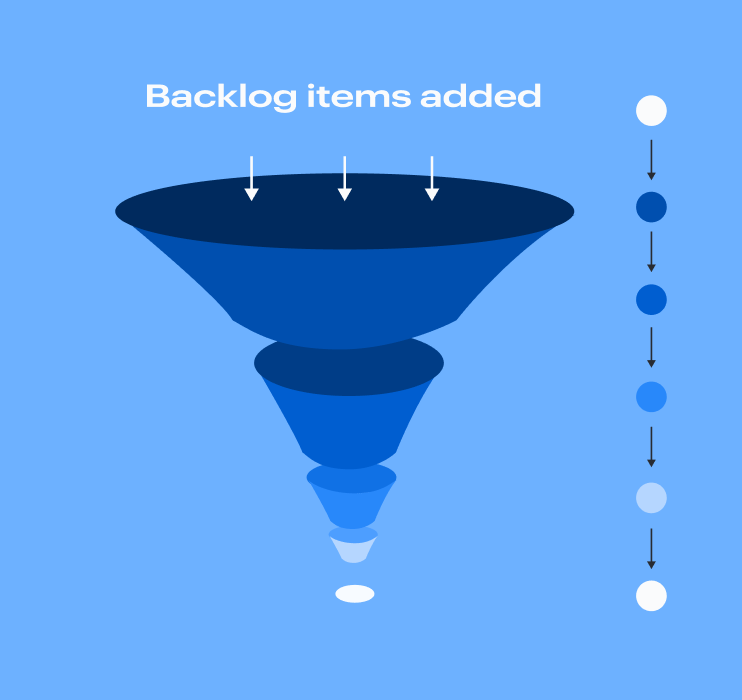
Backlog refinement resembles a funnel. The team starts with a larger product goal, determines items to meet that goal, and then breaks down those items until they can be completed within an iteration.
Product backlog management is most successful when it’s approached with an Agile mindset, opens in a new tab of providing customer value through incremental work—that is, as team members complete their work, they incorporate feedback and focus on continuous improvement.
See for yourself how Lucid streamlines Agile workflows
Why does an Agile product backlog matter?
Developing and maintaining a product backlog can benefit all kinds of teams—you don’t have to work in software development to have a product backlog.
As the input source for your team’s outcomes, a product backlog provides:
- Clear direction: Sprint planning or iteration planning begins with the backlog since it already lists the most important items to work on next.
- Flexibility: The product owner may change the order of items as new information emerges from discussions with stakeholders or other types of feedback.
- Transparency and alignment: The product owner can use the backlog in discussions with stakeholders about what’s needed for delivering product value, what's planned to be completed, and what's currently being worked on. The backlog also helps everyone understand how the product vision and goals have been interpreted and broken down into more actionable items.
- Efficiency: The backlog order ensures that the team is focused on the most important, high-value items first.
Who owns a product backlog?
While the whole team is responsible for being aware of backlog items and completing items that they have committed to, one person is accountable for maximizing value through the product backlog. In Scrum, this person is the product owner.
The product owner’s accountabilities include:
- Developing and communicating the product goal
- Creating, ordering, and clearly communicating backlog items
- Ensuring the product backlog is transparent and understood by all team members
An effective product owner is organized, articulate, and constantly focused on delivering value to the customer. They’re open to feedback from both customers and their team members as they emulate high-value collaboration and try to meet the needs of many stakeholders. While it’s possible to change the product backlog, people must collaborate with the product owner first to enact those changes.

Learn the key roles and responsibilities of a Scrum product owner
How to create a product backlog
It’s important to remember that creating a product backlog isn’t a one-time event. It’s an ongoing process.
Teams will continuously update and refine the backlog as new information emerges, and the backlog should be regarded as a living, breathing document. It should change as market trends, stakeholder input, and customer needs change.
Keeping that in mind, here are the steps to creating a product backlog.
1. Gather input
Collect ideas from stakeholders, customers, and team members to inform the product goal. You can also conduct competitor analysis and customer research.
2. Define a product vision
Have this vision in mind as you discuss what it’ll take to achieve the product goal. Backlog items should align with this overall vision and strategy.
3. Hold a backlog management session
You can host backlog management workshops with stakeholders and team members. In these sessions, brainstorm items to complete, consider their value, and determine relative priority.
4. Articulate the product backlog items
Often, teams describe backlog items in the format of a user story, outlining the desired functionality from the user’s perspective. You can conduct user story mapping to visualize the user journey and organize backlog items in a way that helps a team see how different features and tasks fit together to deliver value.
5. Refine the backlog with your team
Starting at the top of the ordered backlog, break down larger ideas into more granular backlog items. Leave refinement of lower-priority items until they become more relevant. Add acceptance criteria and an estimate for each backlog item.
6. Order the items
The order should be based on value, cost, risk, and dependencies.
7. Make continuous updates
As the product owner receives new information, use it to update and refine your backlog continuously.

Learn how you can create a product backlog successfully and keep it organized
What to prioritize in a product backlog
Once you’ve created a product backlog, the next step is to decide what to work on first. Because the product owner is accountable for ordering the backlog, they ultimately decide what will deliver the most value, but this process requires a lot of collaboration not only between team members but also with stakeholders to reach alignment. Facilitation skills and collaboration tools are needed to help the group reach agreement.
Visual collaboration software is especially helpful here. A virtual whiteboard can get everyone on the same page by providing a central, shared canvas where you can gather everyone’s input. Visualizing your product backlog can help your team understand relative value and complexity. As you determine ordering, consider aspects such as business value, customer value, risk, level of effort, dependencies, and time sensitivity.

In Lucid, teams can quickly and collaboratively estimate the level of effort associated with each task with a planning poker-style approach.
Here are some helpful activities that you can use to facilitate these discussions:
- While the product owner is accountable for the final ordering, tools like an impact vs. effort matrix can help identify items with the greatest value. A user story map can help visualize this flow of work.
- Use various estimation techniques like affinity estimation, Planning Poker®, and T-shirt sizing to align on size and complexity of product backlog items.
- Gauge the team’s understanding through confidence voting and fist to five voting. These activities help surface concerns and provide opportunities to discuss different perspectives.
What is product backlog refinement?
Product backlog refinement, opens in a new tab is the act of breaking down items into smaller, more precise items. For example, a common backlog item is a feature request.
That request is broken down into detailed pieces of work that can be more readily completed. The team collaboratively refines these items to ensure they are properly sized and understood.
The Scrum values of commitment, focus, openness, respect, and courage are essential when refining the backlog: Team members should be open about their work, its challenges, and their commitment to achieving goals. Product backlog refinement also requires team members to demonstrate respect for each other and courage to address difficult tasks.
Product backlog refinement isn’t a one-time activity that occurs during sprint planning or reviews. It’s an ongoing activity to add order, description, and size to items while ensuring alignment with the product vision. Like a garden, the product backlog needs constant tending, and backlog refinement is a practice that helps teams tend to their backlog.
Common pitfalls teams encounter when managing backlogs
It takes conscious effort from the whole team to successfully maintain a product backlog. These are some common pitfalls that teams tend to encounter as they develop backlogs.
Insufficient stakeholder involvement
Even the best product strategies can be rendered useless if there’s a lack of stakeholder involvement or support, as this leads to misaligned priorities. For successful backlog management, it’s essential to involve stakeholders early and maintain ongoing dialogue throughout the process.
Allowing the product backlog to get unmanageable
While there's no fixed rule, having too many items makes it very difficult to maintain transparency and effective ordering. The product owner should be empowered to say "no" to items that don’t align with current vision to keep the backlog focused on delivering value.
Focusing solely on new features
While new features may be most exciting for customers, it’s important to address technical debt and other quality issues, including bugs that need to be fixed. Both product features and technical health need attention for sustainable delivery.
Focusing on only the long term or short term
Delivering on customer value requires balancing immediate needs with long-term vision. The product backlog should reflect both quick wins and strategic initiatives while staying aligned with the product goal.

Don't let your backlog become overwhelming—learn effective strategies for product backlog management and prioritization
Lucid for Agile
Backlog development and refinement is a core aspect for Agile teams who use Scrum and other Agile frameworks. Lucid can help you create and maintain product backlogs for your entire organization. With features that enhance cross-functional collaboration, visualize work to be done, and connect work back to your system of record, you can use Lucid to develop a product backlog and prioritize tasks that deliver customer value.
See for yourself how Lucid streamlines Agile workflows
Next up: Sprint planning
Go now