
Innovation is promised as the golden ticket to increasing an organization’s profitability, exceeding customer expectations and producing competitive products or services. McKinsey research shows that 84% of CEOs believe innovation is critical to growth—yet only 6% are satisfied with their innovation performance. If executives are on board with the value of innovation, then why are so many innovation initiatives falling short?
The problem lies in executing on these initiatives, which often stems from confusion or misunderstandings around what “innovation” actually is. With all the hype surrounding innovation, it’s easy to lose sight of its true meaning. To find out what it really means to be innovative, we talked to David Dabscheck, founder and Co-CEO of GIANT Innovation, a consultancy transforming the way organizations and people think and act to become world-class innovators.
Drawing from his experience in helping leading organizations unleash their innovative potential, Dabscheck helped us clarify just what innovation is—and is not—by busting five common myths that many mistakenly accept as truth.
Myth #1: Innovation is the same thing as creativity
What comes to mind when you think of innovation? For many people, it’s the newest, creative technologies like blockchain, artificial intelligence, or virtual reality. While these new inventions can certainly enable innovation, they’re not enough on their own to be labeled as innovative. True innovation lies in what value is provided to customers as a result of these creative ideas.
Simply put: An idea can be creative, but if it’s not needed or helping customers, it’s not innovative. When organizations think innovation means creativity, they lose sight of solving real customer problems and end up with tons of novelty ideas that there’s no market for. Dabscheck refers to this as the “solution bubble,” and it’s especially common in technical industries like engineering.
“We find that teams become so passionate about their products and services that they forget what the customer problem or need is that they’re even solving for,” said Dabscheck.
Reality: Innovation = something new + something useful
There are a lot of new things that aren’t useful (like garlic-flavored soda) and a lot of useful things that aren’t new (like the chair you’re sitting on). But the combination of something new and something useful helps teams focus on new ideas that are actually addressing fundamental human needs.
“This definition provides a really empowering and enlarging way to think about innovation,” said Dabscheck. “Everyone can do something new and useful in their work, so it broadens our perspective of innovation beyond that of just new technology.”
Leaders looking to increase innovation should keep this definition in mind when working on every facet of the organization: Building their business model, creating new products, improving processes, and more. Dabscheck explained:
“Start by identifying who the customer is and what their problem is—this is what drives innovation.”
An experimental mindset is key to this approach. Coming up with ideas is only half the battle—to find a solution that works, you have to test your ideas, learn, and iterate. This is a continuous process that’s essential to transition organizations away from brainstorming novelty ideas to building solutions that address real-world customer problems.
Myth #2: Innovation is limited to an innovation team
Often driven by a belief in the myth above, many companies tend to enable innovation only for select teams, typically those involved in building new technology or new ventures.
“Organizations do themselves a disservice when they limit innovation to only a small designated team,” said Dabscheck. “They miss out on opportunities to increase efficiency, improve processes, and better the customer experience across all departments.”
Reality: All employees can—and should—be innovators
While it may be beneficial to hire leaders and teams dedicated to innovation, they’re not the only ones in the company that can be innovative.
Remember: Innovation starts with understanding the customer—and everyone has a customer.
“We define a customer as ‘someone to whom you need to deliver a service or product,’” said Dabscheck. “This viewpoint opens up innovation to everyone in the organization, not just those building a product.”
For example, if someone in HR considers to whom they deliver a service, they might determine that their customers are hiring managers across the organization, prospective employees, and new hires. They can then focus on understanding the specific problems these groups face and developing innovative solutions to solve those problems.
Because this is such a simple, yet often overlooked aspect of innovation, GIANT Innovation has focused its attention on transforming teams into everyday innovators, no matter what their job function is. “We believe that everyone in an organization can be innovative, from a finance team making a process more efficient to a sales team testing out a new approach,” said Dabscheck. “The key is enabling innovation at every level of the organization: individual, team, and company-wide.”
At the individual level, innovation speaks to the human need to create. It brings out the best versions of people and drives engagement. At the team level, innovation aligns teams with a common mindset and language so they’re working towards the same goals. And the more teams that adopt an innovative mindset, the more the company will benefit at an organizational level, with increased agility that allows them to grow, scale, and stay competitive.
Myth #3: Innovation requires a large upfront investment
Many executives mistakenly believe that the more money they dedicate to innovation, the more innovative their organization will be. Unfortunately, these organizations invest so many resources into new infrastructure and technology, they often forget to invest in their people.
“We see this scenario play out a lot, where organizations invest a huge amount of resources early on, only to find out they spent money on something that isn’t actually helping their people innovate,” said Dabscheck.
Reality: Innovation is not about the investment—it’s about empowering your people
The best ideas are not the result of a new tool or technology—they’re the result of collaborative knowledge sharing, group learning, and unique perspectives from all voices contributing. Whether you’re doing in-person, remote, or hybrid work, focus on fostering a collaborative way for employees to experiment, share findings, and easily access information. Dabscheck offered this recommendation for fostering collaboration:
“One of the best ways to bring people together is through experiential workshops. A platform like Lucid is essential to deliver these experiences because it allows employees to collectively understand customer problems and co-create solutions, rather than one-way conversations.”
Tip: Lucidspark’s template gallery offers pre-made templates to kick-start your collaborative workshops. Check out this design thinking workshop to get started.
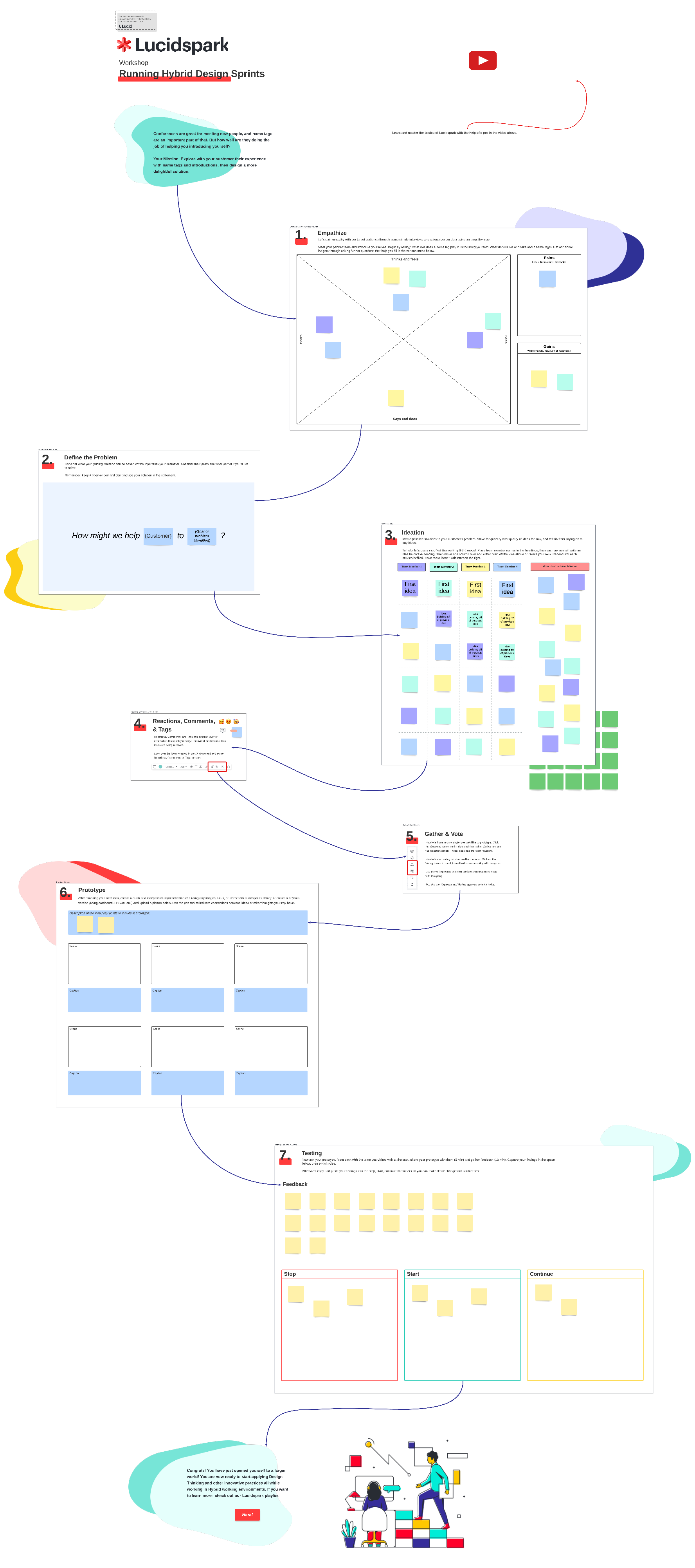
Focusing on your people first will allow you to build an innovation competency that actually increases innovation. After all, you don’t know what the most effective version of innovation looks like for your organization until you experiment, learn, and continually implement findings. Take an iterative approach when building an innovation capability, investing minimally up-front so you can change course as needed to build innovation into your organization in the most effective way possible.
“The formation of any good innovation competency within an organization needs to apply the same skills and tools for its own formation as it later plans to use for the development of products and services,” said Dabscheck. “Meaning, innovation programs need to be lean and iterative themselves.”
The takeaway: Start small, enable your employees with the right tools and mindsets, and invest slowly as you learn what works for your organization.
Myth #4: Innovation follows a formulaic, linear process
Organizations often wish to approach innovation like they would any other initiative: By following a rigid process with known outcomes. But innovation doesn’t work that way—there’s no cut-and-dry formula that always ends with innovation.
Organizations that rely on a rigid step-by-step process to achieve innovation are missing a key element: Continuous learning, iteration, and improvement.
Reality: Innovation is about intentional discovery and experimentation
“Innovation isn’t necessarily a process you can layer on top of everything,” said Dabscheck. “It requires an intentional, flexible approach to discovery and experimentation within the confines of organizational boundaries.”
The keyword here is intentional. While innovation doesn’t follow a formulaic process, it also doesn’t mean leaving everything to chance or waiting for a good idea to strike. There are proven approaches to foster activities like brainstorming, creative thinking, and prototyping—many of which Dabscheck teaches to organizations. These frameworks provide the foundation needed to accelerate innovation but are most effective when they are adapted to fit each team’s unique needs.
Tip: Get in touch with GIANT Innovation to learn more about their proven approaches to innovation.
Leadership plays a key role in intentionally enabling innovation. It’s a leader’s responsibility to foster a culture that supports experimentation and provide their workforce with the necessary training, frameworks, and tools. This requires an agile approach to leadership, meaning: placing trust in self-organizing teams, enabling cross-functional collaboration, and leading by example.
Myth #5: Remote and hybrid work stalls innovation
As more organizations accept a future of remote or hybrid work, many fear that a lack of in-person exposure will slow down their organization’s ability to innovate. While hybrid work undoubtedly poses challenges, the situation isn’t so black and white. When it comes to innovation, one way of working isn’t necessarily better. They’re fundamentally different, with both in-person and remote work offering their own distinct advantages.
“The problem is when the workshop or mode of innovation isn’t adjusted to take advantage of the strengths of a digital, hybrid world,” said Dabscheck. If you try to approach remote or hybrid innovation in the same way you would in-person, you’ll miss out on key opportunities that virtual working presents.
We’ve seen this trend throughout history: Early radio programs essentially played over the radio, then early television programs were simply radio shows on TV. Over time, the media was adjusted to take advantage of the strengths of the new medium. Collaboration and innovation must also be adjusted to fit the strengths of a virtual world.
Reality: Hybrid work provides an opportunity to diversify ideas and democratize innovation
The correlation between diversity and innovation is undeniable. In fact, a Boston Consulting Group survey found that organizations with above-average diversity earned 45% of their revenue through innovation, compared with only 26% for companies with below-average diversity.
This is where hybrid and remote work comes into play. Dabscheck described the unique advantage these new ways of working represent:
“One of the greatest opportunities that remote work has presented is the opportunity to hire employees from around the world instead of being limited to a single geographical location. Organizations can easily hire employees with diverse backgrounds, perspectives, and ideas.”
However, it’s not enough to just hire a diverse workforce. Organizations need a way to help these employees collaborate, experiment, and share ideas. One such way is through visual collaboration platforms. With features to capture everyone’s ideas, plan next steps and timelines, and work asynchronously on a single document, visual collaboration platforms help organizations take advantage of hybrid work. Collaborating and aligning across large, dispersed, or cross-functional teams can be very hard to do in person, but works well virtually.
And by using a visual collaboration platform, teams will organically build a document repository for innovation—a record of ideas and decisions that helps organizations make innovation scalable and repeatable.
“Before collaboration tools, innovation workshops were cost-prohibitive and not easily accessible to everyone,” said Dabscheck. “They were primarily limited to leadership. But these tools democratize access—especially in large organizations—so you can bring people together with different ideas and really unlock the everyday innovator.”

Kick-start innovation at your organization with an innovation framework.
Check it out