Key takeaways
- AI in product management is increasingly embedded in core workflows, but high adoption does not automatically equal AI maturity.
- The trust gap remains the primary blocker for product teams, driven by uncertainty around data sources, quality, and context.
- Effective AI usage requires grounding tools in structured product context and establishing clear standards for decision-ready outputs.
- Teams must set up shared workflows to collaboratively review AI-assisted insights and maintain human accountability for prioritization decisions.
- Organizations should measure AI success by decision quality and clarity rather than focusing solely on output productivity gains.
AI in product management is no longer a question of if but how. For most product teams, AI adoption is already well underway. The more urgent question now is whether AI is helping teams make better decisions, or simply helping them move faster.
A new airfocus survey of 500 product professionals across the U.S. and U.K. explored this question: 71% of respondents said their output would be less productive if AI were removed from their workflows tomorrow, while 86% agreed that AI has delivered value for their organization.
That level of dependency shows how quickly AI has moved from experimentation into everyday product operations. Product teams are using AI to summarize research, synthesize feedback, draft requirements, analyze data, and explore product opportunities – but adoption alone doesn't create maturity.
The next challenge is trust.
Product teams need to understand where AI outputs come from, what data the outputs are based on, what assumptions they include, and how those outputs should influence actual product decisions. Without that foundation, AI can create more activity without creating more clarity.
So the question is no longer whether teams should use AI in product management, but how they can use AI in ways that are trusted, contextual, collaborative, and decision-ready.
The current state of AI in product management
AI is already part of how many product organizations work. But the research from airfocus also shows a gap between AI usage and AI maturity. Here are the top findings from the report.
Finding #1: AI is already part of core product workflows
AI in product management is no longer limited to side experiments, individual productivity hacks, or isolated pilots. According to the research, 45% of respondents said AI is embedded in multiple core workflows, while 20% said AI is foundational to how their product organization operates.
And those workflows include some of the most important areas of product decision-making. Respondents said they are using AI for analytics and experimentation, user research and insight synthesis, product discovery and ideation, customer feedback analysis, and roadmapping and prioritization.
This is important because these are the places where product decisions begin to take shape.
AI is no longer just helping teams write faster or summarize longer documents; it’s increasingly being used around the work that determines what teams learn, what they prioritize, what they build, and how they align stakeholders around those choices.
That shift creates an opportunity, but it also raises the stakes. If AI is being used in the workflows that shape product direction, then teams need more than just fast outputs. They need outputs they can understand, challenge, and trust.
Finding #2: Adoption doesn’t mean maturity
One of the clearest tensions that emerged from the research is the gap between AI strategy and AI maturity.
Some 80% of respondents agreed their product organization has a clearly defined AI strategy. Yet
57% also agreed that their strategy is only informal.
That's not necessarily a contradiction. A team can have executive support, approved tools, internal champions, and active AI use cases while still lacking a mature operating model for AI in product management.

Maturity requires answers to much harder questions, such as: Where should AI be used? What data should it draw from? Who is accountable for its outputs? How should AI-supported insights be reviewed? How does the team know whether AI is improving decisions, rather than simply increasing the volume of work?
Without those answers, AI can become just another layer of fragmented activity. Different teams may use different tools, different prompts, different data sources, and different standards for quality. The result is more AI usage, but not necessarily more confidence.
Adoption puts AI into the product management workflow, but maturity makes it useful, trusted, and accountable.
Finding #3: The trust gap is holding product teams back
The biggest blocker identified in the research was trust in AI outputs, cited by 40% of respondents. Security, privacy, and legal concerns followed close behind at 39%, while 35% pointed to a lack of training or time dedicated to upskilling. Poor data quality or lack of access to data was named by 32%, and 29% cited a lack of clear use cases or defined goals.
That hierarchy is revealing. The ceiling on AI maturity isn't simply what the model can generate, but whether teams can trust the output, understand where it came from, and judge whether it is grounded in the right product, customer, and business context.
“If your organization has strong practices, clear intent, good alignment, and rigorous decision-making, AI makes you faster and better. If your organization has fragile processes and fuzzy strategy, AI makes that worse. It doesn't fix dysfunction. It exposes it, at speed.”
—Jamie Lyon, CPO, Lucid Software
That is especially true in product management, where many decisions are ambiguous by nature. A product team rarely has perfect information. They're weighing everything from customer needs to market signals, business goals, technical constraints, stakeholder expectations, and timing. AI can help synthesize some of that complexity, but it cannot remove the need for judgment.
For teams to trust AI, they need to know that its output is grounded in their product reality: their strategy, feedback, research, roadmap, objectives, and prior decisions. Without that context, even a polished AI-generated recommendation can be difficult to act on.
Finding #4: More AI doesn’t automatically mean clearer signal
One of the risks of scaling AI is that more output can feel like progress.
AI can summarize faster than humans. It can cluster feedback, draft documents, generate options, and identify themes at speed. But speed doesn't automatically create a clearer signal. In fact, the research found that 48% of respondents agree their product organization struggles to separate signal from noise.
That problem gets worse when product context is fragmented across a slew of different tools, documents, meeting notes, feedback repositories, roadmaps, spreadsheets, and individual knowledge. AI may be able to generate a summary from whatever it is given, but if the inputs are incomplete, disconnected, or out of date, the output may still leave teams with more interpretation to do.
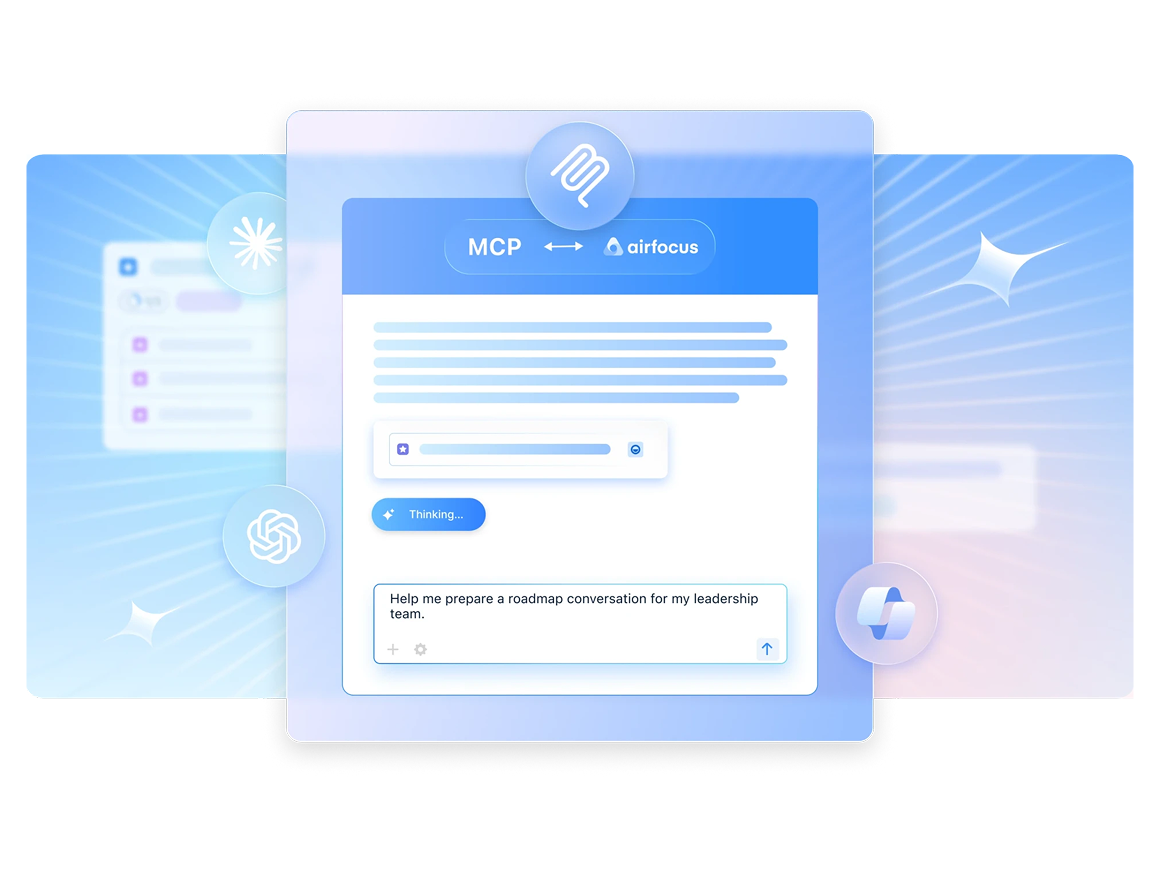
This is where AI maturity becomes less about the tool itself and more grounded in the system around it. Product teams need shared context, clear decision-making workflows, and standards for what makes an AI output useful enough to influence the roadmap. This is where AI readiness in documentation and infrastructure with MCP, opens in a new tab comes into play. It’s no longer enough for a product tool to have a clean UI and decent search. Increasingly, it also needs a way for AI systems to understand what information it contains, what actions it can support, and how to interact with it reliably.

Get the full report
Read the full airfocus report on AI maturity in product teams.
Get the full reportHow to use AI in product management more effectively
The practical challenge for product teams is scaling AI in a way that improves product decisions. And that starts by treating AI not as a general-purpose productivity layer, but as part of the product operating model.
Tip #1: Start with the product decisions AI should support
Before scaling AI across product workflows, teams should define the decisions they want AI to support.
For example:
- Which customer feedback themes should we prioritize?
- Which discovery insights are strong enough to influence the roadmap?
- Which experiments suggest a change in direction?
- Which roadmap items support strategic goals?
- Which opportunities deserve investment now?
- Which trade-offs need leadership alignment?
Framing AI around decisions changes how teams use it. Instead of asking AI to “summarize this feedback” in isolation, a team might ask it to identify the feedback themes most relevant to a specific strategic objective. Or instead of using AI to generate a list of product ideas, a team might use it to compare opportunities against customer evidence, business impact, and roadmap constraints.
This focus helps prevent AI from becoming a scattered collection of prompts and experiments and gives teams a clearer standard for success: Did AI help us make a better product decision?

Tip #2: Connect AI to trusted product context
AI becomes more useful when it can access structured product context.
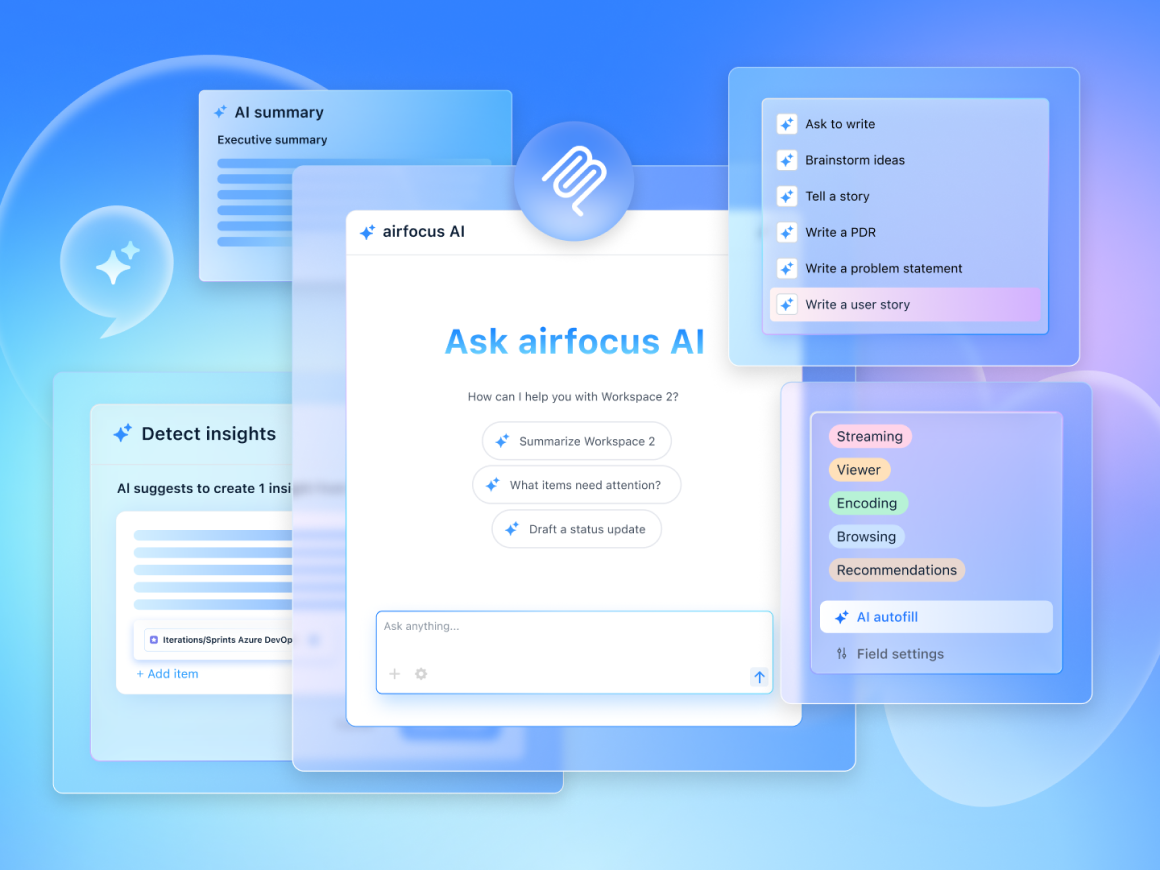
That context might include product strategy, opens in a new tab, objectives, customer feedback, research insights, roadmap items, prioritization criteria, analytics, experiments, and past decisions. Without it, AI risks giving teams plausible but shallow answers. With it, AI can help teams identify patterns, summarize evidence, and make better-informed decisions.
This is why the quality of the product system is so important. If strategy lives in one place, feedback in another, roadmap decisions somewhere else, and stakeholder context in people’s heads, AI has a limited view of the work. The output may be fast, but it may not be grounded.
A product management platform such as airfocus by Lucid, opens in a new tab can help teams centralize and connect product strategy, roadmaps, feedback, priorities, and decisions. The goal isn't to replace human judgment, but to give AI and the people using it a stronger foundation of product context for reasoning.
Better AI-supported decisions require better product context.
Tip #3: Create shared workflows for reviewing AI outputs
AI outputs shouldn't disappear into private prompts, isolated documents, or one-off summaries.
Even when AI produces a useful synthesis or recommendation, product decisions still need to be reviewed, challenged, and refined by human teams. A product manager may use AI to summarize customer feedback, but engineering, design, research, sales, customer success, and leadership may all need to understand what evidence was used and what trade-offs are being proposed.
This is where shared workflows become so important.
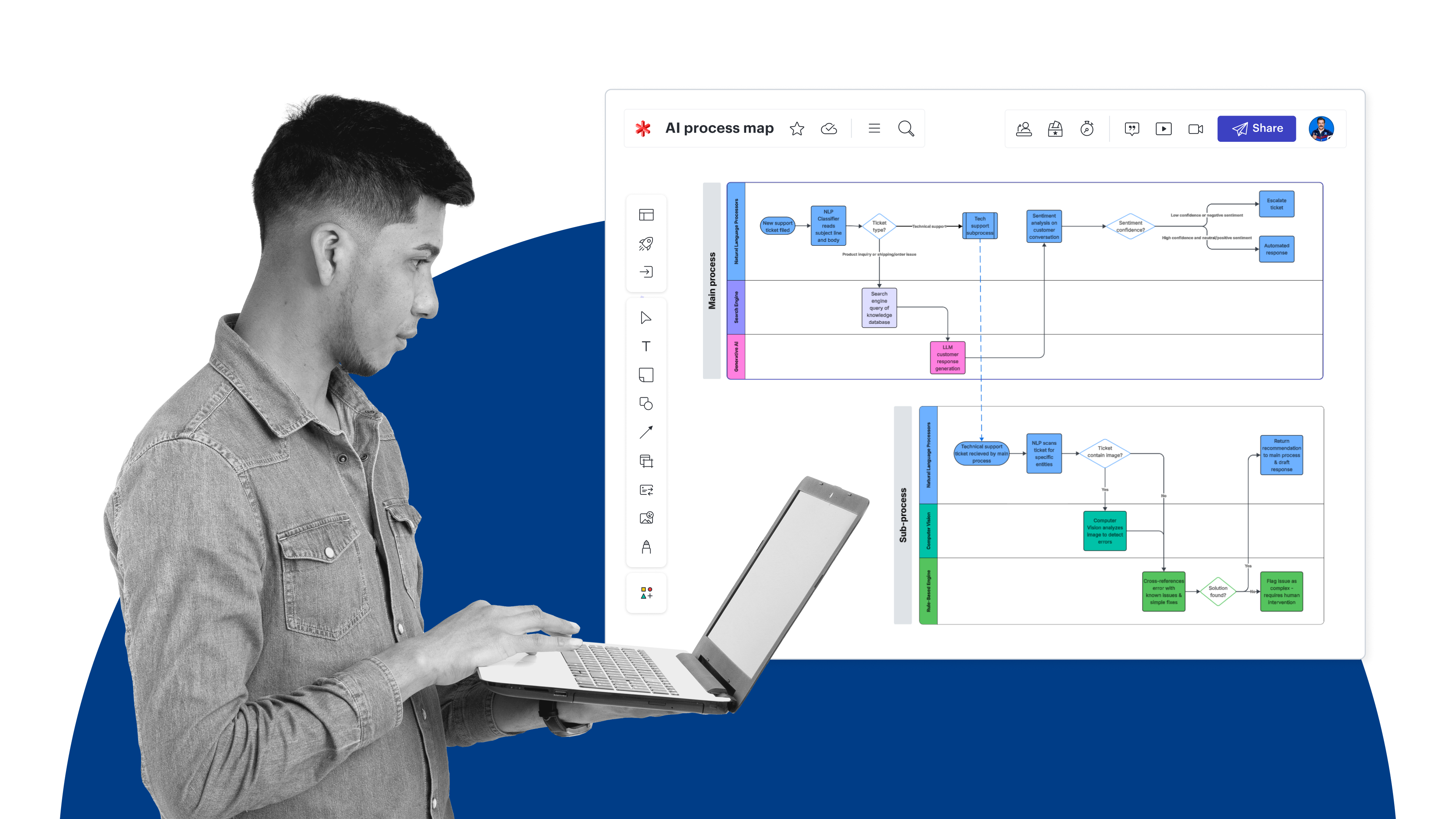
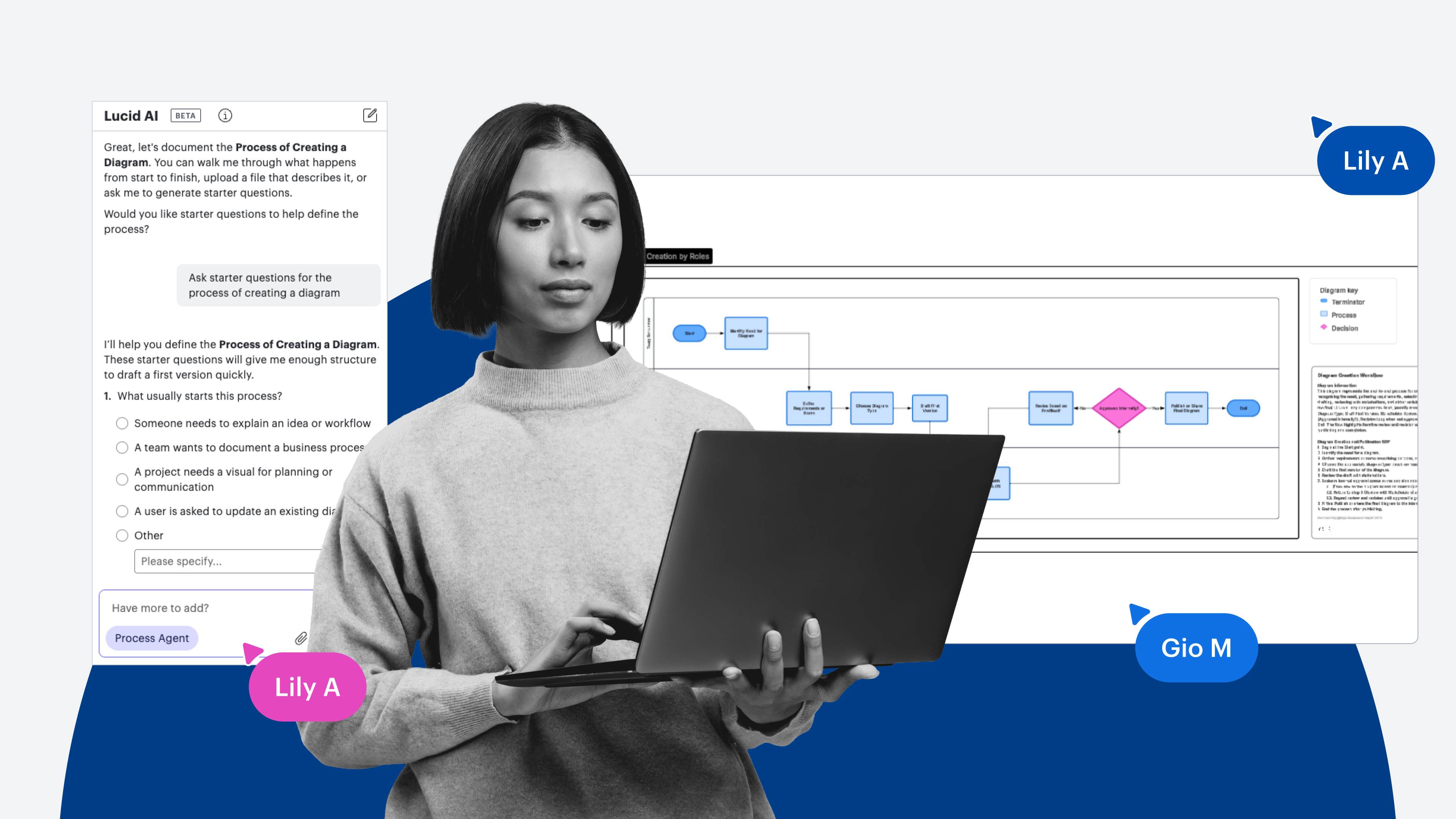
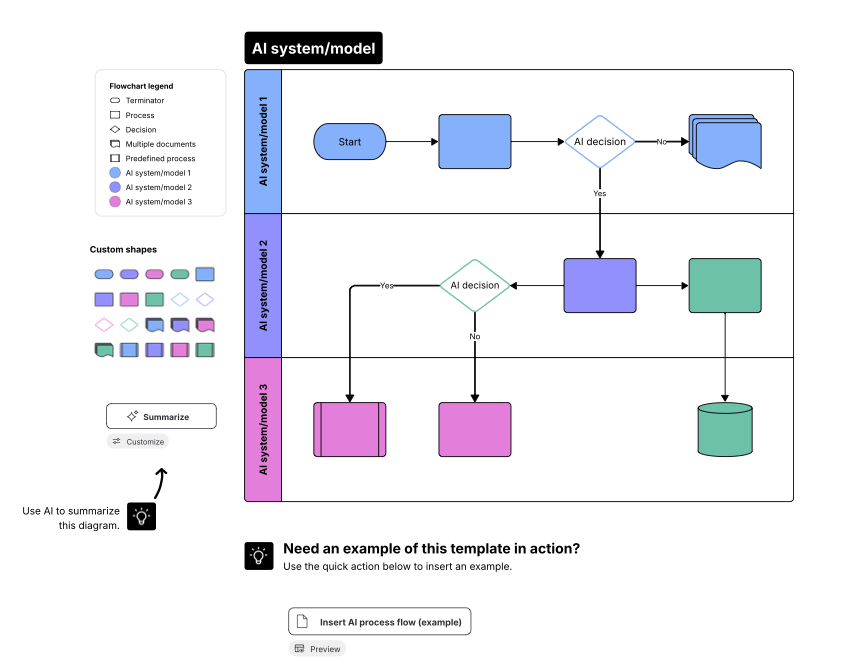
Teams need places where they can review AI-assisted insights together, compare them with strategic goals, surface assumptions, and make decisions collaboratively. That might mean mapping the decision process, documenting how AI is used at each stage, defining review steps, or visualizing the relationships between customer evidence, product opportunities, and roadmap choices.
Lucid can support this kind of work by giving teams an infinite, intelligent canvas to map, document, and improve the workflows around AI-assisted decision-making. An important part of AI readiness, opens in a new tab is not just having AI tools, opens in a new tab, but having shared processes for how teams use, evaluate, and act on AI-supported insights.
Tip #4: Set standards for decision-ready AI outputs
Not every AI output should influence a product decision.
Before using an AI-generated summary, recommendation, or synthesis, teams should agree on what “decision-ready” means. A useful output should make it easier to understand the evidence, identify assumptions, assess risk, and decide what action to take.
Before acting on an AI-supported recommendation, teams can ask:
- What source data did this use?
- Is the data current and representative?
- What assumptions are being made?
- What evidence supports the recommendation?
- What risks or counterpoints are missing?
- Who needs to review this before we act?
- What decision will this actually inform?
These questions help teams treat AI outputs as inputs to judgment, not as substitutes for judgment, and make AI usage more transparent and repeatable across teams.
This clarification is especially important in product organizations where decisions often cross functions. A roadmap decision may affect engineering capacity, customer commitments, sales priorities, support readiness, and company strategy. The more consequential the decision, the more important it is to understand how the AI-supported insight was produced.
Tip #5: Keep human judgment accountable for prioritization and trade-offs
AI can accelerate synthesis and analysis, but it doesn't replace product judgment.
AI is already changing the economics of execution. Coding, testing, prototyping, and content generation are all getting faster. For product leaders, that speed creates a new pressure. If teams can build faster, they need to be clearer earlier about what is worth building.
For years, product leaders fought for velocity, and the enemy was long development cycles, slow handoffs, and features that took quarters to ship. AI is now reducing some of that friction, but the bottleneck hasn't disappeared. It's just moved upstream.
“As an industry, we've spent years talking about velocity,” says Malte Scholz, Head of Product and Co-founder of airfocus by Lucid. “AI just made velocity cheap. The scarce resource now is vector, or knowing clearly enough where you're going before the machines start building.”
This is where human judgment, opens in a new tab remains essential. AI can help identify feedback themes, summarize research, compare opportunities, and generate options. But humans still need to weigh customer value, business impact, feasibility, risk, timing, and strategic fit.
AI can support prioritization, but should not own it.
Tip #6: Measure decision quality, not just productivity
The research shows that product teams already see productivity gains from AI. And while that is useful, it's not enough.
If product organizations only measure AI by productivity, they may miss the more important question: Is AI helping teams make better decisions?
A mature approach to AI in product management should also look at whether AI improves decision confidence, decision speed, stakeholder alignment, quality of insight synthesis, traceability from insight to roadmap, reduction in duplicate or low-value work, and follow-through from decision to execution.
This shifts the conversation from output volume to decision quality.
For example, a team may be able to synthesize customer feedback faster with AI. But the more important question is whether that synthesis helps the team identify the right opportunity, align stakeholders more quickly, and make a clearer roadmap decision.
Productivity is a starting point, but decision quality is the better measure of maturity.
Building AI maturity in product teams
Product teams have already adopted AI, and the next stage is making it trustworthy, contextual, and collaborative enough to support better product decisions.
That stage requires more than better prompts or broader tool access. Product teams need to define the decisions AI should support, connect AI to trusted product context, create shared workflows for reviewing outputs, set standards for decision-ready insights, and keep human judgment accountable for prioritization and trade-offs.
AI can make product teams faster, but speed alone isn't the goal.
The product teams that benefit most from AI will be the ones that use it to strengthen clarity, alignment, and judgment before execution begins. They will be able to move faster because they understand what matters, why it matters, and what evidence supports the decision.
Lucid helps teams collaborate, visualize, challenge, and align around AI-supported insights. airfocus helps teams connect strategy, feedback, roadmaps, priorities, and decisions so AI has the product context it needs. Together, that context and collaboration are what turn AI from a productivity tool into a more trusted part of product decision-making.

Learn how product managers use Lucid and airfocus throughout the full product roadmapping process.
Learn more