Key takeaways
-
SAFe and Scrum are both Agile frameworks that help companies enhance flexibility, alignment, and delivery of value.
-
It’s not really about SAFe “versus” Scrum, but more about choosing which approach is the right fit for your organization’s size, pain points, and goals.
-
While Scrum is practiced at the team level, SAFe is practiced at the program level, with different events, goals, and roles.
Scrum and SAFe are two of the most widely practiced Agile frameworks. According to the 17th State of Agile report, Scrum is the most popular team-level methodology (63%), while the Scaled Agile Framework (SAFe) is the top choice at the enterprise level (26%).
When you want to enhance agility across your organization, how do you know whether SAFe or Scrum is the best choice? And what are the differences between the two frameworks in the first place?
The good news is, it's not really about one framework “versus” the other. SAFe involves many Scrum practices and essentially implements Scrum at scale across an organization. If you’re already familiar with Scrum (or already practicing it), you’re ready to build off of that foundation with SAFe and iterate work up to the program level.
This blog post breaks down the differences and similarities between Scrum and SAFe, including Scrum vs. SAFe roles, artifacts, and events, so you can ensure you’re taking on the best approach to enhance agility at your organization.
SAFe vs. Scrum: The differences
Both Scrum and SAFe provide valuable benefits and help companies solve specific problems. Scrum is a lightweight framework best for small teams, while SAFe implements Agile at the program level, providing structure and alignment for large companies.
Here’s a breakdown of the differences between Scrum vs. SAFe:
| Scrum |
SAFe | |
| Context | Scrum is practiced on the team level and is best for smaller teams/smaller organizations. | SAFe is practiced on the enterprise level to scale and coordinate directives across complex areas. It is best for large organizations with multiple cross-functional teams. |
| Timeline | Scrum teams plan and deliver value within a sprint, which is typically two to four weeks long. | Agile teams plan and deliver value within a program increment, which is typically 8-12 weeks long. |
| Team structure | Scrum teams are made up of about 10 members with a product owner, Scrum master, and developers. | Agile teams are essentially the same as Scrum teams, with additional roles such as business owners, RTE, and solution architect. |
| Events | Scrum has regular events such as daily standups, sprint planning, sprint reviews, and sprint retrospectives. | SAFe keeps many Scrum events at the team level with additional scaled events such as PI planning, ART syncs, and solution demos, which involve multiple teams. |
| Strategy and focus | Scrum focuses on continuous iteration with emphasis on speed, delivery, and customer collaboration. | SAFe focuses on goal-setting based on organizational needs, aligned with the overall strategy of the business. |
| Culture fit | It’s best to use Scrum for small teams, companies in early-stage Agile, and bottom-up rollouts. | It’s best to use SAFe for enterprise organizations that are implementing Agile across multiple departments with a focus on program execution, collaboration, and coordination. |
| Benefits | Scrum creates visibility into the flow of team-level work. Therefore, Scrum provides more project-related benefits, including quick turnaround time, optimized development processes, and increased customer satisfaction. | SAFe creates visibility into the overall business value stream and potential blockers. Therefore, SAFe provides program-level benefits, including enhanced business agility, increased market competition, and consistency and standardization across the organization. |
SAFe vs Scrum: Roles, rituals, artifacts
SAFe and Scrum define different roles, involve different rituals, and produce different artifacts. Here’s what you need to know to transition from Scrum to SAFe.
Roles: Who does what in SAFe and Scrum
In SAFe, team-level roles will remain the same as Scrum, but there are new roles (such as the RTE and program manager) to handle coordination and strategy at scale. Here’s a quick breakdown of who does what in SAFe vs. Scrum.
Scrum team/development team vs. Agile team
In SAFe, an Agile team is essentially the same as a Scrum development team. It involves 5-9 individuals, including developers, a product owner, and a Scrum master. There is no structural change to teams in SAFe, just a change in name.
Scrum master vs. release train engineer (RTE)
In both SAFe and Scrum, a Scrum master coaches a Scrum team/Agile team and facilitates team-level events. The Scrum master role itself is not eliminated in SAFe (each team will still have one), but Scrum masters work in tandem with the release train engineer (RTE).
The RTE is a new addition who essentially acts as the “chief Scrum master” for the entire Agile Release Train (ART), which involves several Agile teams working in tandem. The RTE coordinates across multiple teams at the program level and facilitates events such as PI planning, Scrum of Scrums, and ART syncs.
Product owner vs. product manager
In SAFe and Scrum, each team has a product owner, but there is an additional product manager (PM) role in SAFe that focuses on overall strategy and alignment. The PM is responsible for the program backlog, which is a backlog of features that spans multiple teams. The product manager defines which features need to be built across the ART, while product owners translate those features into detailed user stories for their individual teams.
Additional SAFe-only roles
SAFe has a few extra roles at the program and portfolio levels, which may include:
-
Business owners: The key stakeholders (often executives or senior managers) who guide the ART and ensure it delivers business value
-
System architect/system engineer: An individual who is responsible for designing and sharing the product vision from an engineering perspective
-
Epic owners: The individuals who work at the portfolio level to drive large initiatives or epics from ideation to implementation
Events: The differences in cadence
Traditional Scrum events (such as daily standups, sprint planning, and retrospectives) still happen in SAFe. However, SAFe includes a few extra large-scale events that help everyone realign and refocus.
Sprint vs. iteration
Rather than executing in sprints, SAFe teams execute in iterations that are often two weeks long, similar to a typical Scrum sprint. Traditional Scrum events such as sprint planning, sprint reviews, and sprint retrospectives still occur, but are given SAFe terminology such as iteration planning, iteration reviews, and iteration retrospectives.
Sprint planning vs. program increment (PI) planning
As one of the biggest changes in SAFe, PI planning is a two-day event that happens typically once every 8-12 weeks as the entire ART plans out the next increment of work to be done. PI planning is essentially sprint planning on an organization-wide scale with the goals of establishing PI objectives and crafting a high-level plan for cross-team alignment.
Additional SAFe-only events
SAFe involves a few larger-scale rituals to keep multiple teams aligned. These events may include:
-
ART sync (also known as Scrum of Scrums): Periodic meetings at the program level to ensure teams remain aligned. A Scrum of Scrums (SoS) in particular is essentially a scaled standup facilitated by the RTE where Scrum masters or other representatives from each team share progress, blockers, or scope adjustments.
-
Solution Demo: A new practice that occurs once every two weeks. During this event, the combined work that the ART has delivered so far is shown to stakeholders, providing a full view of progress and verifying that the work is integrating continuously among teams.
-
Inspect and Adapt (I&A) workshops: Large sessions that take place at the end of a program increment. These workshops are essentially large-scale retrospectives and function as an opportunity to reflect and improve at the ART level with all teams and stakeholders involved.
Artifacts: What to plan and produce
There are similarities between Scrum and SAFe artifacts, as well as some completely new ones for SAFe.
Product backlog vs. program backlog
In Scrum, there is a single product backlog that contains desired work to be done. SAFe involves multiple backlog levels to organize work by scope; teams maintain their own backlog of prioritized user stories (much like a sprint backlog). Above that, SAFe also includes a program backlog of features that are intended to be delivered by the ART. Even higher than that, SAFe has a portfolio backlog of epics (large initiatives) that span across multiple ARTs or the entire organization.
Sprint backlog vs. iteration backlog
An iteration backlog is equivalent to the sprint backlog in Scrum, just with a different name. To form an iteration backlog, teams will conduct iteration planning to determine what value they can deliver on during each two-week iteration.
Additional SAFe-only artifacts
A few artifacts that are unique to SAFe include:
-
PI objectives and roadmaps, which are developed during each program increment. Teams set specific objectives that are then evaluated by business owners, connecting team goals to overall business objectives. SAFe also emphasizes having a roadmap to visualize when and how PI objectives will be delivered.
-
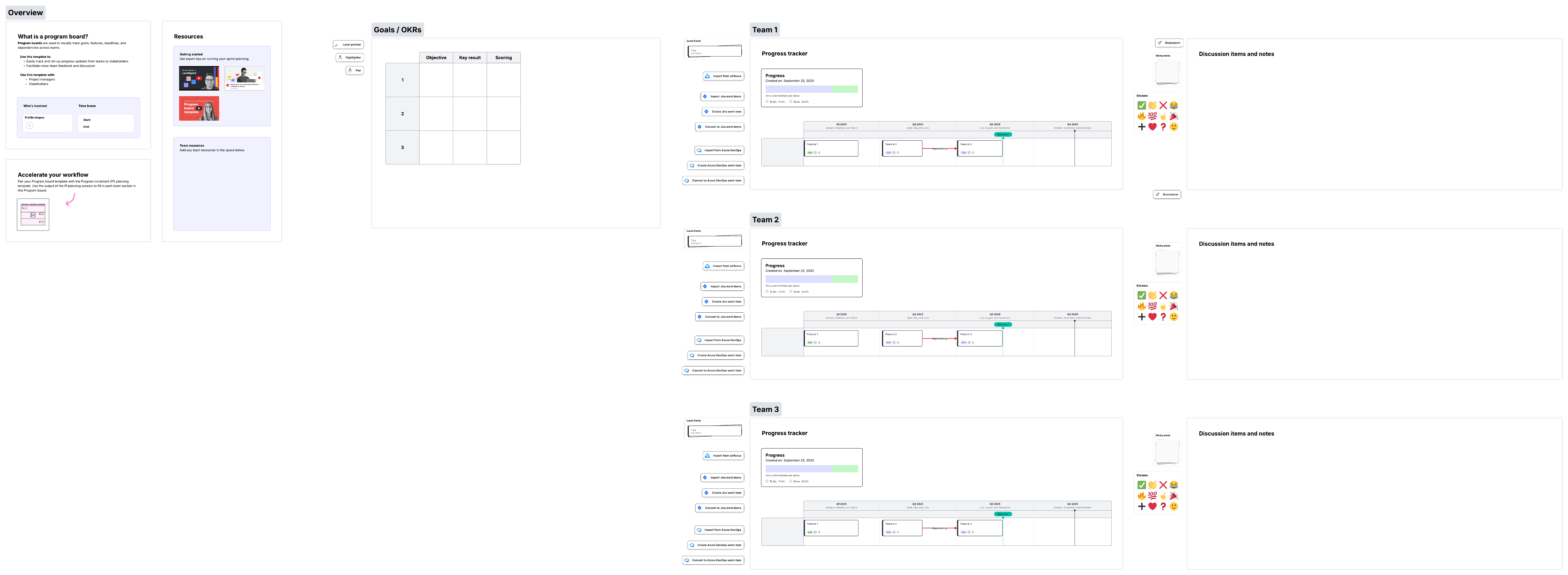
ART planning boards (formerly known as program boards), which are produced during PI planning to show when features will be delivered and map cross-team dependencies. The ART planning board is a new artifact for multi-team planning, and there is no equivalent in Scrum.
Which Agile framework is right for you?
When it comes to deciding between the two different approaches to Agile, the choice will depend on your needs and maturity as an organization. Remember, it’s not really Scrum versus SAFe, but rather a consideration of how your business will change and how teams will need to iterate over time.
Many organizations start with Scrum, then evolve into SAFe, which often works for companies that need to start small and layer on more elements as they scale. Other organizations find that SAFe is easier to implement right away at the program level.
Which one is right for you? Here are a few factors to keep in mind:
-
The size of your company. Scrum is best practiced at the team level and is beneficial for smaller companies made up of a few teams with relatively minor needs for cross-collaborative work. Large enterprises particularly benefit from SAFe, as the SAFe framework helps align multiple departments so your company is delivering value and iterating in tandem.
-
Maturity and where you’re at in your Agile journey. If you’re completely new to Agile, Scrum is a great framework to begin with. If you’ve been practicing Agile for a while and are ready to bring multiple teams together, SAFe can help you with cross-functional alignment.
-
Leadership buy-in. Companies that already have leadership buy-in for agility across the organization can often implement SAFe right away. If you need to do more of a “grassroots” approach and build up to leadership support, doing Scrum in small teams can help you establish a foundation for scaling Agile, opens in a new tab further down the road.
-
Product vision or goals. If your product vision involves frequent feedback loops and flexibility, Scrum helps many teams accomplish this. If compliance and standardization are critical for project execution as you frequently iterate, SAFe helps achieve those goals.
-
Pain points, such as misalignment or inconsistency. Consider which pain points you’re trying to solve by becoming more agile. Is the main problem at the team level, as teams need a better way to consistently deliver value? Or is the problem across multiple teams, and you need a way to align the entire organization? This question is an important factor for determining which framework is the best fit.
3 steps to implement SAFe or Scrum
There are a few things you can do to begin enhancing agility and alignment regardless of whether you’re using Scrum or SAFe across your organization. Follow these steps to standardize and scale your organization’s chosen Agile framework.
Make work visible
Whether you’re practicing Agile with your Scrum team or trying to align across multiple departments, a central space to host documentation helps enhance transparency and understanding. Create a team hub in a visual collaboration solution like Lucid so people have access to the information they need, stay organized, and make decisions together.
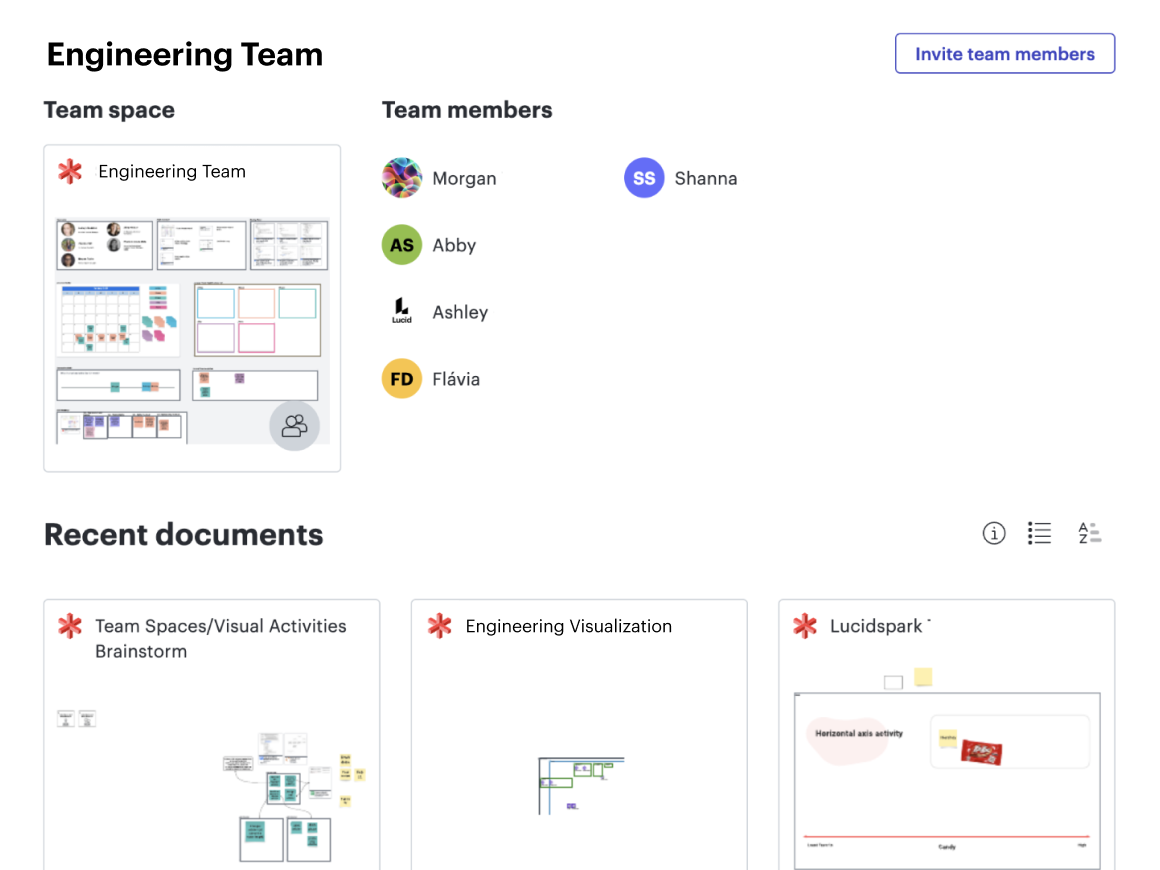
Having a centralized space also helps you establish a single source of truth that cross-functional teams and stakeholders can refer to, which further enhances alignment if you’re implementing Agile at scale.
Use customizable templates
SAFe and Scrum involve different events, but you can effectively host any kind of Agile event with customizable templates that help you quickly get started, whether it’s for sprint planning, retrospectives, or company-wide PI planning.
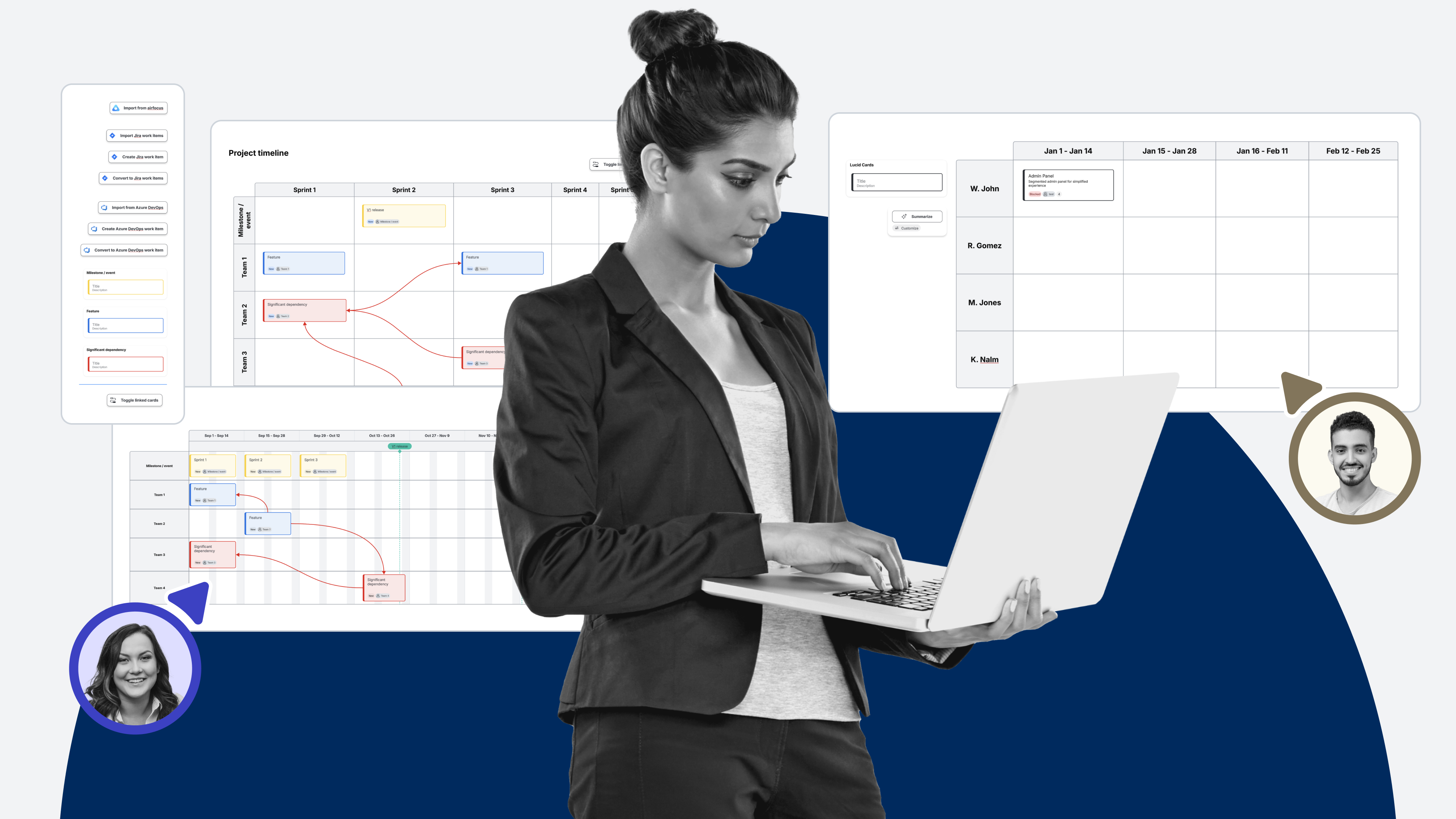
Lucid’s Agile development templates have helpful features like breakout boards, facilitator tools, and dependency mapping to track work and enhance planning. During larger events, such as PI planning, you can break into team sessions while staying in one board, and map dependencies to identify potential risks. With Lucid’s templates, you can enhance the way events are facilitated while increasing understanding and transparency.

Attach your event templates to your team space so it’s easy for everyone to find what they need to host an Agile event.
Enhance transparency and flexibility
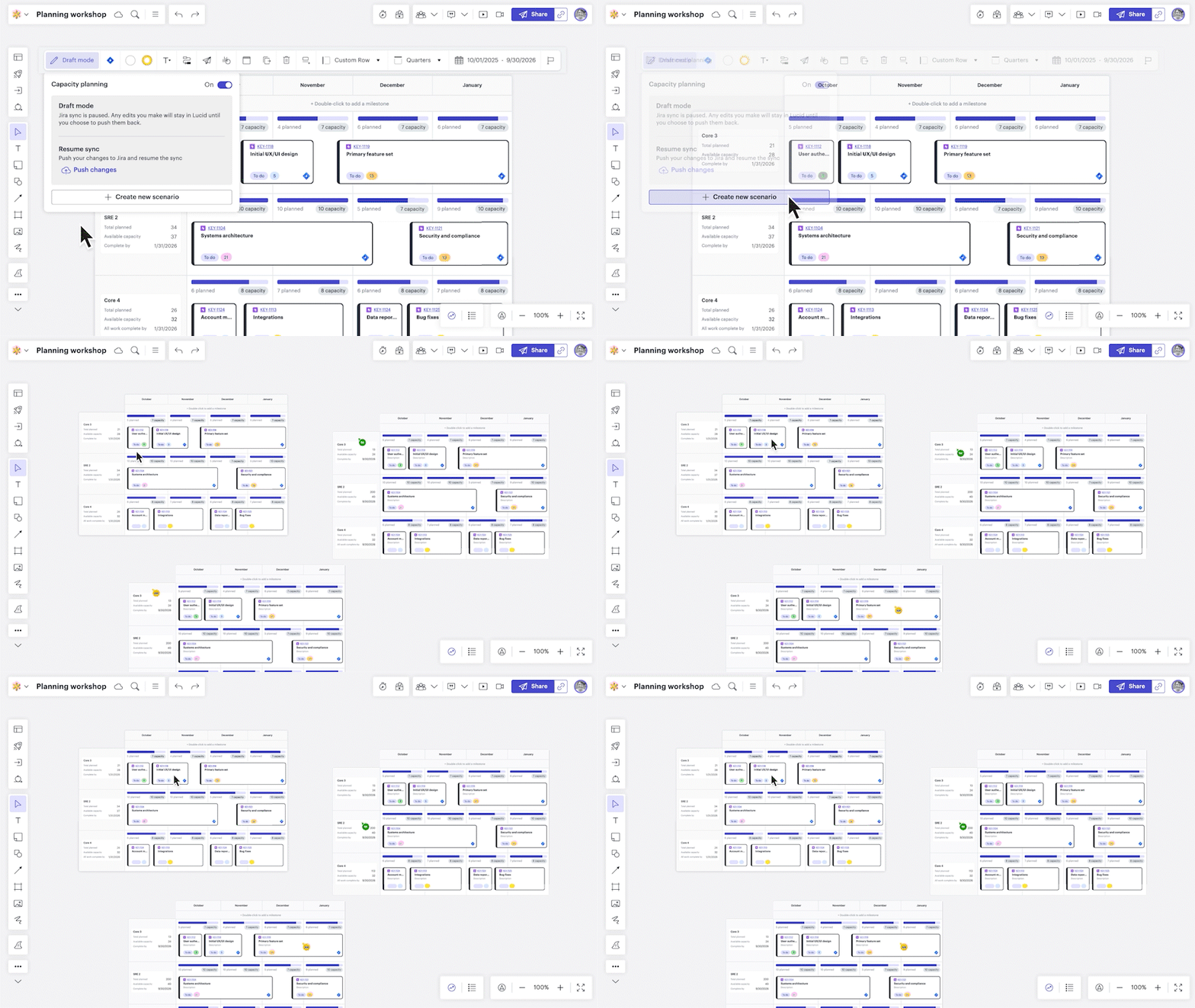
Whether you're conducting sprint planning with a Scrum team or hosting a larger PI planning session, having insight into team capacity is essential. By understanding capacity and proactively accounting for workload in your plans, you can ensure teams aren't overloaded.
In Lucid, you can use enhanced planning features to conduct capacity planning , opens in a new taband determine which teams can take on which tasks. You can also conduct scenario planning, opens in a new tab to inform your overall business strategy as you test multiple possible scenarios and visualize the impact of potential changes.
Whether you're practicing Scrum or SAFe, you can enhance org-wide transparency and adaptability as you ensure teams work at an efficient, sustainable pace.
How visual collaboration supports organizational agility
Understanding the differences between Scrum and SAFe—and using one framework over the other—often boils down to whether you need to enhance alignment at the team or program level for your organization. Whether you practice sprint planning among Scrum teams or scale planning to inform iterative work for the whole org, the ultimate goal of each framework is to increase adaptability, flexibility, and delivery.
Regardless of the Agile approach you choose, Lucid helps companies improve alignment with customizable templates, enhanced features, and specialized support. Check out how Agile teams can use Lucid regardless of where they are in their journey, and see how you can boost transparency and alignment for your organization.
How Agile teams use Lucid
Learn why Lucid is the end-to-end solution for Agile teams that work efficiently and aim to continuously improve.
Read more