
Key takeaways
-
IT cost optimization shifts organizations from operating defensively to offensively. The goal is to invest in tools that drive revenue growth and long-term ROI.
-
Optimization is different than cost-cutting. To identify optimization opportunities, organizations should focus on identifying underutilized tools, systemic process redundancies, and gaps between a tool’s cost and its impact.
-
To optimize your spend, you must identify a dedicated tool champion, use hard data to score a solution’s ROI, and perform a “delete test” to determine whether to keep or cut applications.
The term “cost optimization” is often viewed as simply being a “nicer” way to talk about cost-cutting. When revenue dips or the market changes, of course leadership teams may have to consider cutting costs. But the two are actually different, and viewing IT cost optimization through a purely defensive lens is a missed opportunity for growth.
What is cost optimization?
True IT cost optimization is not about spending less; it’s about spending better. Optimizing costs is a strategic move to free up capital and create reinvestment opportunities. While the goal of cost-cutting is to lower costs and save funds, the goal of cost optimization is to maximize the multiplier—generate a higher return on each dollar spent.
Optimization involves looking at hidden costs in your budget.
-
Cloud waste: Paying for compute capacity that you aren’t using
-
Tool sprawl: Having multiple tools that do the same thing
-
Legacy tax: Keeping old software alive because it feels too difficult or time-consuming to upgrade
IT cost optimization vs cost-cutting
To understand the difference between cost-cutting and cost optimization, consider this car analogy that David Torgerson, VP of Technology & Security at Lucid, shares:
-
Cost-cutting is like removing the back seats of a vehicle to make it lighter and to save on gas. Yes, you’ll save money at the pump, but you’ve reduced the car’s utility in the process. You can’t carry the same number of people or the same amount of luggage anymore. Your operating costs may be lower, but it’s also now a less capable vehicle.
-
Cost optimization is like fine-tuning the car’s engine. There may be a significant upfront investment of time or money, but the result is a vehicle that goes faster and farther than ever on the same amount of fuel.
The cost-cutting fallacy
If a company is solely focused on spending less, it’s often a sign of a deeper organizational issue—usually declining revenue or strategic reinvestment in higher-priority initiatives. When you cut licenses for productivity tools without a plan, you may save money, but you incur an opportunity cost as you lose productivity and effectiveness.
True optimization isn’t defensive. It’s proactive, freeing up capital for innovation and current market needs. Or, as Torgerson explains:
“The goal of optimization isn’t to cut costs—it’s to get the ROI from the multiplying impact.”
Red flags to watch out for
Even the most efficient organizations have blind spots, so every business can be more optimized. Here are four signs that your organization needs optimization:
-
Ghost tools: If a software suite can save your team 10 hours a week but isn’t used, that investment is a 100% loss. Are there tools that team members have access to that they don’t know about, don’t know how to use, or don’t see the value of?
-
Value blindness: Many leaders judge an investment solely by its price tag rather than its impact. Cheaper is rarely better when it comes to ROI, so choosing the least expensive solution is rarely the best choice.
-
Micro-lens trap: Organizations often invest significant time and money to make a process faster, when they should be asking whether the process is supposed to exist at all. Organizations need a broader perspective to remain efficient and innovative. In fact, Torgerson shares: “The number one fallacy that holds people back from cost optimization is looking at small, broken pieces instead of systemic issues.”
-
Sentiment over data: Software decisions should be made based on whether a solution drives a trackable percentage of revenue, not just how the team feels about it. You should invest in impact first, then sentiment after.
Cost optimization process checklist
Use these IT cost optimization strategies to begin auditing your solutions.
1. Identify a tool champion
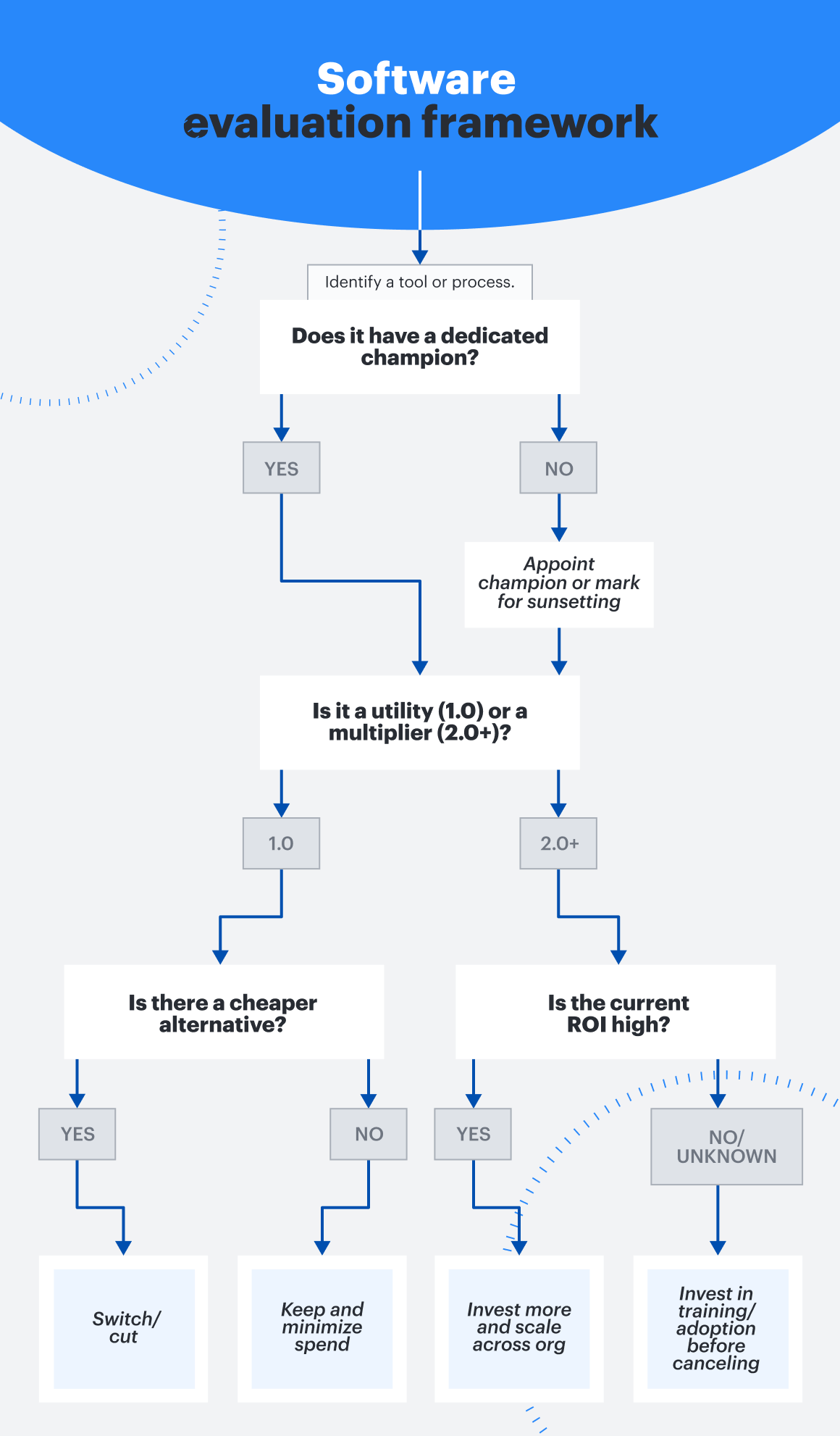
Every piece of software in your stack needs a champion to drive adoption and best practices. If no one is responsible for “owning” an application, the tool is more likely to go underutilized and should be a candidate for cutting.
2. Score the tool’s ROI with hard data
Work with your champion (in large orgs) or observe usage organically (in smaller orgs) to estimate the tool's return. To avoid spending based on opinions, require your champions to provide data on their use cases, not just preferences. You can ask them questions like:
-
If we lost this tool tomorrow, how many hours of labor would you lose?
-
How often do you use the tool?
-
What points in the day or week do you find yourself using the tool?
From there, determine the tool's value. Keep the following value framework in mind:
-
1.0x value: For every $1 you spend, you get $1 in basic service (e.g., email, cloud storage). Applications like email and cloud storage are value-neutral and are good candidates for cost-cutting if you can find a similar application that’s cheaper to use.
-
2.0x value: For every $1 you pay, you get at least $2 of output (e.g., dev tools, automation, CRM). These are your “multipliers” and are good candidates for optimization.
Note: If a 2.0x tool has a 1.0 usage score, your first move shouldn’t necessarily be cancellation but should be holding a training session to unlock more value. Torgerson elaborates, “The answer isn’t to cut costs; it’s to push people to use the tool more so they can be more productive.”
3. Conduct a delete test
Before you try to fix a process, try to eliminate it entirely first and see what happens. This approach targets the manual “middle man” work, or those redundant tasks where a human is simply moving data or bridging a gap that technology could potentially handle natively. If you can connect your systems directly, the process and tools associated with it become obsolete and should be removed altogether. If you learn that the task cannot be automated, it becomes a prime candidate for optimization.
4. Final verdict: Keep, cut, or train
Once you have a champion, the tool’s ROI, and delete test results, you must take one of these actions:
-
Keep: If the tool is a necessity but offers basic 1.0x value, keep it but mark it for annual review to ensure you still have the most affordable contract available.
-
Train: If the tool has high potential but low usage, hold a mandatory training session led by the champion. Then, re-score the ROI later.
-
Cut: If a tool has no champion, provides less than 1.0x value, or fails the delete test by proving its associated process can be connected while eliminating the middle-man work, sunset it immediately. Use the extra budget to fund the 2.0x “investment” tools.
Move from defensive to offensive with strategic IT cost optimization
The ultimate goal of IT cost optimization is to shift from merely surviving to executing growth strategies offensively. By viewing productivity software like Lucid, Jira, or Asana as multipliers rather than expenses, leadership isn’t just saving money, they’re investing in the speed and agility required to do their best work now and in the future.

Dive deeper into cloud waste with our guide on cloud cost optimization.
Read now