Key takeaways
-
Efficiency does not equal productivity. Real productivity lies in the clarity of work and the measurable value delivered to the business, not how fast teams can produce code.
-
Prioritize team alignment over individual metrics. Build teams around a shared mission of collective ownership and empowerment.
-
Leverage visual collaboration throughout the development lifecycle. Identify blockers, evaluate workloads, and promote alignment by bringing teams together in a visual workspace.
Improving developer productivity is a growing concern among engineering leaders. According to Gartner®, “Leaders are struggling to meet growing productivity expectations, with the same survey showing more than 80% of engineering managers (respondents) at least somewhat agreeing there is a significant opportunity for their teams to be more productive.” But as engineering organizations move away from the “growth at all costs” mindset, we’ve entered a leaner, more scrutinizing reality focused on profitability and value.
As a senior engineering manager at Lucid, I’ve seen how easy it is to mistake speed for success. We’re surrounded by a lot of great tools promising to accelerate our output, with AI leading the charge, but one thing that often goes unnoticed is this: Efficiency and productivity are not the same.
So, the answer to meeting growing productivity expectations goes far beyond adding another app to your tech stack. And while leveraging AI can accelerate activity, it doesn’t automatically guarantee a better product. Using more tools can create a productivity paradox where we move the needle without advancing the business.
Improving developer productivity has become more critical than ever before, driven by heightened stakeholder expectations due to the hype around AI tools. Over 67% of software engineering team managers at least somewhat agree that AI has increased pressure to improve developer productivity at their organization, according to respondents to the 2024 Gartner Improving Engineering Team Productivity and Leadership Survey.
– Gartner, “3 High-Impact Non-AI Strategies to Unlock Developer Productivity Gains,” June 27, 2025
Measuring productivity for engineers is difficult. Lean too hard on the wrong metrics, and you quickly go from motivational to unhelpful incentives. But productivity can no longer take a back seat. The catalyst for this shift is twofold. First, the industry has shifted its focus from primarily emphasizing growth to achieving sustainable profitability. Second, AI has provided a high-priced model for speed, claiming to yield strong productivity gains. When models come with high usage-based price tags, leadership naturally expects a clear ROI.
However, actual productivity doesn’t lie in producing a higher volume of code but rather in the clarity of the work being done.
That’s why I sat down to share my thoughts on how to bridge the gap between leadership expectations and the reality of the developer experience. My goal with this piece is that you walk away with tangible tips on how to make productivity an organizational standard rather than a source of friction. And it all starts with your teams.
Developer productivity and why it matters
As I mentioned earlier, efficiency and productivity are not the same. Efficiency is about minimizing waste, whereas productivity is about maximizing output, specifically maximizing the meaningful output and value delivered to the business and its customers.
Gartner notes, “Developer productivity is ultimately not about the volume of work but about how software engineering work impacts business outcomes. While operational efficiency enables teams to deliver more and faster, it doesn’t automatically translate to high-impact software that generates greater business value.”
The emergence of AI has placed efficiency at the forefront of people’s minds, but it can be an expensive solution. Because AI tools for developer productivity are often usage-based, like Claude and Cursor, engineering leaders must justify the additional spend by proving that a tool drives tangible results. However, tools (AI or not) are secondary to culture. True productivity is a team sport; it involves collaborating to solve complex problems rather than focusing on how fast an individual contributor can generate lines of code.
Spending time empowering your teams to reach your productivity goals helps build a sustainable, synergetic, and safe place to work. Developers thrive when they feel effective. High-performing teams are more likely to set ambitious goals, whereas stagnant productivity often leads to missed deadlines, dissatisfaction, and burnout. Productive, happy teams have a certain dynamism that propels organizations forward. These are often the teams that attract the best talent and inspire big ideas.
To give a real-world example, let’s take a look at Lucid’s engineering org. Last year, we set a lofty goal to improve productivity in the second half of the year. Through that process, we learned a critical lesson: The metric is not the goal.
We tracked metrics like pull request throughput as an indicator of health, but we never mistook the indicator for the objective. A ton of code changes doesn't necessarily mean we're delivering more value. It’s easy to unintentionally "game the metric," creating the illusion that productivity is up when, in reality, we’re not adding value to the business.
So how do we focus on actually improving developer productivity?
How to improve developer productivity
In the world of engineering, I often observe a discrepancy between intuition and data. Numerous claims suggest that AI is the magic bullet for engineering output, alongside other tools, and on the surface, many developers believe that’s true.
However, our data at Lucid told a more nuanced story. We found that productivity improvements were not necessarily highly correlated with AI usage alone. While AI helps us with specific tasks, such as producing and reviewing code, planning work, and learning about new technologies, it doesn’t automatically solve the systemic bottlenecks that actually slow teams down.
Improving developer productivity is a balance between leadership alignment and individual empowerment. If you want to double the productivity of the organization, you have to double the productivity of each individual. But that can quickly become a toxic environment, so we intentionally avoided measuring people against each other to prevent unhealthy competition. The focus must remain on personal improvement.
Here are some actionable ways to align your teams with leadership productivity goals and enhance performance at the individual level.
Clearly communicate business goals
Leadership noticed the most significant jump in productivity when we began treating it as a shared mission across all our teams. When we announced our goal of increasing productivity for the second half of the year, it wasn’t just an executive mandate but the start of an organization-wide conversation.
Awareness is the first step toward alignment. If your developers don’t understand that leadership is committed to productivity and why, they won’t appreciate or recognize the investment in the initiative.
But communication alone isn’t enough. We had to provide the infrastructure for success. At Lucid, we have a dedicated engineering team that focuses on the developer experience rather than shipping product features. They are tasked with identifying and integrating efficient tools into the workflow to improve developer productivity.
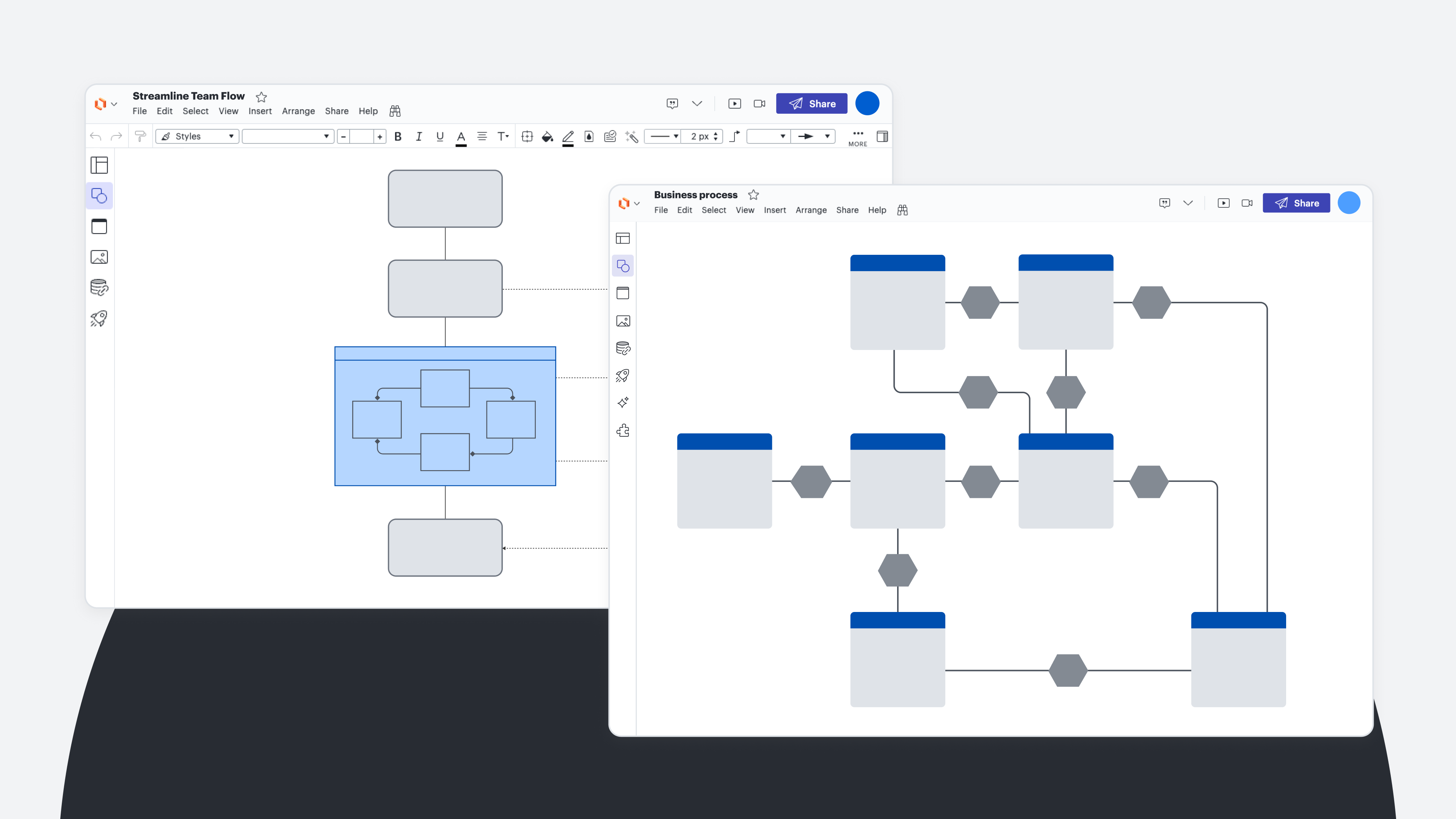
And what better way to do this than to use our own product? Using Lucid to document and map business goals has been a game-changer for alignment. By creating a central source of truth to house our strategy, we make our goals clear and visible to every engineer in our org so that they can see how their work connects directly to the broader business objectives. When the path from a pull request to a business outcome is visually mapped, the “why” becomes undeniable, and that has been the ultimate productivity booster.
Empower developers to make strategic decisions
Once business goals are made clear and accessible, we can then focus on empowering our teams to make strategic decisions based on those goals. Part of that is setting individual goals that directly correlate with the broader team, department, and company goals.
The Lucid engineering org sets our OKRs in airfocus because it works seamlessly with Lucid to drive alignment and provide a single source of truth across product teams, keeping everyone informed.
When we make focus and clarity the standard, productivity follows. Individuals are at the core of achieving broader goals, and it is up to leaders to provide the necessary framework for that to happen.
Decision-making is often where productivity stalls due to analysis paralysis or a lack of feedback. Our team moves past these roadblocks by using Lucid to make the impact of a decision visible before a single line of code is written. By mapping out technical dependencies and user flows visually, developers can see exactly how a change in one area affects the entire ecosystem.
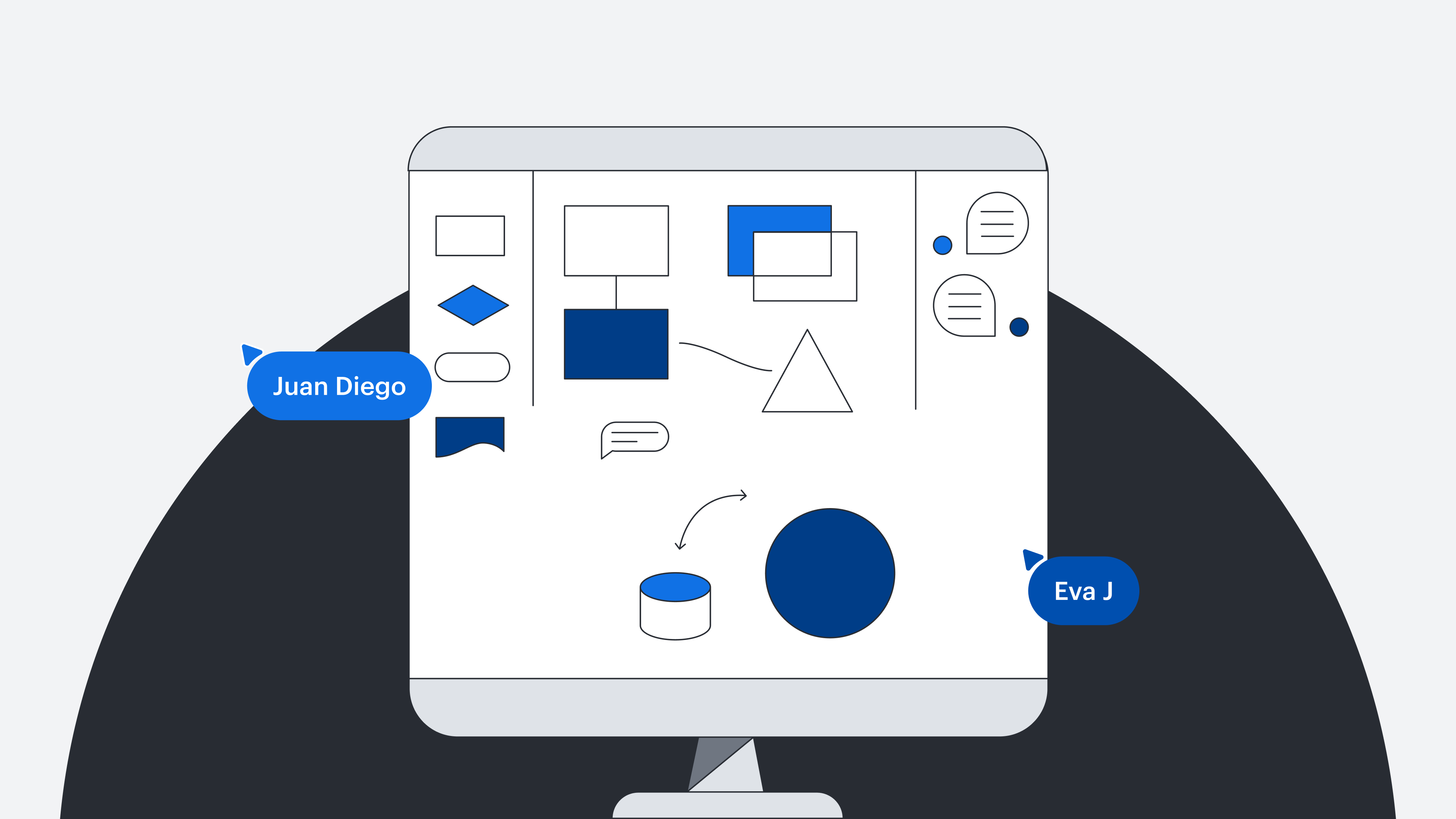
We also use Lucid’s Visual Activities to capture rapid team feedback and reach a consensus. Instead of long, circular email threads or unproductive meetings, we use these interactive frameworks to instantly gauge the team’s stance on a technical direction.
When developers can visualize their impact, they don’t just work faster, they work more strategically.
Consider the development lifecycle
Productivity shifts based on where your team is in the development lifecycle. And your productivity needs will change accordingly.
In my org, we view the development cycle as an infinite loop where discovery informs execution, and execution reveals new opportunities for further discovery. Lucid’s visual collaboration features can benefit your team at each of these stages.
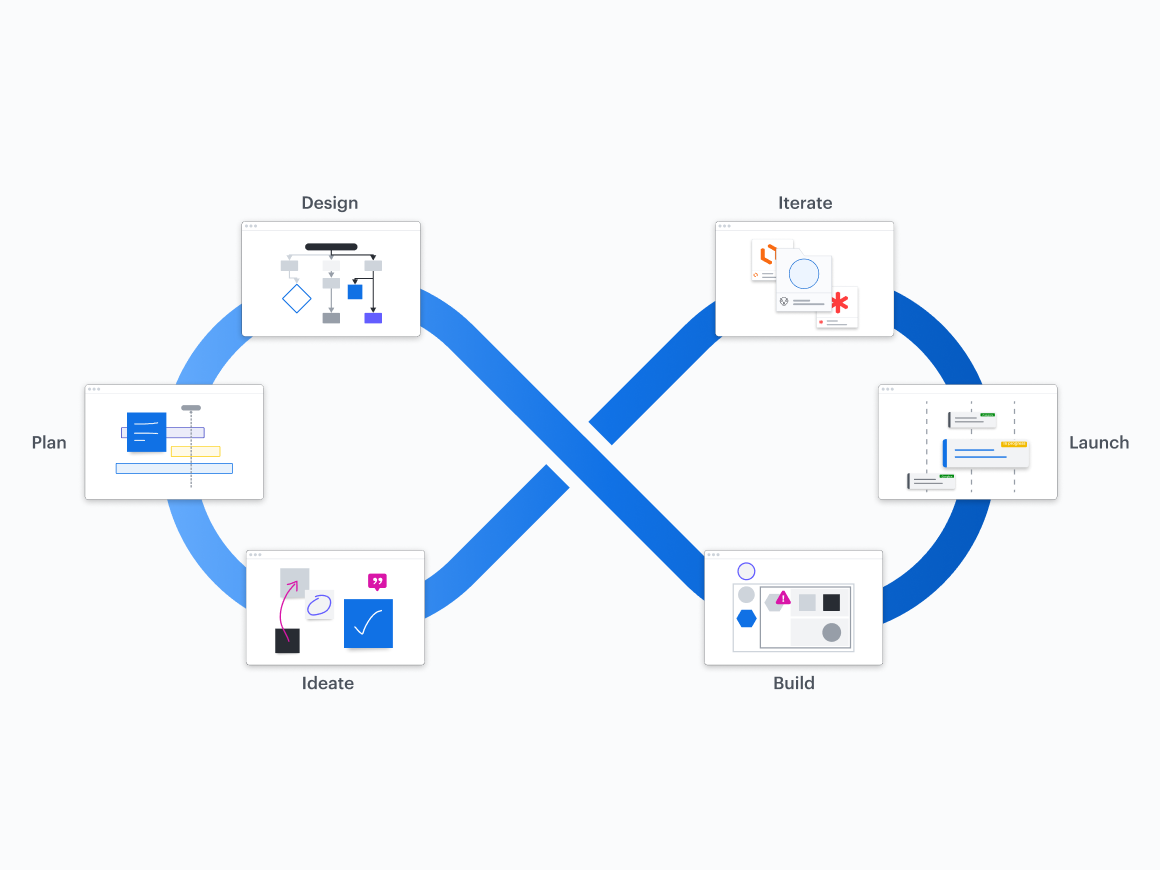
Strong coordination and collaboration are imperative for the discovery and execution phases.
Discovery phase
In the discovery phase, the goal is to validate your ideas as quickly and cheaply as possible.
Focus: Rapid learning, divergent thinking, brainstorming, and testing ideas
How we do it: In this stage, my team collaboratively builds a proof of concept, shares pilots with customers, and gathers feedback. This information is housed in a Lucidspark board, where we can leave feedback and vote on the best course of action to move forward.
Execution phase
The execution phase shifts to improving specific, system-level metrics, such as faster response times and increased rendering performance.
Focus: Deconstructing complex work to enable the team to collaborate without compromising quality. The challenge here, however, is balancing the launch of new features, fixing bugs, and addressing technical debt.
How we do it: In Lucidchart, we visualize our resource allocation and system architecture. When everyone can see our current and future state, they can better understand where to focus their strategy. To keep asks reasonable and prevent overwhelm, we also conduct capacity planning meetings for each sprint to ensure that people have the necessary resources to focus on their priorities.
Identify critical blockers
Productive, high-performing teams focus on reducing the obstacles in their way. You don't want to focus a goal on the one most important thing at the expense of everything else you've built so far.
But you can’t fix what you can’t see. Here’s how I, along with my colleagues, have used Lucid to gain visibility into these blockers at every stage of the development lifecycle:
-
Visualizing friction and misalignment: Org charts help us visualize how people are connected within our organization. Process maps identify where the bureaucratic red tape is slowing down deployments.
-
Asynchronous collaboration: Keeping information centralized to reduce ineffective meetings and empower asynchronous work. Teams can provide feedback at their own convenience, thereby preserving time for in-depth work.
-
Open feedback: Visual Activities and retrospectives enable teams to anonymously rank blockers and vote on the most pressing technical debt, providing a pulse on our organization’s overall health.

Develop a mindset around continuous improvement
True productivity is achieved through consistency, not a single, strong sprint. Teams need to move away from reactive troubleshooting and toward a mindset of continuous improvement.
When processes are siloed or living in a developer’s head, velocity stalls. This is why documentation is key. Leveraging capabilities like Lucid’s Process Accelerator, teams can transform abstract workflows into accessible, living documents. This ensures that every team member, from senior architects to new hires, has an immediate line of sight into how the org operates.
But documenting how we do things is only part of the battle. You must also connect high-level strategy to team-level execution. In Lucid, we created standardized templates to give every team a starting point without sacrificing flexibility. Once consistency is established, leaders can utilize capacity planning to leverage data-backed insights, ensuring workloads are balanced and achievable. With features such as scenario planning, we made productivity and scalability a reality.
Here are a few other tips to consider for encouraging continuous improvement:
-
Facilitate mentorship opportunities.
-
Encourage work-life balance.
-
Set healthy working boundaries.
-
Foster team connection with team activities.
-
Provide creative outlets.
The pressure to deliver "more, faster" is a permanent fixture of the modern engineering landscape, but adopting every tool that promises efficiency is rarely the answer. Investing in a proven, intuitive platform, on the other hand, is money well spent.
Real growth happens when you empower your developers with the clarity to make strategic decisions and the infrastructure to collaborate asynchronously. By shifting the focus from individual metrics to organizational alignment—and using visual tools to map the journey—you don’t just move the needle; you advance the business. It’s time to move past the productivity paradox and build a culture where efficiency and innovation exist in lockstep.

Explore how Lucid helps engineers maintain accuracy, velocity, and standardization.
Read moreSource: Gartner Report, 3 High-Impact Non-AI Strategies to Unlock Developer Productivity
Gains, By Akriti Kapoor, Raveena Gandhi, etc, June 2025.
Gartner is a trademark of Gartner, Inc. and/or its affiliates.