Brainstorming is a common way to generate ideas—but it isn’t always the most effective method. Despite its popularity among businesses across industries, brainstorming has a number of disadvantages, from inefficiency to social anxiety, that may not make it the best choice for your team.
Luckily, there is another way.
Brainwriting is an idea generation technique that complements and, in many cases, improves on the traditional brainstorming model.
Here’s how to use brainwriting to generate more (and better) ideas fast.
What is brainwriting?
Brainwriting is an alternative method to brainstorming. It is a technique for rapid idea generation that eliminates many of the pitfalls of traditional brainstorming meetings.
There are a few different ways to approach brainwriting, but the basic method is as follows:
- Each person writes down their ideas in response to a question or problem.
- When finished, they pass their paper to the next person who then reviews the ideas and adds to them.
- Once the papers have made a full round, the team shares all the ideas (usually on a whiteboard).
Brainwriting vs. brainstorming
Typically during the brainwriting process, there is no conversation. Everyone is quiet and focused on committing their ideas to paper. Only after all the ideas have been recorded does the team begin sharing and discussing the group’s responses.
This is unlike brainstorming, where the group bounces ideas off one another out loud in no particular order.
Both techniques help teams generate ideas quickly, but brainwriting has some advantages over traditional brainstorming sessions.
Benefits of brainwriting
Brainwriting has several benefits and advantages over brainstorming.
- Faster, more efficient idea generation
- Less social anxiety and competing personalities
- Often yields more diverse and creative ideas
- Avoids falling into group-think consensus
Because brainwriting has everyone write down their ideas at the same time, the process often generates more ideas faster.
Additionally, brainwriting is a more inclusive approach to idea generation because it gives everyone an equal opportunity to participate and share their thoughts.
In a traditional brainstorming session, it is easy for dominant personalities to, well, dominate the conversation. This can discourage more introverted team members from contributing. With brainwriting, that pressure to speak up is relieved and there is less focus on any one individual’s ideas.
Brainwriting also helps increase creativity and reduce anxiety because people can submit their ideas anonymously. Because no one’s name is attached to the ideas, people tend to be less self-conscious about sharing off-the-wall solutions. Plus, when no one has to vie for the spotlight, there’s less social anxiety over looking foolish in front of their peers or boss.
Finally, the brainstorming technique sometimes limits the variety and quality of ideas because the first ideas often become the focus of the discussion. It can prevent team members from adding new ideas because the group has already come to a consensus. Brainwriting ensures all ideas are shared and considered before the team begins honing in on any one solution.
When to use brainwriting
Brainwriting is a great alternative to brainstorming, especially when you have a mixed group of personality types (i.e., introverts and extroverts) or those who think better on paper first.
It’s also a good choice if you don’t have an experienced moderator to keep a lively brainstorming session on track. With brainwriting, most of the work is done quickly and quietly on paper, so it’s easier to stay focused on the question or problem at hand.
How to use brainwriting
As noted earlier, the brainwriting technique is pretty simple. Everyone writes down their ideas and shares them (sometimes passing the papers around for the team to build on).
To ensure your brainwriting session is a success, follow these steps:
1. Clarify the rules and parameters
Explain to the team what technique or process you will be following. Are there specific rules or parameters they should adhere to when generating ideas? For example, you might limit the number of ideas to 5 per person or allow only certain types of answers.
2. Identify the problem or question to be answered
Next, identify what problem you are trying to solve or what question you want the team to answer. This is the prompt for the brainwriting process.
3. Have participants write down their ideas in a set amount of time
As the brainwriting leader, you will keep time. Most brainwriting sessions are short and sweet. If you are having team members pass their cards to the next person for another round, shorter time limits work best (e.g., 3-5 minutes per round).
4. Share all the answers in one place
Once the ideas are recorded, share them in one place. If you are all together in one room, writing the ideas on a whiteboard or taping the notes to the wall is an easy way to present everyone’s ideas.
You can also use a collaborative tool like Lucidchart to record ideas in a shared virtual whiteboard. An online whiteboard works especially well for remote or distributed teams who need to collaborate and stay on the same page. It’s also great for in-house teams where people can add ideas or notes anytime even after the official brainwriting meeting has ended.
Brainwriting techniques
There is more than one way to approach brainwriting. Other common brainwriting variations include:
- 6-3-5 brainwriting
- Collaborative brainwriting
- Remote brainwriting
The method you choose will depend on your team and specific goals.
6-3-5 brainwriting
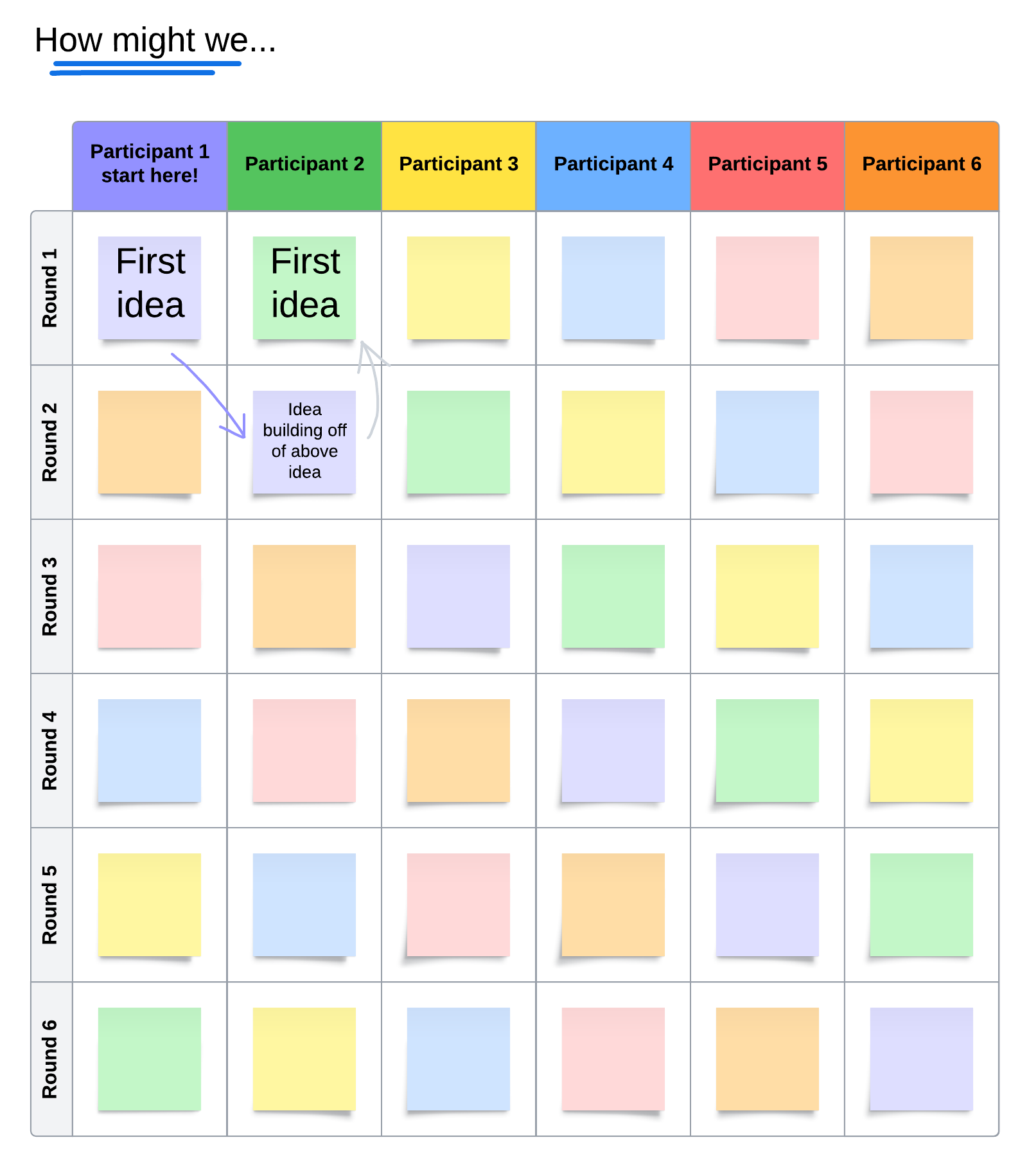
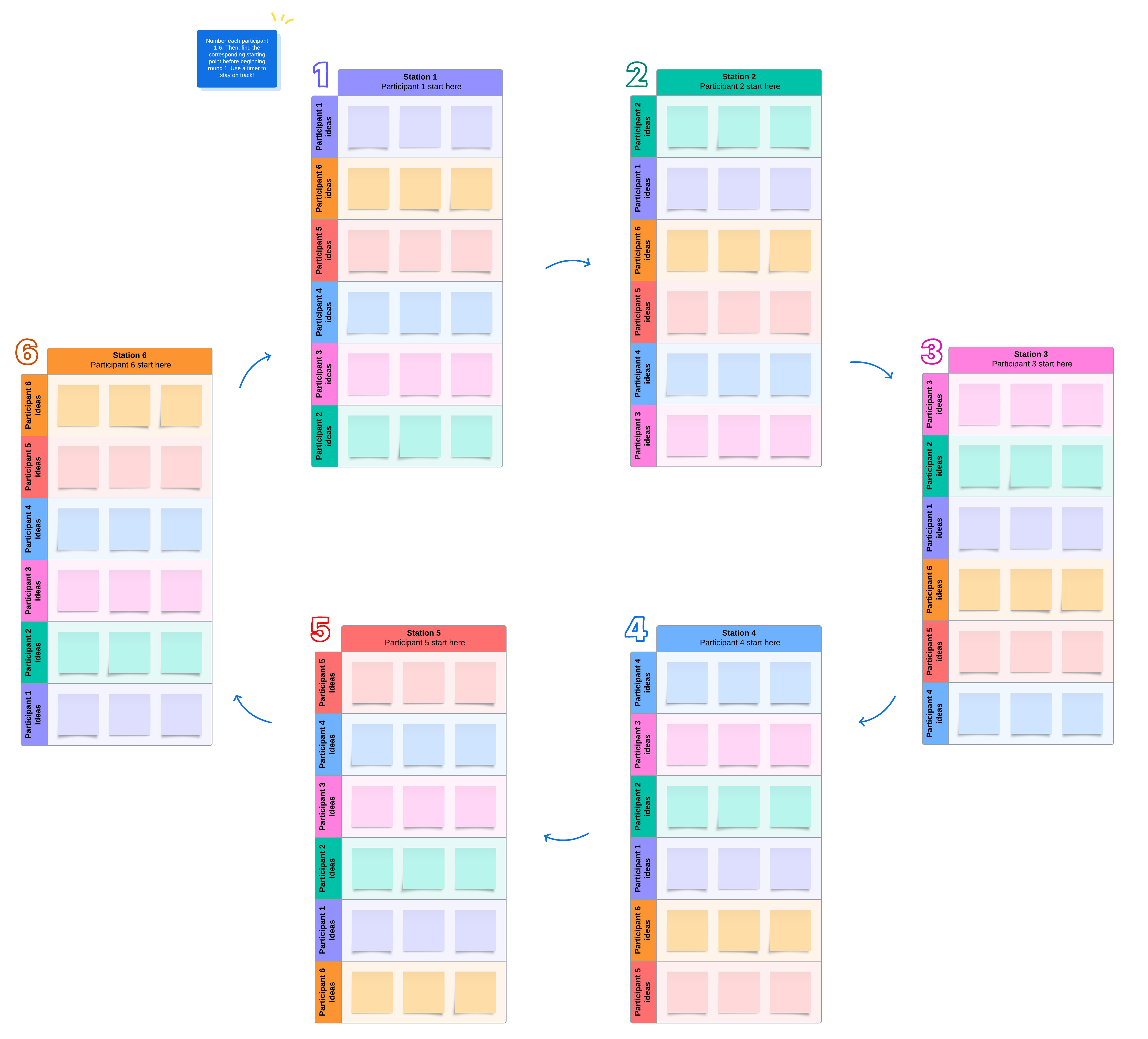
This is a straightforward variation of a basic brainwriting session where you have a group of six people write down three ideas in five minutes on a worksheet. When the five minutes is up, each person passes their sheet to the next person to add another three ideas, and so on.
This process lasts for six rounds (until the worksheet is filled up and each person has their original paper back—filled with ideas). By the end of the process, you should have 108 ideas written down and ready to review.
The 6-3-5 method is a good option if you have a large group of people you want to get ideas from. Simply break the team up into groups of six and off you go. It makes the idea generation (and sharing) process much simpler among a lot of people.
Collaborative brainwriting
If you want to avoid a formal meeting, collaborative brainwriting is a good alternative. In this process, you select a space (a wall or whiteboard for example) that is easily accessible by your team and post a prompt.
Then, throughout the day or week (whatever timeframe you choose), your team can add ideas to the board as inspiration or convenience strikes.
This method is more flexible and low-key, which can work better for those who prefer to think through problems in their own time without the pressure of other people or the clock.
Remote brainwriting
Similar to collaborative brainwriting, remote brainwriting provides a simple method for remote teams to generate and share ideas effectively.
Typically, the process follows the collaborative method where a question or problem is posed and the team can respond within a certain timeframe. The difference here is that the platform for sharing ideas is virtual.
Common remote brainwriting tools or platforms include:
- Instant messenger
- Blogs or wikis
- Google spreadsheets
- Virtual whiteboards like Lucidchart
If you decide to use remote brainwriting, consider doing a test run first to work out any technical difficulties and determine the guidelines and best practices that will work best for your team.
Brainwriting is a simple and effective technique for generating many high-quality ideas in a relatively short amount of time. Combined with a team-building brainstorming session, and you will be well on your way to your next great ideas.

Use our brainstorming software to gather multiple perspectives and generate ideas faster.
Learn more