Imagine you’re starting a company. You’ve already hired your first 50 people, you’ve got a clear idea of what to build, and you have the finer points of your competitive advantage mapped out. The problem is that, while you’ve had meeting after meeting about your core values and key differentiators, it seems that members of your team are still at a loss.
That’s likely because of a lack of effective communication. Good communication—even sometimes overcommunication—is crucial for keeping your team aligned, no matter what changes may arise in the business.
We’ll walk you through how to overcommunicate without overcomplicating things, which is especially important in today’s remote and hybrid work environments.
What is overcommunication?
Overcommunication tends to get a bad rap, but overcommunication isn’t just an excess of talking. Rather, it has three important key traits:
- It reinforces important messages
- It relays key information
- It helps everyone stay on the same page
Think back to the last time you had a difficult class in high school. If you had an exceptional teacher, you probably learned a concept by:
- Hearing about it
- Doing homework on it
- Studying it in groups
- Writing about it
After approaching a complicated concept in multiple ways, you were able to better understand it. That’s because you were given enough reiteration for the information to sink in.
As another example of when overcommunication can be a good thing, think back to a time in your work life when you were part of a complicated project. You may have had an initial brainstorming meeting, a kickoff meeting, many tasks, many check-ins, and many standups. If you overcommunicated throughout the project, everyone likely understood the assignment and stayed aligned.
How overcommunication can turn into overcomplication
In the above examples, overcommunication led to a positive outcome. But you’re probably also remembering a time when there was so much communication, that everything felt like it took twice as long. That’s because overcomplication set in.
Here’s what that overcomplication can look like: Pretend you’re in charge of naming your newest product. At the first meeting, you’re told what you’ll be naming and what the deadline is for the new name. Your project manager suggests you work with a naming agency. Then you’re asked to poll internal stakeholders about their preferred names, and you’re told to turn that poll first into a document and then into a slide deck. At the next check-in, your manager asks you to turn a brainstorm into a mood board.
The naming agency, meanwhile, presents you with a spreadsheet of competitive analysis. In the following weeks and months, a fairly straightforward task becomes mired in tasks and last-minute additions and meetings and standups. Worse, every time someone is taken off the project or added to the project, they need to be brought up to speed, which bogs the process down even more. Something that should have taken a week ends up taking a whole quarter.
Overcomplication is when you create extra steps that aren’t necessary.
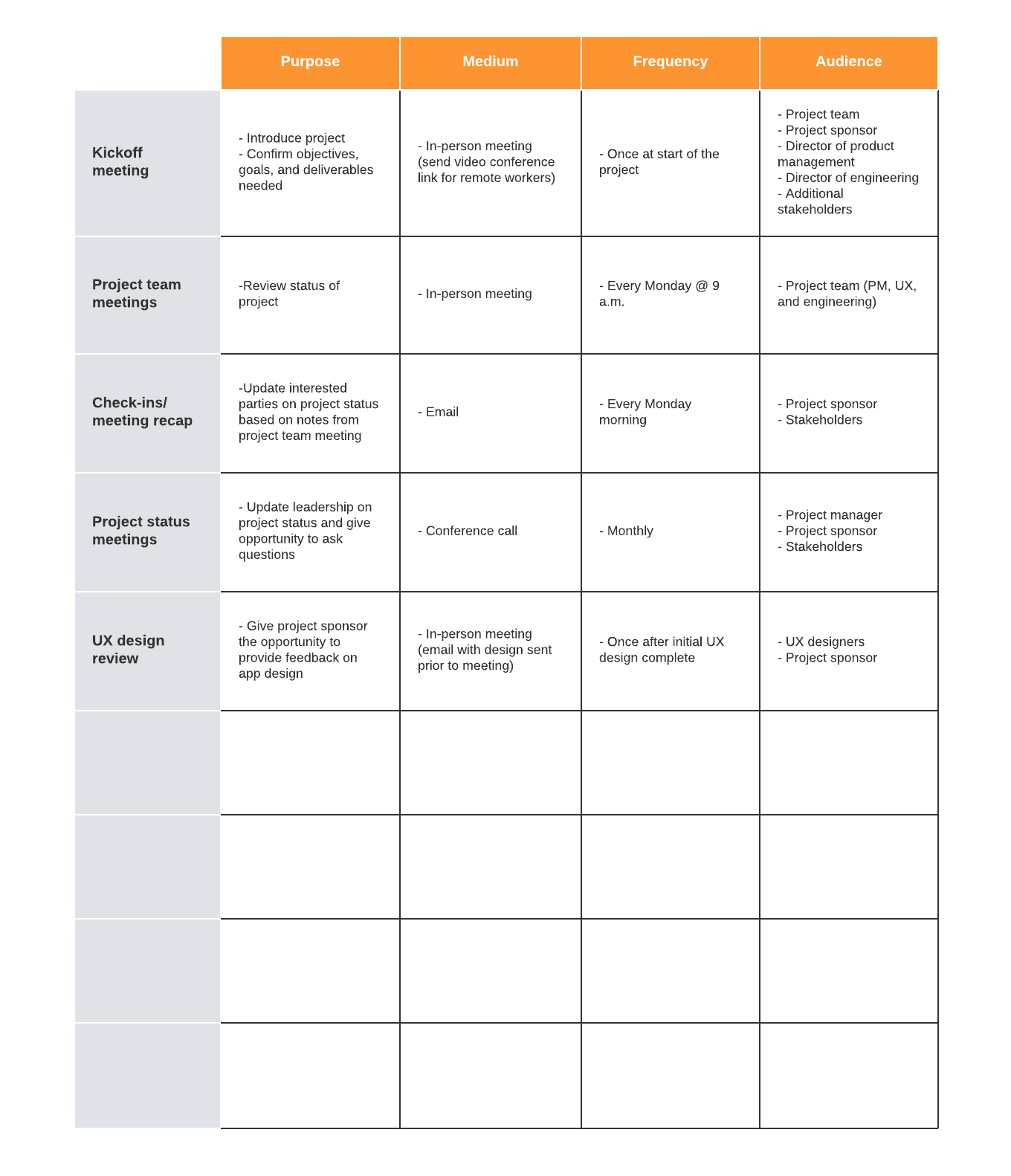
You may consider using a communication matrix like the one below to determine which steps are necessary and which aren’t.
Best practices for effective communication
If the line between overcommunication and overcomplication seems overwhelming, here are best practices to ensure you’re leaning towards effective overcommunication.
- Simplify your message- Before you communicate anything, think about the core of your message. Can it be simplified or more clear? If you’re uncertain if your message is getting across properly, try this: ask a team member to repeat the message back to you in their own words, according to their own understanding. If they’re off base, it’s time to simplify the message even further.
This also doesn’t need to be limited to just complicated projects. Simplifying your message should hold true for communication of all types. Look at your emails, for instance. Are you writing multiple paragraphs? Try to shorten your emails and get to the point.
- Clearly state goals and next steps- The clearest, most aligned meeting or email means nothing if no one knows what to do with the information. At the end of your meeting, have goals and next steps written out and accessible to everyone.
- Keep communications timely- Can you remember what was in your kickoff meeting three weeks ago? Likely not. So if you’re sending a communication about that meeting, make sure it happens close to the meeting itself.
- Conduct a communications preferences audit- The way your team communicates likely varies from person to person. An audit is how you make your communication preferences appropriate for everyone.
Learn how different team members prefer to receive feedback and instructions, then keep that noted for easy access. You may default your communication through messaging but discover that a certain team member prefers a phone call. This allows you to communicate efficiently without adding complexity.
- Pick the right communication channel- You should know how your team prefers to communicate, but you should also be able to discern which channel is appropriate for the content you’re trying to communicate.
For instance, if you’re communicating a casual, everyday message, it’s appropriate to use Slack or Microsoft Teams.
If you’re communicating something more serious, consider a video conference or phone call where appropriate.
- Document your communication- Documenting your communication makes sure you know what you said, who you said it to, and when it was said. This is important to keep everyone accountable and iterate on your processes for greater efficiency in the future. Keep running agenda documents or notes for everyone to reference as a single source of truth, then keep everything in the cloud for easy access.
Overcommunication without overcomplication is key to helping everyone feel engaged and informed so they have ownership over their role. You’ll find your projects go smoother and everyone is able to work with greater clarity.

Improve your internal communication in eight steps.
Learn more
