Do you remember the last time you set foot in a bank? If you’re like many people, it’s probably been a few years. That’s because the majority of things we used to visit the bank for—depositing checks, transferring money, setting up automatic payments—are all now available as online processes. In fact, some banks don’t even have traditional branch locations; they’re entirely digitized, and that’s what customers have come to expect.
And yet, while many businesses have moved online, their internal processes remain stuck in the past. To help prevent your business from being left behind, here’s a great primer on how you can use digital transformation to meet evolving customer demands and keep pace with the changing world of modernization.
What does it mean to take your business digital?
The digitalization of business processes means documenting the processes you’re currently using in a cloud-based, visual platform so that the processes can be perfected while harnessing technology to automate and streamline those processes, creating a digital work culture.
There are three types of digital processes:
-
Operational processes: An organized set of activities that result in a specific product, service, or business methodology.
-
Management processes: Setting goals, leading the organization, and executing activities and tasks.
-
Supporting processes: Processes that support the core functions of running the business itself.
Advantages of business process digitalization
Business process digitalization can be a lot of work, but it’s worth it. And it’s a necessity. If you don’t, you’ll be at a distinct disadvantage to your competitors—a disadvantage that could ultimately force you out of business.
Beyond that, there are some other critical advantages to the digitalization of business processes.
Everything is stored in the cloud
Having a cloud-based business helps you maintain your documentation library and unlocks the agility of your processes. Document redundancy is important. If a document lives on a single hard drive, the likelihood of something happening to the physical hardware is pretty high and that could mean the loss of valuable information.
Cloud storage also means that when a document is updated by one person, it’s updated for everyone in real time. No more worrying about outdated or inaccurate information.
Everyone can access the necessary information
Keeping everyone on the same page can only happen when information is stored in an accessible place, such as the cloud. Allowing your team members access to the information they need keeps business moving and sets the standard for a single source of truth.
Consider this: If your customer has a question about a return and all returns information is kept in an internal wiki, it’s easy for a customer success team member to access that wiki page and quickly provide accurate return information. Without that ease of access, your team member has to ask someone else—which could mean relying on third-hand and potentially inaccurate information—or spend valuable time hunting down documentation. When information is digitized, it can be disseminated instantly.
Adapt faster to agile environments
An agile team should embrace change and quickly adapt while focusing on continuous improvement. A business that isn’t digital is as inflexible and fragile as the antiquated systems it relies on. Digitalization allows for processes to be changed quickly and for every team member to immediately see that change, which helps support Agile benefits such as improved communication and better risk management.
Reduce operational costs
Remember what it used to be like to get a car insurance quote? It involved calling in, speaking to a customer representative, getting a quote over the phone, and then signing documents by mail. That cost the car insurance company significant money. Each quote represented a significant investment in time and resources.
Now, thanks to online quotes, a single car insurance business can use algorithms and machine learning to provide quotes instantly without human intervention, and unlimited quotes can be provided online to any number of customers. It costs much less money to operate the business, and there’s a much higher conversion of customers.
Apply that same strategy to processes across your business. Process digitalization can lead to decreased human interference, lower cost, maximized efficiency, and reduced errors.
Accommodate flexible work
In today’s world, flexible work is not a novelty: It’s an expectation. Flexible work policies, such as remote work options and having a distributed team, enable businesses to access top talent anywhere in the world. This flexibility also limits the amount of money invested in office space and similar overhead.
The caveat is that in order to accommodate remote workers, a business must be entirely digital. Every process needs to be replicated and accessible online. That means your business should invest in digital tools such as video conferencing, digital task management systems, cloud-based storage, online HR systems, instant messaging, and more.
How to make your processes digital
Since you know your business best, you’ll also know how best to convert to digital processes. This isn’t an exhaustive list, but here are some ways to get started:
Determine the end state and go from there
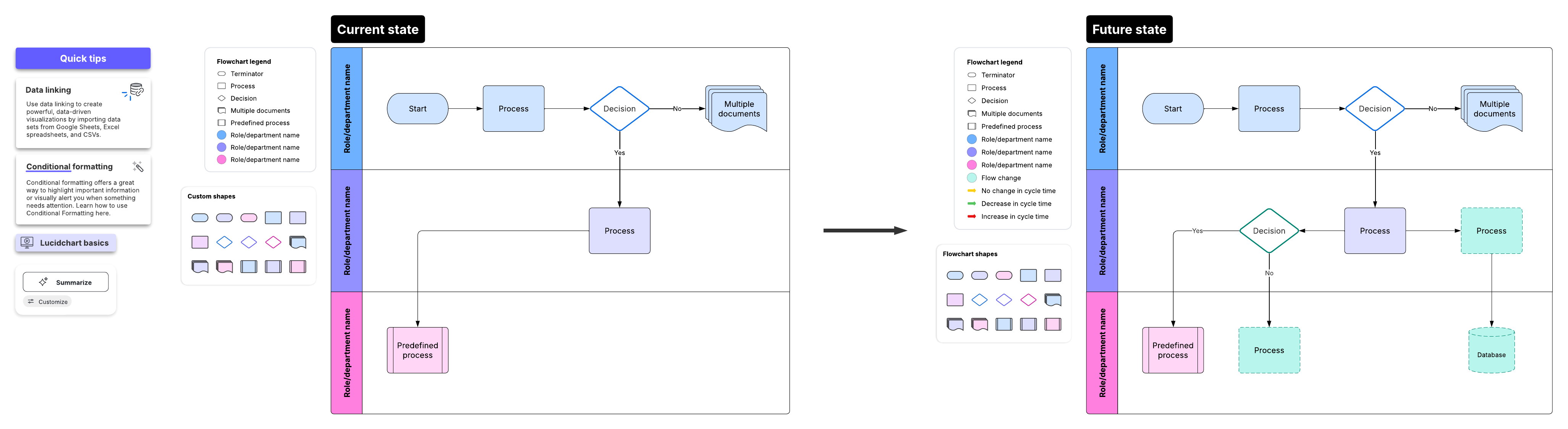
In other words, work backward. Document what your ideal business would look like with a future state flowchart. Your future state goals don’t have to be limited by what’s currently realistic. Once your dream business outcomes are documented, you can begin to examine the steps it will take to get there.
Think about your users first
The digital transformation of your internal processes is ultimately meant to benefit your customers. So start with determining what ideal user experience you’d like to create, document it, and then work on building processes or improving existing processes to make that ideal experience a reality.
Rethink how you roll out new processes
It’s one thing to purchase a digital task management system and quite another thing to get your team to use it. Once you decide how you’re going to bring on new systems and processes, you’ll need to determine how they’ll be successfully integrated into your business and evangelized within your teams. It’s important to communicate and ensure that each team understands the plan for rolling out a new work process, the estimated timeline, and how the change will affect them.

How to implement new work processes
Learn the 7 key steps for successfully implementing a new process at your business.
Read moreMove all process documentation online
Digital processes won’t work unless they're documented and consistent across the business. Document each process, then host it in the cloud so that it can be accessed and referenced as a source of truth.
Lucid’s Process Accelerator helps businesses standardize how processes are documented and stored. With Lucid, you can not only move all your processes online, you can make updates to documentation faster and define a standard for visualizing processes throughout your entire organization. This makes it easier to build a library of assets and ensure consistency across the board.
Examples of making processes digital
Overwhelmed? Don’t be. Here are some ways to convert your current processes to digital ones:
-
Sprint planning: Sprint planning can easily be documented and hosted in the cloud.
-
Digital whiteboarding: Think brainstorms can only be done in person? Think again.
-
Onboarding: Onboarding doesn’t have to happen in the office. See how you can upgrade your onboarding processes.
-
Strategic planning: Leaders can use digital templates to identify goals, establish action plans, and track progress.
Remember that digitizing your business practices isn’t a one-time thing. To keep your business successful, you’ll need to continuously update and adapt your processes to keep up with the current technology-driven environment. But the good news is that, once you’ve accelerated your business processes, you’ll have the confidence and the skills to continually evolve.
What’s stalling your digital transformation?
Are you feeling stuck on digitalizing your business? Get key tips on resolving common digitalization issues in this blog post.
Read now