When collaboration isn’t working—either in our interactions with a single person, within a team, or across a company culture at large—we often look to external factors we can easily fix and hope that will solve the problem. That might look something like this:
- “We’re having a hard time understanding each other when we communicate asynchronously—let’s buy this popular new tool so we can communicate better.”
- “I’ve noticed we’re routinely not aligned on priorities and strategy even after lengthy planning sessions—let’s add another coordination meeting to the calendar to make sure we’re on the same page.”
- “That project didn’t go as smoothly as we would have liked—let’s reorg the team and change the reporting structure to make sure it goes better next time.”
The problem with this approach? Adding new tools, more meetings, and making endless template tweaks only keeps teams focused on surface-level symptoms. Instead, teams need to invest in the deep, uncomfortable human work that’s required to improve collaboration.
And when it comes to that human work, understanding your own collaboration style and the preferences of the people on your team is one of the highest leverage activities we can do to improve how we collaborate.
“By enabling the collaboration styles, teams can create an environment that minimizes worker frustration but maximizes contribution.”
– Nathan Rawlins, CMO, Lucid
Our research found more than half of knowledge workers identify with one of three collaboration styles: introspective, expressive, and relational. Let’s explore what these styles mean for your own working preferences—and then dive into how you can work best with someone who has a different style from you.
Understanding how you work best: What’s your collaboration style?
When teams understand each other better, they are able to eliminate resentment, blame, and bad interpersonal habits that get in the way of effective collaboration because they aren’t just immediately writing off teammates as “bad collaborators.” And this road to understanding starts with a self-awareness of your own style.
As we dive into the three most common collaboration styles, it’s important to remember: There is no “right” or “best” collaboration style. Simply knowing your collaboration style—regardless of what it is—can help you do more satisfying and effective collaborative work with your teammates.
Curious to find out what your collaboration style is? Take our 2-minute quiz and find out!
Take the quizIntrospective collaborators
If you are an introspective collaborator, deep work is your jam. You thrive when given an opportunity to think on a topic and do your own research, writing, and ideation—as opposed to a live brainstorming session where you are expected to come up with ideas off the top of your head.
As an introspective collaborator, you tend to prefer:
- Working alone before validating your ideas with a group
- Tackling complex problems that require lots of deliberate thought
- Pre-work and thorough agendas before meetings
Relational collaborators
If you are a relational collaborator, you value human connection as one of the most important parts of collaboration. The tools you use to collaborate are less important than having face-to-face time with your teammates, where you can make sure everyone is heard and aligned.
As a relational collaborator, you tend to prefer:
- Meetings where you can work meaningfully together with teammates, especially in smaller groups
- Time for connection before getting to the “content” of the meeting
- Collaboration tools that are easy to understand and use
Expressive collaborators
If you are an expressive collaborator, nothing gets you more excited than visual engagement and freewheeling brainstorming. Expressing yourself with visuals, sticky notes, emojis, and GIFs unlocks your creativity, and you think most clearly when you can sketch out your ideas. As an expressive collaborator, you tend to prefer:
- Tools that let you diagram, draw, and make visual connections
- Sharing ideas in active meetings and riffing off-the-cuff
- Having creative freedom to go off in unexplored and unconventional directions
How does your collaboration style diverge and align with other styles?
Let’s dive into the relationships between each of the three styles, their natural areas of tension and common ground, and some collaboration resources that can help them work best together.
The relationship between introspective and relational collaborators
Where they diverge:
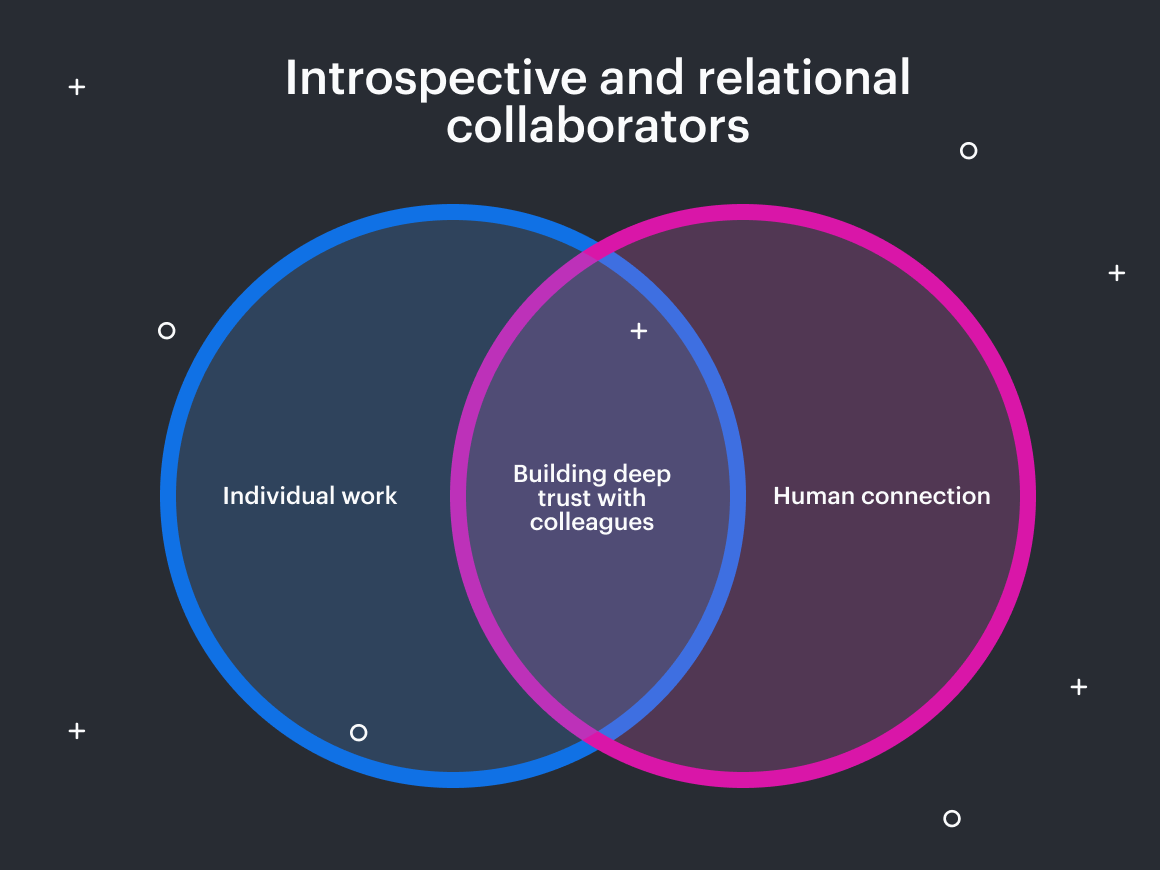
Because introspective collaborators are more naturally introverted, they may not need as much human connection as relational collaborators do to feel like they are contributing and connected to the team.
Where relational collaborators feel most collaborative when working with teammates to get aligned face-to-face (whether in-person or over a video call), introspective collaborators prefer quiet, reflective time to validate their ideas before feeling prepared to open up to their team. The types of small-group meetings that relational collaborators thrive in might be intimidating to introspective collaborators if they haven’t been given what they feel is appropriate time to prepare for the discussion.
Where they align:
Though they approach it in slightly different ways, both introspective and relational collaborators value establishing trust with colleagues. For an introspective collaborator, that trust and respect might come through dialog and discussion around another teammate’s research, writing, and educational pursuits. For a relational collaborator, that trust might come more from personal vulnerability.
Both styles are also likely to resent loosely structured or poorly facilitated meetings where deep value and alignment are not realized.
Though introspective collaborators like to do work on their own before collaborating with the team, they still need to validate ideas with their peers, and relational collaborators can be thoughtful partners for this.
Strategies and techniques to help introspectives and relationals work better together:
- Be prepared: Sharing a thorough meeting agenda (that an introspective collaborator can dive into beforehand) and keeping diligent meeting notes (so relational collaborators can review a history of their discussion to ensure alignment) will accommodate both collaboration styles.
- Try brainstorming with brainwriting: One way to encourage live human interaction and build connection without overwhelming introspective teammates is with a brainwriting activity. Teammates start by silently writing ideas that then get passed to other teammates to build off of and discuss, inverting the traditional brainstorming flow to put the deep work first.
- Don’t overly rely on technology to drive collaboration: At their core, introspectives and relationals don’t need fancy tech to feel like they are collaborating. Instead, they value simple solutions that promote deep work on interesting ideas with teammates they value and trust. Using a visual collaboration platform like Lucid can give them the canvas they need to work on complex ideas together in whatever form they need.
The relationship between relational and expressive collaborators
Where they diverge:
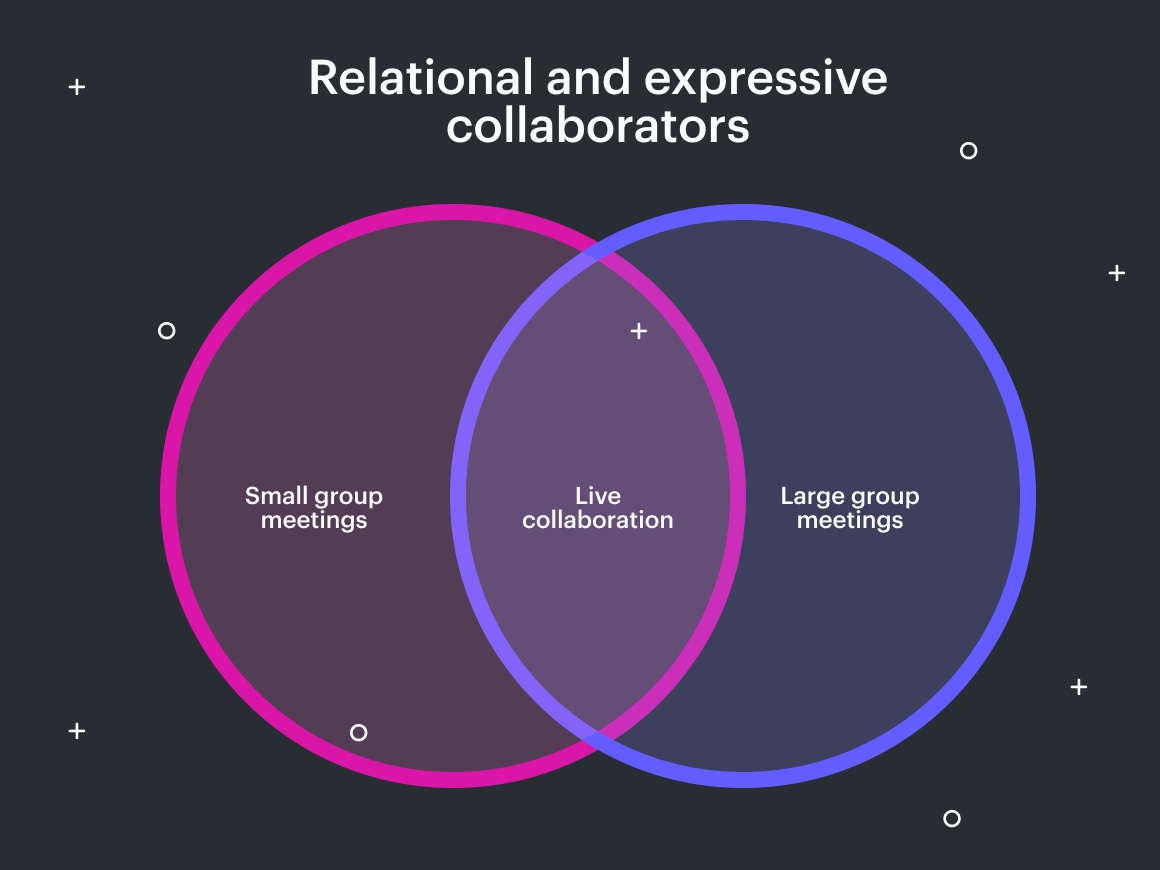
Relational collaborators work best when they can talk through ideas with their words, which naturally clashes with expressive collaborators who prefer to express their ideas in a variety of visual mediums. Because of this, expressives might find themselves unfocused or feel they are wasting time in meetings that are heavy with “warm up” icebreaker activities, preferring to dive right into sketching, drawing, and ideation.
Relational and expressive collaborators will also have conflicting feelings about meetings. Relational collaborators are more likely to see Zoom calls as a necessary evil of remote work and would prefer one-on-one connection in the office, while expressive collaborations thrive in large-group, interactive brainstorming activities.
Where they align:
Compared to introspective collaborators who like to work on their own before connecting with the group, both relational and expressive collaborators see value in thinking through ideas live with others. Both will respond positively to opportunities to collaborate with teammates as long as the size of the group is intentional.
Strategies and techniques to help relationals and expressives work better together:
- Use a timer: Set up agreements around the duration of both icebreaker activities and brainstorming activities; timeboxing in this way will reassure relational collaborators that there will be time set aside for human connection before jumping into brainstorming, while also giving expressive collaborators confidence that the entire meeting won’t devolve into personal chit-chat without any meaningful ideation work.
- Hold visually engaging voting sessions: Voting sessions accommodate expressives by letting them see their preferences reflected visually while giving relationals a chance to connect with others on their ideas. With Lucid, you can host voting sessions or use emoji reactions to visually organize, prioritize, and align on ideas as a group. You can even host voting sessions in smaller group breakout sessions.
- Start with a template: In general, utilizing visual collaboration templates will help you facilitate your collaborative sessions more effectively so both collaboration styles feel like they’re using their time effectively.
The relationship between expressive and introspective collaborators
Where they diverge:
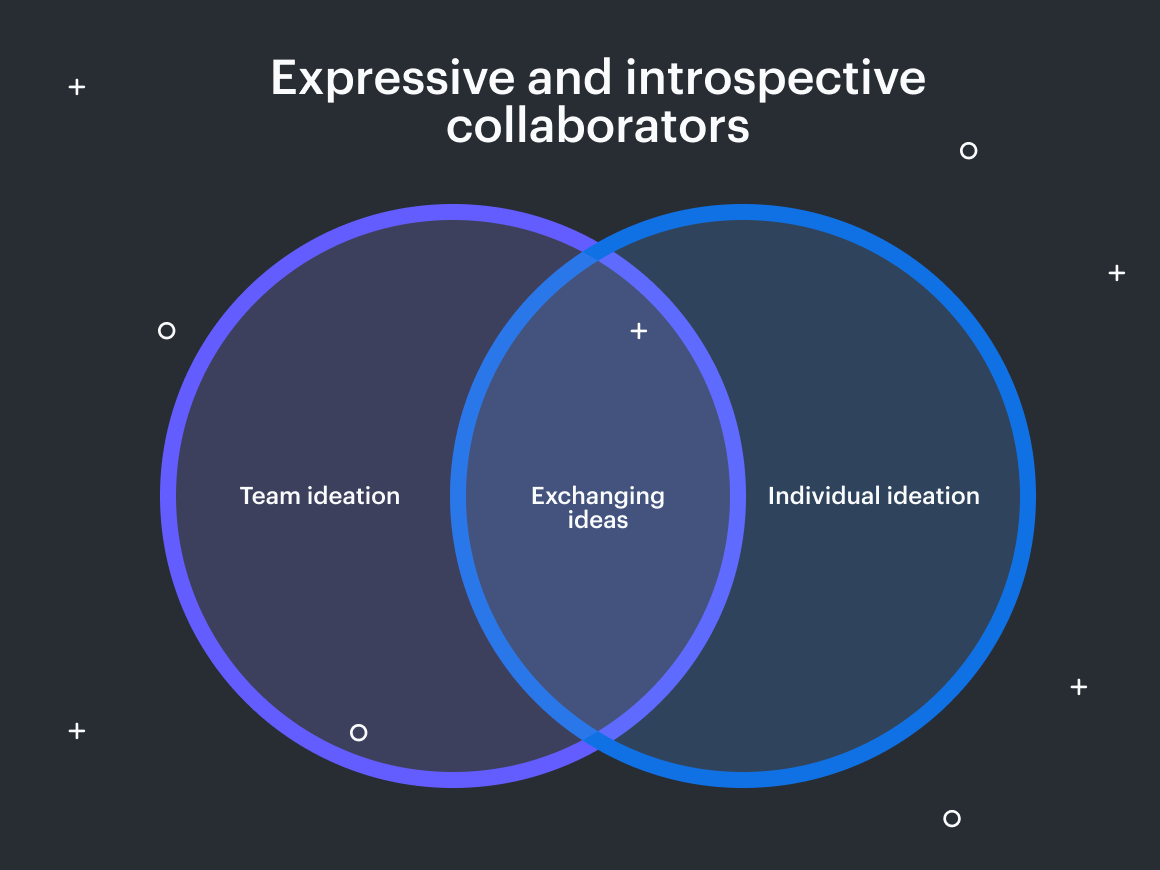
Expressive and introspective collaborators are diametrically opposed in many obvious ways: Whereas expressive collaborators prefer to share ideas off the top of their heads with teammates, introspectives need time to gather their thoughts before sharing.
For expressives, this might take the form of large group brainstorms; for introspectives, it might mean supplying a lot of context up front that they can dive into on their own. Introspectives might also prefer writing versus the visual approach expressives would take. Forcing each other’s preferred workflow on one another would cause each to feel extremely frustrated in their ability to communicate their ideas.
Messaging an introspective collaborator and saying, “Hey, can I bounce a few ideas off you really quick?” might make their stomach drop, but the same message might be the highlight of an expressive collaborator’s day.
Where they align:
Compared to relational collaborators whose first priority is human connection, both expressive and introspective collaborators prioritize the exchange and exploration of ideas. They put a lot of effort into expansive ideation and feel most collaborative when they are making tangibly valuable contributions.
Both expressive and introspective collaborators will respond positively to thorough project briefs that clearly define a business problem to be solved.
Strategies and techniques to help expressives and introspectives work better together:
- Embrace asynchronous collaboration: Async work in a document or structured template allows both styles to contribute independently and then review together at an accelerated pace.
- Follow up: Expressive and introspective collaborators will feel valued when they can see the progress of their ideas into active projects. Make sure you’re following up to let them know the impact their brainstorming contributions had.
Bringing the collaboration styles together
Understanding your own collaboration style is important. But similarly to how love languages function in romantic relationships, it’s arguably more important in work relationships to understand the collaboration styles of the people you work with. This understanding of the people on your team will allow you to be accommodating and empathetic.
Differing collaboration styles might initially have some conflict as you look for ways to work together effectively, but over time, you can build best practices for working together in a way that meets everyone’s collaboration needs.
Want to improve your brainstorms? Check out our complete guide to better collaborative sessions.
Get the guide
