
Key takeaways
- Visual collaboration applications have achieved mainstream adoption as essential productivity tools for both synchronous and asynchronous work.
- Generative AI capabilities are increasingly common, enabling faster content creation and automated diagramming within visual collaboration platforms.
- Leading vendors are expanding with structured workflow elements to support technical roles and end-to-end use cases.
- Organizations are placing a growing emphasis on security, compliance, and data residency controls to protect sensitive company information.
- Evaluation of platforms should focus on high-value use cases and potential ROI to ensure features align with specific business goals.
The visual collaboration market has certainly changed since the first Gartner® Market Guide for Visual Collaboration Applications was released in 2022, and even more so since Lucid was founded in 2010. What started as a relatively niche market for real-time diagramming and whiteboarding tools has evolved into a workplace staple.
Today, organizations use visual collaboration applications for a wide variety of use cases: planning projects, brainstorming ideas, promoting collaboration equity, making collective decisions, creating dashboards, and providing status updates, to name just a few.
Unsurprisingly, as visual collaboration has grown in popularity, so has the number of vendors in the space. Enterprise application leaders evaluating vendors can use the 2025 Gartner Market Guide for Visual Collaboration Applications to understand the latest market trends and inform their decisions.
We’ve compiled our greatest takeaways from the report below, with our own reflection on what these trends mean for your business and your visual collaboration evaluation process.
Takeaway #1: Visual collaboration applications have entered mainstream adoption
In the latest Market Guide, Gartner refers to visual collaboration applications as a “mature market that has entered mainstream adoption.”
There was a time, though, when visual collaboration applications were considered by many to be little more than a replacement for an in-office whiteboard. It was during the remote work boom of the pandemic, after all, that many organizations first adopted visual collaboration apps.
But even as workers returned to the office, visual collaboration applications remained a core part of many workflows (and tech stacks). Why? Gartner lists a few reasons for the ongoing success, and we believe the greatest reasons are that visual collaboration applications have been recognized as valuable productivity tools (regardless of your in-office status) and asynchronous collaboration solutions that combat meeting fatigue and burnout.
Lucid has seen this value play out for our customers; In a survey of Lucid users, 88% say that Lucid enables them to be more productive, and 87% say Lucid helps them collaborate with other teams and departments. One of the greatest lessons learned from remote work is that collaborating visually leads to improved business outcomes, no matter where you work: aligned teams, faster decision-making, centralized communication and documentation, and so on.
In fact, “Gartner identifies visual collaboration as a key part of the digital workplace ‘Work Hub.’” This new work hub is a collection of applications essential for employee collaboration and innovation.
It’s safe to say the question is no longer whether you need a visual collaboration solution, but what kind. When visual collaboration applications are commonplace, the right solution can be your competitive advantage.

Need help choosing a visual collaboration solution?
Get our buyer's guideTakeaway #2: AI capabilities are increasingly common in visual collaboration apps
AI capabilities are touching nearly every software, and visual collaboration is no exception. Gartner explains that “most visual collaboration vendors have released new GenAI and traditional AI-based capabilities, allowing for faster content creation and enhanced productivity.”
Of course, the best-in-class visual collaboration solutions have been leveraging intelligent features like automation for years. At Lucid, we consider AI a natural extension of this intelligence, helping teams gain deeper insights, save time on manual tasks, and innovate continuously.
In our opinion, the most popular AI features Gartner lists include:
- Generating mind maps or vision boards
- Generating ideas with prompts
- Summarizing text from different parts of the canvas
- Categorizing canvas elements to reveal patterns
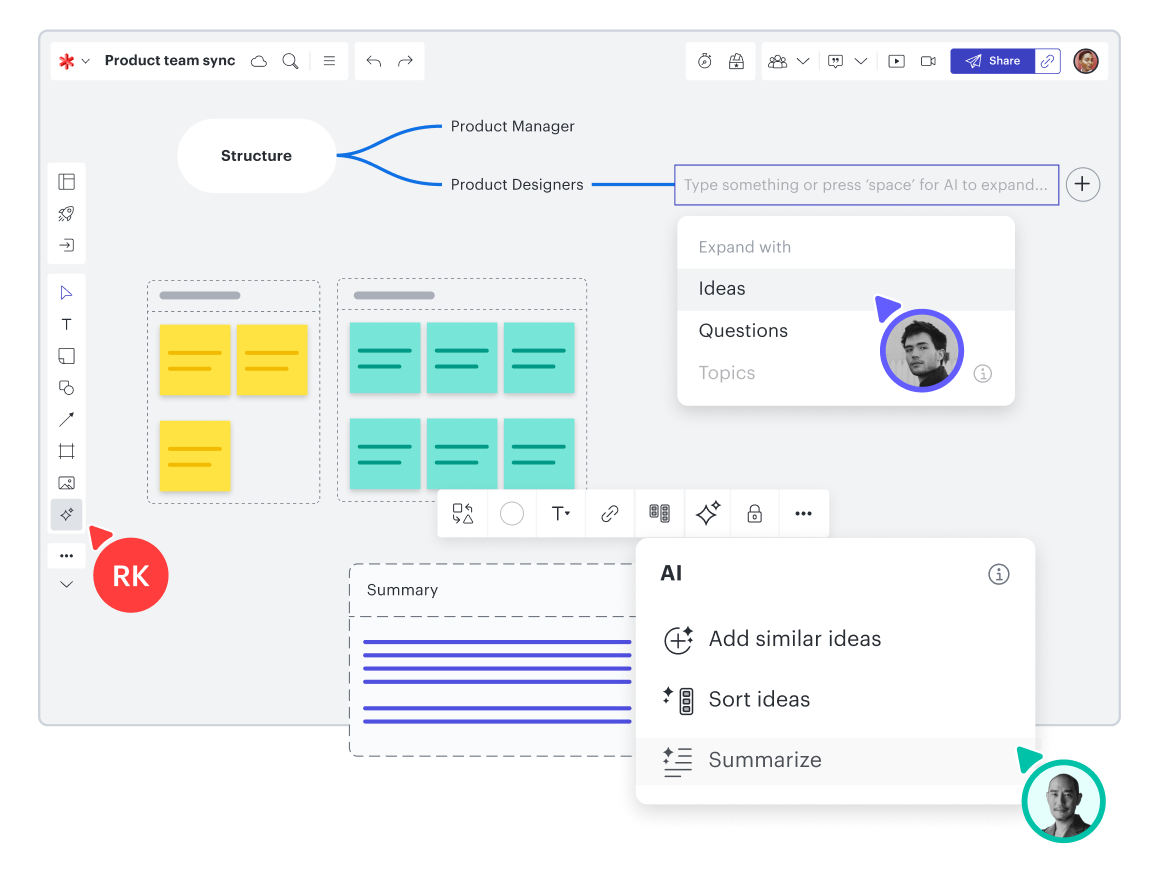
All of these features are available within Lucid. But Gartner also references a few advanced capabilities that we believe Lucid supports, including the ability to “[generate] complex models, architecture diagrams, or process workflows based on connected systems, data, and/or documents.”
With Lucid’s long-time focus on intelligent diagramming, we’ve also applied AI to accelerate the diagramming process. For example, with Lucid AI, you can generate a diagram using a text prompt, iterate on that diagram, and even add conditional formatting rules based on a simple description.
Conditional formatting icons are added to a diagram using a prompt in Lucid AI
Takeaway #3: Many vendors are expanding with structured workflow elements
“By default, the content created within visual collaboration applications is unstructured. The canvas inside these applications is highly flexible and customizable,” explains Gartner.
This flexibility is what makes visual collaboration perfect for riffing on ideas, plans, and designs. But without structured elements, many people—particularly those in technical roles such as enterprise architects or IT—end up transitioning to a more specialized, structured tool as the project progresses.
This workflow is changing, though, as visual collaboration applications add structured workflow elements to support the end-to-end workflow.
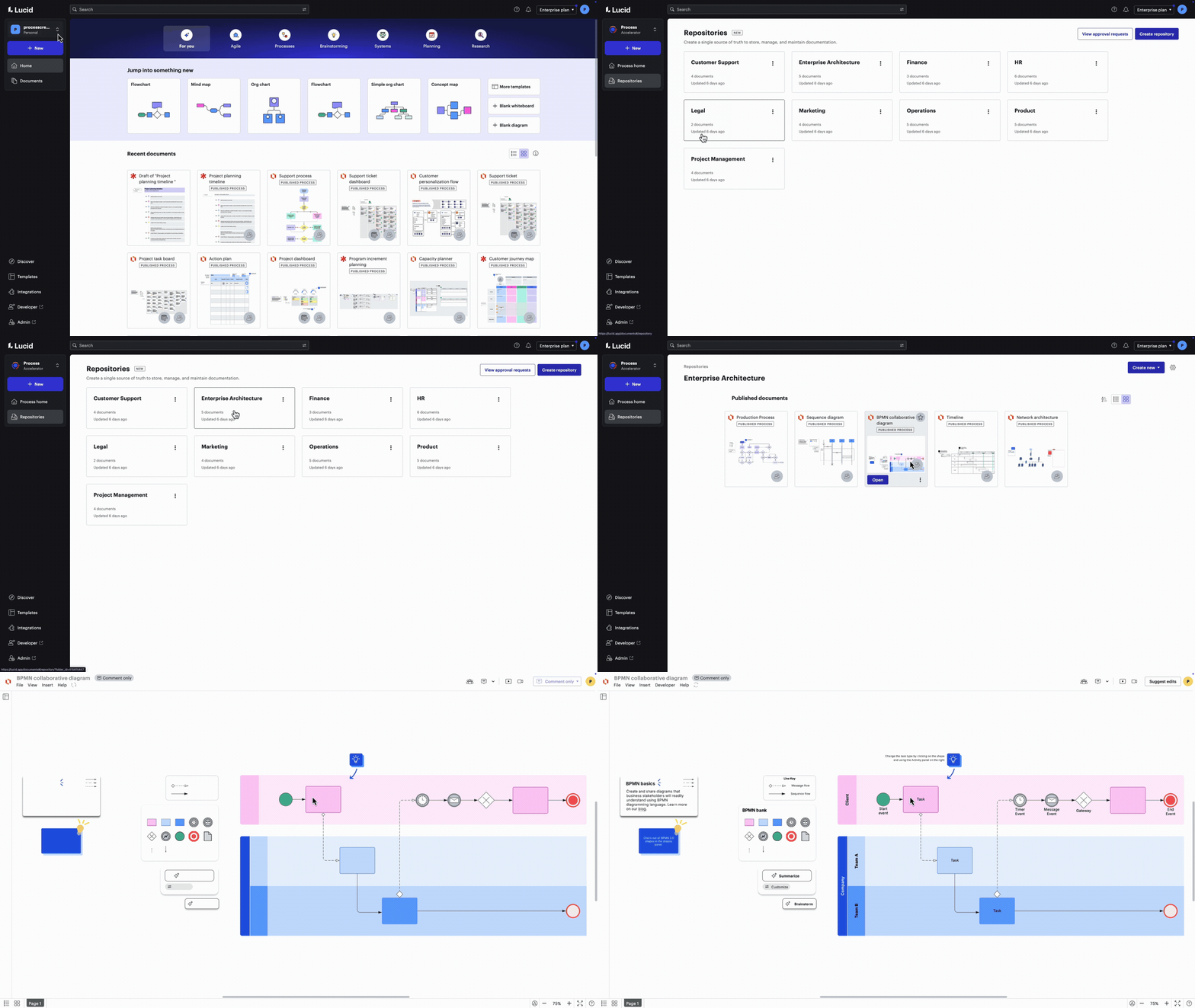
At Lucid, we consider this specialization to be the next evolution of visual collaboration. We’re paving the way for this evolution by applying the powerful capabilities of visual collaboration to large-scale initiatives, such as AI transformation, which requires the traditional flexibility of an infinite canvas with an additional layer of governance, standardization, and structure for scaling.
Lucid has added this layer of structured workflow elements via three new purpose-built capability sets, called accelerators, for cloud and process transformation, as well as through the acquisition of airfocus, an AI-powered product management platform.
Lucid’s evolution from a traditional visual collaboration platform to a work acceleration platform is indicative of the expanded value and consolidation opportunities that the changing visual collaboration market offers.
Takeaway #4: There’s growing emphasis on security, compliance, and data sovereignty
Security and compliance are other top considerations as visual collaboration applications grow mainstream and are widely used for creating and sharing content.
According to Gartner, “Data protection, data retention, and compliance with the EU’s General Data Protection Regulation (GDPR) are frequently cited as top considerations when evaluating vendors in this market.”
While most vendors offer basic security controls, some visual collaboration solutions offer an additional layer of security through add-ons. For instance, with Lucid’s Enterprise Shield, customers can customize document classification controls, automatically identify sensitive content, track audit logs for potential threats, and more.
Gartner also identifies increasing data residency and sovereignty concerns. “Support for data residency controls is available from some vendors in the visual collaboration applications market, but many vendors still lack these options.” Lucid is ahead of the curve here, offering global data residency controls for accounts to select specific geographic regions for storing data at rest.
Takeaway #5: Evaluation should focus on high-value use cases and ROI
Gartner explains that visual collaboration applications are typically adopted to support particular use cases that can drive significant ROI. What are those?
The most common use cases discussed by Gartner include:
- Internal collaboration, including brainstorming, mind mapping, or simple diagramming
- Design, including co-creation and reviews
- Engineering, including acting as a hub for agile workflows
- Project management, including templatized and integrated workflows
Although all visual collaboration platforms support basic internal collaboration, the other use cases may require a more thorough evaluation to find the best solution. To choose a platform with the highest ROI, Gartner recommends “mapping your visual collaboration needs to [the platform’s] feature set.”
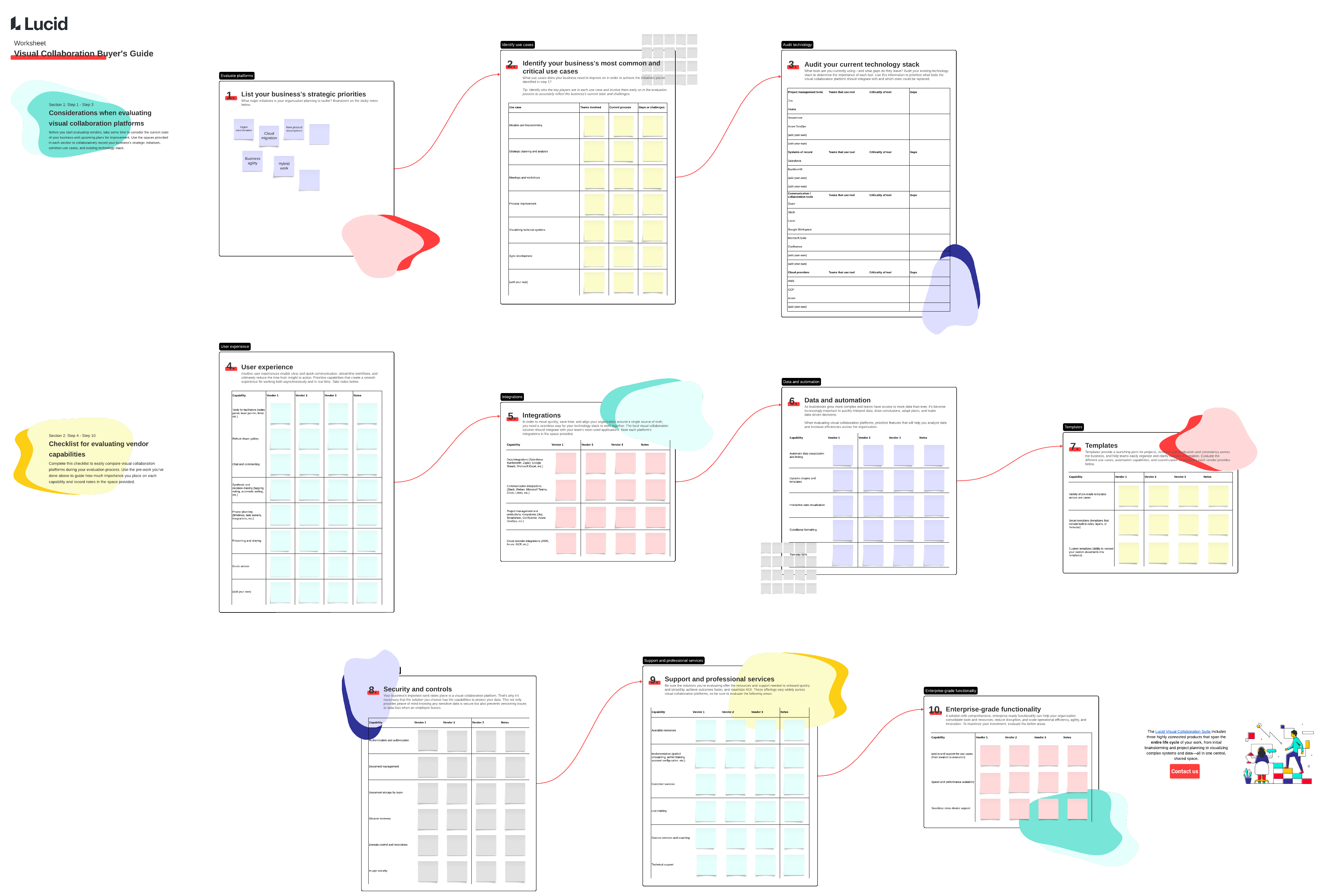
For supporting project management use cases, for instance, you’d want to look for advanced capabilities such as a bidirectional integration with your work management systems, whether that’s Jira, Azure DevOps, Asana, or another tool. This two-way sync would simplify and accelerate project management by ensuring any changes made to your plan in Lucid are automatically reflected in your system of record, and vice versa.
For engineering teams, you may look for specialized capabilities that allow you to not only facilitate sprint planning and retrospective events, but also estimate work, reach consensus, and plan capacity. For example, with Lucid, teams can visualize different scenarios to plan the most efficient path forward and gain valuable insights into team sentiment.
“Support new ways of working by using visual collaboration applications beyond live meetings—integrating them into creative, educational, ideation/brainstorming, process management, task management, and data analysis workflows.”
—Gartner, “Gartner Market Guide for Visual Collaboration Applications,” October 27, 2025
See why Lucid is listed in the Gartner Market Guide for Visual Collaboration
We believe that being named in the Gartner Market Guide for Visual Collaboration Applications is a testament to Lucid’s ongoing commitment to supporting teams in the future of work. As the workplace continues to change and AI transformation initiatives take center stage, Lucid helps organizations navigate these changes efficiently and effectively.

See if Lucid is right for your business.
Watch a demoGartner, Gartner Market Guide for Visual Collaboration Applications, Christopher Trueman, Adam Preset, 27 October 2025
GARTNER is a registered trademark and service mark of Gartner, Inc. and/or its affiliates in the U.S. and internationally and is used herein with permission. All rights reserved.
Gartner does not endorse any vendor, product, or service depicted in its research publications, and does not advise technology users to select only those vendors with the highest ratings or other designation. Gartner research publications consist of the opinions of Gartner’s research organization and should not be construed as statements of fact. Gartner disclaims all warranties, expressed or implied, with respect to this research, including any warranties of merchantability or fitness for a particular purpose.