Sailboat retrospectives are a unique way to think about your sprints or projects and brainstorm ideas for how to reach your goals. By using this popular retrospective model, you can keep your retrospective meetings collaborative and engaging.
What is a sailboat retrospective?
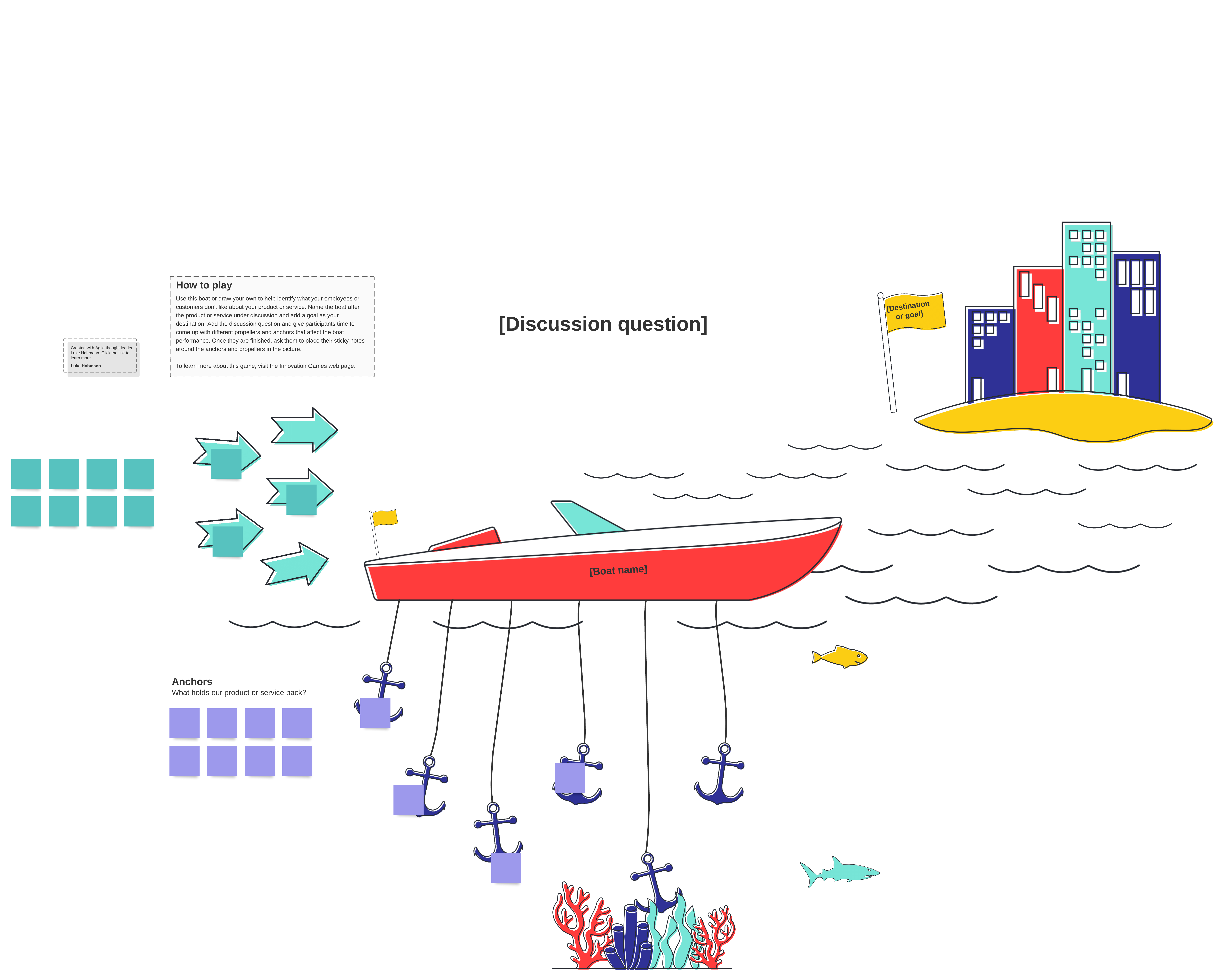
Sometimes referred to as a speedboat retrospective, a sailboat retrospective uses a metaphor to understand the Agile journey, placing various aspects of a sprint or project into perspective for your team. Sailboat retrospectives are an excellent visualization technique. By taking familiar elements of a sailing journey and comparing them to the obstacles, goals, and tools your team has, you can look back on what happened with a project and highlight areas of particular interest and emphasis.
Elements of a sailboat retrospective
Each element serves as part of the metaphor—a sailing adventure where your team is trying to sail successfully to an island destination. Along your journey, the wind carries you forward by filling your sails and pushing your boat, but one or more anchors or rocks can get in your way and impede your progress.
As you think about your sprint or project’s story, you may find obvious elements for each category that stand out to you. Other elements may not be so obvious or may fit a different category than you’d expect. Creating a sailboat retrospective can change your interpretation of a recent sprint and cast light on elements you weren’t previously aware of.
Anchor
Anchors represent what held your sprint back from moving forward. Anchoring your boat in place, these obstacles can be issues that cause delays, challenges you identify partway through your voyage, or impediments presented by other projects, stakeholders, or environmental conditions (such as the market).
You may have more than one anchor that restricted your project. As you brainstorm your anchors, you could make a note of solutions that come up, but don’t focus on them until you’ve identified all of your anchors. Remember to think about:
- Anchors stall or drag your project
- How might you manage anchors?
Wind
Wind is whatever helped your team keep moving. Wind gives your project momentum and may be your advantages, helpful team members, support from stakeholders, or even the roadmap you used to guide your project along. Looking back at your previous sprint, considering what helped enable your project’s progress allows you to see what represents wind in your sailboat retrospective.
If it’s tempting to skip over the wind section and focus on your challenges, keep in mind that this part of the retrospective is a great time to thank colleagues and recognize stakeholders. Positive recognition is encouraging for your team and creates a positive cycle that supports your project. Consider the following:
- Wind advances your project forward
- How do you guide your boat with the wind?
Rocks
For any project, threats are a strong possibility, so planning for them is appropriate risk management. Real rocks are destructive to boats and can impede the adventurer’s chances of ever reaching the island. Since rocks aren’t always visible from inside the boat, sometimes rocks show up unannounced. If sailors see rocks, they can correct their course, but it’s too late to avoid a rock if you’ve already hit it.
Retrospective rocks are a little like that, too. Once the risk is now part of your project’s reality, your best approach might be to manage it. Anticipating rocks and avoiding them in the first place can save a lot of hassle and potential fallout. Just like real rocks tend to be in specific places (such as near land), these rocks can be more common under certain conditions. Finding out what increases the probability of hitting a rock is a valuable part of your journey. Key things to think about for rocks include:
- Rocks can damage your boat
- How can you avoid rocks with risk management and planning?
Island/ Goal
Everyone wants to reach the destination eventually. That’s why you’re working on the project in the first place! Successfully reaching the island represents your team’s success when they arrive at the project destination. All of the planning, navigation, mitigating risks, and looking for wind to push your boat forward culminates in finding the island. You’ll want to make sure your entire team knows what the goals and expectations are for a project. During the retrospective meeting, think about:
- The island is your goal
- Did you reach the island?
Sun
The sun is an optional element, but it can be helpful. Sunshine can be one of the best parts of both the journey and the destination. Instead of including your kudos and positive highlights in your “wind” category, you can count these as the sun shining on your team, giving team members a chance to appreciate the work of their colleagues. Consider:
- The sun makes your team happy
- Where did the sun shine and how can you recognize it?
When to use a sailboat retrospective
Sailboat retrospectives are helpful for nearly any project and can become part of your project management process. Use a sailboat retrospective:
- During a team meeting: With a sailboat retrospective, you can show your team important information and provide a point of discussion.
- If your project is stuck: If your project stalls and you’re not sure where to go next with it, a sailboat retrospective could help you determine how far you are from the island, if you’ve hit a rock, or if you’re dealing with anchors.
- To inform stakeholders: Sailboat retrospectives are also a helpful technique for informing stakeholders on a project’s outcome.
- After the project: Following the completion of your project, you can use a sailboat retrospective to review what was successful and what needs improvement next time.

Learn more about running effective retrospective meetings.
Learn moreHow Lucidspark can help
As a virtual whiteboard, Lucidspark can be used to put together sailboat retrospectives and to review and collaborate on. Lucidspark provides a place where you can brainstorm and share your ideas visually.
Use Lucidspark to create and review your sailboat retrospective as a team during a virtual meeting or get asynchronous feedback and comments whenever your team is online.

Create your own speedboat retrospective in Lucidspark.
Start now
