Key takeaways
- Unresolved friction between product and engineering teams leads to delayed release cycles and team burnout.
- Product managers can improve product and engineering collaboration by bringing engineers into product discovery early and centralizing roadmapping.
- Engineers can bring transparency to the product engineering strategy by mapping dependencies and framing implementation tradeoffs visually.
- Lucid’s Process Accelerator scales engineering collaboration across organizations by transforming ad hoc teamwork into repeatable workflows.
Product managers and software engineers hold the keys to any company’s technological innovation and deployment, yet persistent tension often exists between ambitious product visions and complex technical realities. When left unresolved, this friction manifests as delayed release cycles, missed market opportunities, and team burnout.
Although both teams share the goal of delivering a successful end product, their motivations and processes for getting there can differ. PMs are often unfairly blamed for overcomplicating documentation and fumbling prioritization. At the same time, engineers are frequently mischaracterized as siloed implementers who don't care about the bigger strategic picture.
Because these misconceptions are widely held, teams often operate separately, where PMs lob requirements over a wall and engineers hustle to meet deadlines in isolation. But true efficiency begins when the organization embraces shared accountability at every stage. In turn, both teams can work together more harmoniously to build a stronger, more productive working relationship.
This article will share actionable tips for building better collaboration and alignment between product and engineering teams. We’ve even included practical advice from one of Lucid’s product managers and the vice president of engineering.
Product managers
Building collaborative working relationships with engineers requires establishing a strong foundation before project kickoffs. Here are the core areas product managers should focus on to improve the product-engineering relationship:
Bring engineers into product discovery early on
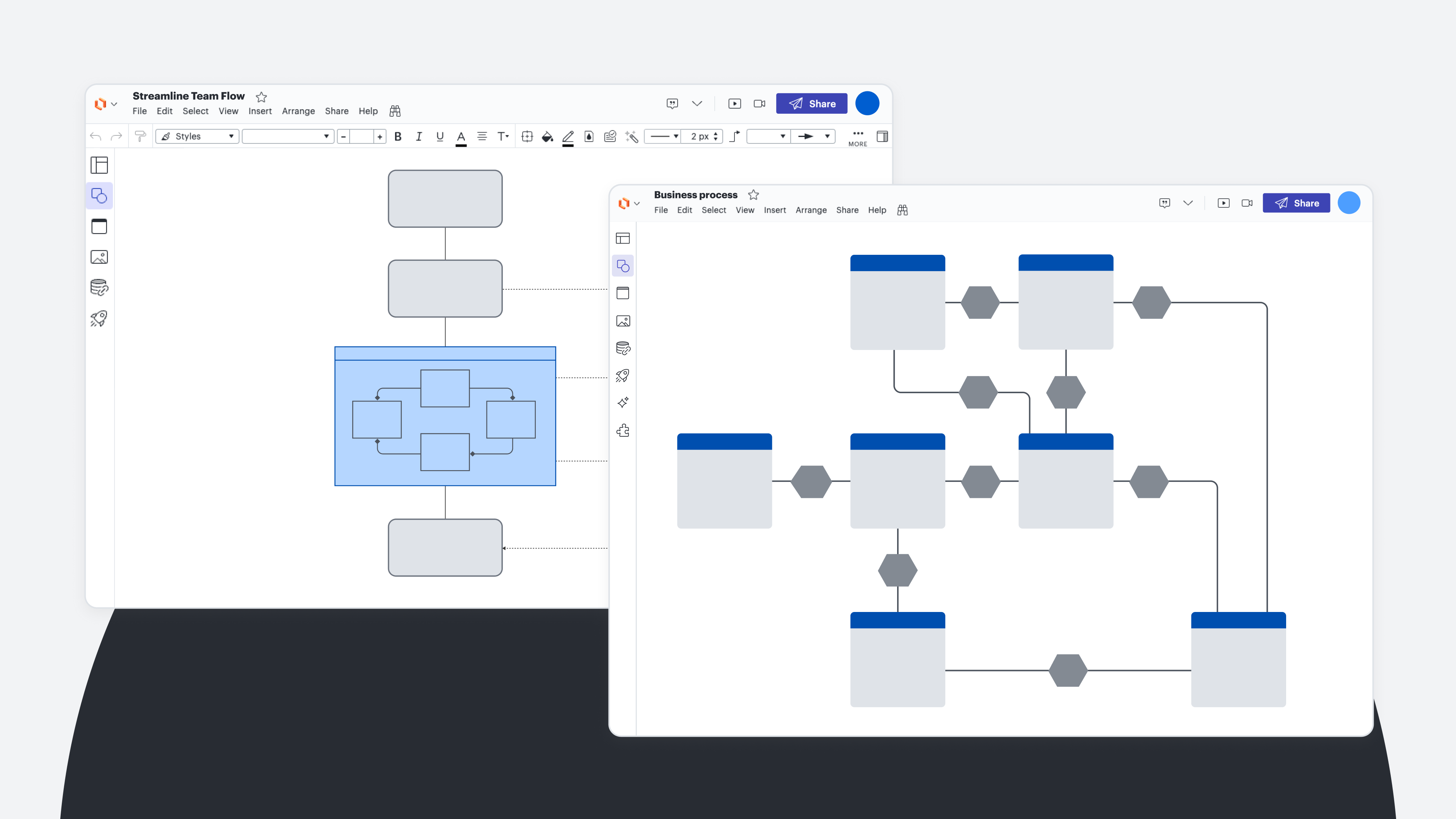
Don’t wait for sprint planning to loop in your engineering team. Bring them into discovery sessions where they can pitch solutions and flag technical constraints before ideas are finalized. To ground these conversations and keep a record for later reference, consider embedding a visual product roadmap, opens in a new tab or user story map, opens in a new tab in your collaborative workspace. This visual anchor keeps cross-functional stakeholders, both technical and non-technical, perfectly aligned on the overarching strategy, ensuring everyone sees the big picture from day one.
Clarify objectives and ownership
Transparently sharing your core principles helps engineers develop a stronger product sense. This empowers them to make autonomous, strategic design decisions on the fly rather than stalling momentum to wait for product approval. To eliminate handoff friction, use cross-functional flowcharts to map out clear boundaries for your Definition of Ready (DoR) and Definition of Done (DoD), opens in a new tab. When both teams co-author these definitions visually, you replace ambiguity with accountability.
Centralize roadmapping
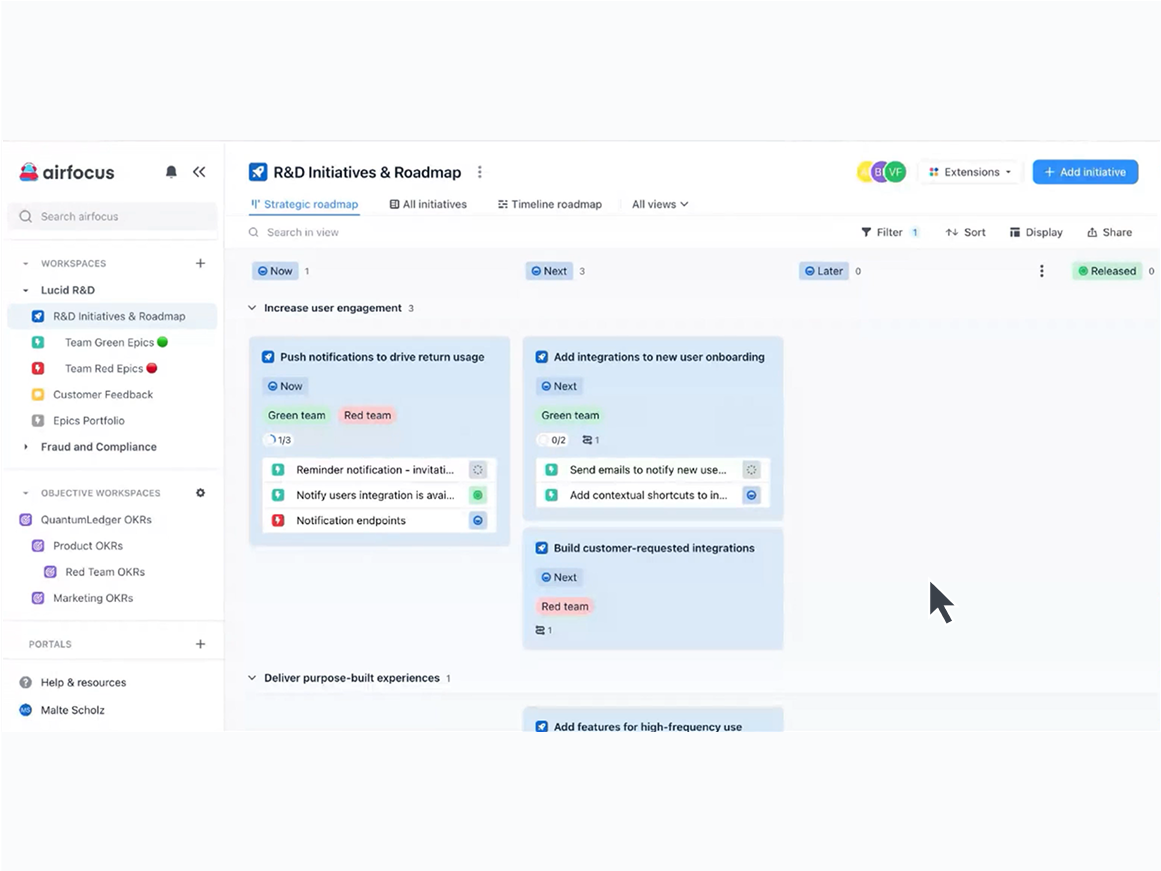
True alignment happens when you combine high-level strategy with day-to-day execution. By connecting your visual plans with a solution like airfocus, you can seamlessly manage prioritization and feedback loops in one centralized place, helping your team make smarter decisions faster.
Centralizing this information does more than align stakeholders—it provides a vital single source of truth (SSOT) for your AI tool stack. While many organizations rush to deploy AI tools, few see meaningful returns because their tools lack context. Giving both your teammates and your AI clients access to a centralized roadmap provides the deep contextual foundation needed to drive true efficiency.
Spread the leadership
Finally, look for consistent opportunities to distribute leadership across both teams. Instead of acting as the sole gatekeeper for executive updates, ask your lead engineer to present technical developments and progress reports directly to the leadership team. This builds mutual respect, fosters visibility, and reinforces the reality that product delivery is a shared victory, not a solo sport.
“I wish more product managers knew how much engineering can help early in the discovery process. There have been a number of times where product brings a fully formed plan that has a critical flaw, or a small adjustment from an engineer can get 90% of the value in 20% of the time. These are the critical moments when engineers can provide significant value. Sometimes in trying to protect engineering time, a lot more work can be created for everyone.”
—Andy Hurd, Vice President of Engineering, Lucid
Engineers
As an engineer, you have a deep understanding of the codebase and the infrastructure required to build a feature. But the product managers you partner with can’t plan around constraints they can't see. When the technical reality is hidden, it’s easy for PMs to make seemingly unrealistic scope demands or set arbitrary deadlines.
To bridge this gap and strengthen product and engineering collaboration, you need to shift from explaining your architecture to visualizing it. Here’s how to bring transparency to your product and engineering strategy:
Map dependencies to protect the timeline
PMs naturally focus on the broad, overarching vision, while the engineer's job is to build the pieces that make it functional. Dependency maps and cross-functional flowcharts help to align both perspectives and connect technical infrastructure directly to user-facing features.
By mapping technologies to specific features, you can clearly demonstrate why certain components must be built in a specific order. This visual clarity not only protects your timeline but also helps your PM identify opportunities to adjust the release strategy and maximize the early delivery of high-value features.
Frame implementations tradeoffs visually
When presenting your implementation plan, address the tradeoffs you’ve embedded into the strategy so your PM can make informed decisions. For example, some features could be deferred to a later release to meet a more aggressive deadline. Or, you may include specific testing that could push back the deadline but will ultimately provide a better end product.
Outlining these tradeoffs visually transforms potential friction into a collaborative strategic decision. It allows product managers to understand the technical “why” behind your proposed schedule and choose which tradeoffs are worth making.
Move from text-heavy documents to a visual blueprint
While text-heavy technical specs are necessary for your code, they become a bottleneck for cross-functional alignment. Before diving into development, use visual architecture diagrams to break down complex technical environments into clean, readable concepts for your non-technical peers.
To bridge the gap between high-level planning and technical delivery, map these architectural components to interactive timelines, opens in a new tab or Gantt charts, opens in a new tab. When a PM can visually track how individual components stack up against an ideal launch date, expectations become transparent for everyone. This eliminates the friction of unexpected delays and makes the entire development process significantly more efficient in the long run.
‘We’re building things faster than ever, which means unclear decisions get expensive fast. Product and engineering need to be aligned on the problem, the plan, and the tradeoffs. When engineers can clearly show the system they’re working in and the direction they want to take it, I can quickly understand what’s changing, make better calls, and help unblock the work.”
—Spencer Cowley, Product Manager, Lucid
Effective collaboration for your product and engineering strategy
As your organization grows, cross-functional alignment becomes harder to maintain. The friction between product visions and engineering realities requires an intentional framework to keep teams connected. True efficiency is about scaling collaboration across your organization.
This is where Lucid's Process Accelerator, opens in a new tab comes in. By utilizing built-in process repositories, structured approval flows, and centralized asset libraries, both product and engineering teams can map, optimize, and standardize the product delivery life cycle. It transforms ad hoc teamwork into repeatable workflows, ensuring that continuous improvements are documented, shared, and scaled across every team.
Instead of siloing your product and engineering teams, leverage the talent and creativity of both groups. When your product managers and engineers work together to plan, develop, and implement a product, they will be better equipped to prevent and mitigate problems, reduce costly delays (and wasted time), and deliver successful products.

Ready to strengthen the relationship between product and engineering teams?
The Process Accelerator can help bridge the gap between strategy and execution.
See howFrequently asked questions
How can better collaboration between product and engineering teams impact our results?
Stronger collaboration ensures user needs, business goals, and technical constraints are reflected in the product strategy, leading to valuable and feasible solutions while reducing rework and misalignment.
What’s a good way for product and engineering to create a shared vision for a project?
Teams should host joint kickoff sessions to define the problem, target users, success metrics, and high-level scope together. Capturing this in a visual artifact provides a common reference throughout the project.
How should roles and responsibilities be defined to support collaboration?
Clarifying ownership of product outcomes and technical execution through a simple responsibility framework helps avoid duplicated work and gaps, giving each team confidence about when to lead and when to consult.
At what stages should engineers be involved in product decisions?
Engineers should be involved from early discovery and ideation stages to flag technical risks and suggest better solutions, improving feasibility and building a sense of shared ownership over the product.
How can product managers improve collaboration with engineers?
Product managers can enhance collaboration by bringing engineers into product discovery early, clarifying objectives and ownership, centralizing roadmapping, and spreading leadership across both teams.
What practices can reduce friction and miscommunication between product and engineering?
Establishing regular touchpoints and clear communication channels encourages early identification of questions and risks. Using shared visual documents helps clarify requirements, dependencies, and decisions transparently.
How can teams handle technical constraints and trade-offs together?
Teams should discuss user impact, technical complexity, and business value side by side when prioritizing work, using shared visual plans to map options, risks, and dependencies for informed compromises.
What tools can facilitate collaboration between product and engineering teams?
Tools like visual roadmaps, flowcharts, and architecture diagrams can help bridge the gap between product vision and technical execution, ensuring both teams stay aligned on goals and timelines.
What are common misconceptions that create friction between product and engineering teams?
Common misconceptions include the belief that PMs overcomplicate processes and that engineers only care about technical specifications. Addressing these assumptions can help build trust and improve collaboration.