
SOAR analysis is a unique strategic planning tool that helps you visualize your organization’s capabilities and potential. By collaborating with your team on a SOAR analysis, you can refine your understanding of the strengths and advantages of your organization.
You can create a SOAR analysis by following an interview process with your team, executive leadership, project manager, and other stakeholders. But first, let’s talk more about what a SOAR analysis includes.
What is a SOAR analysis?
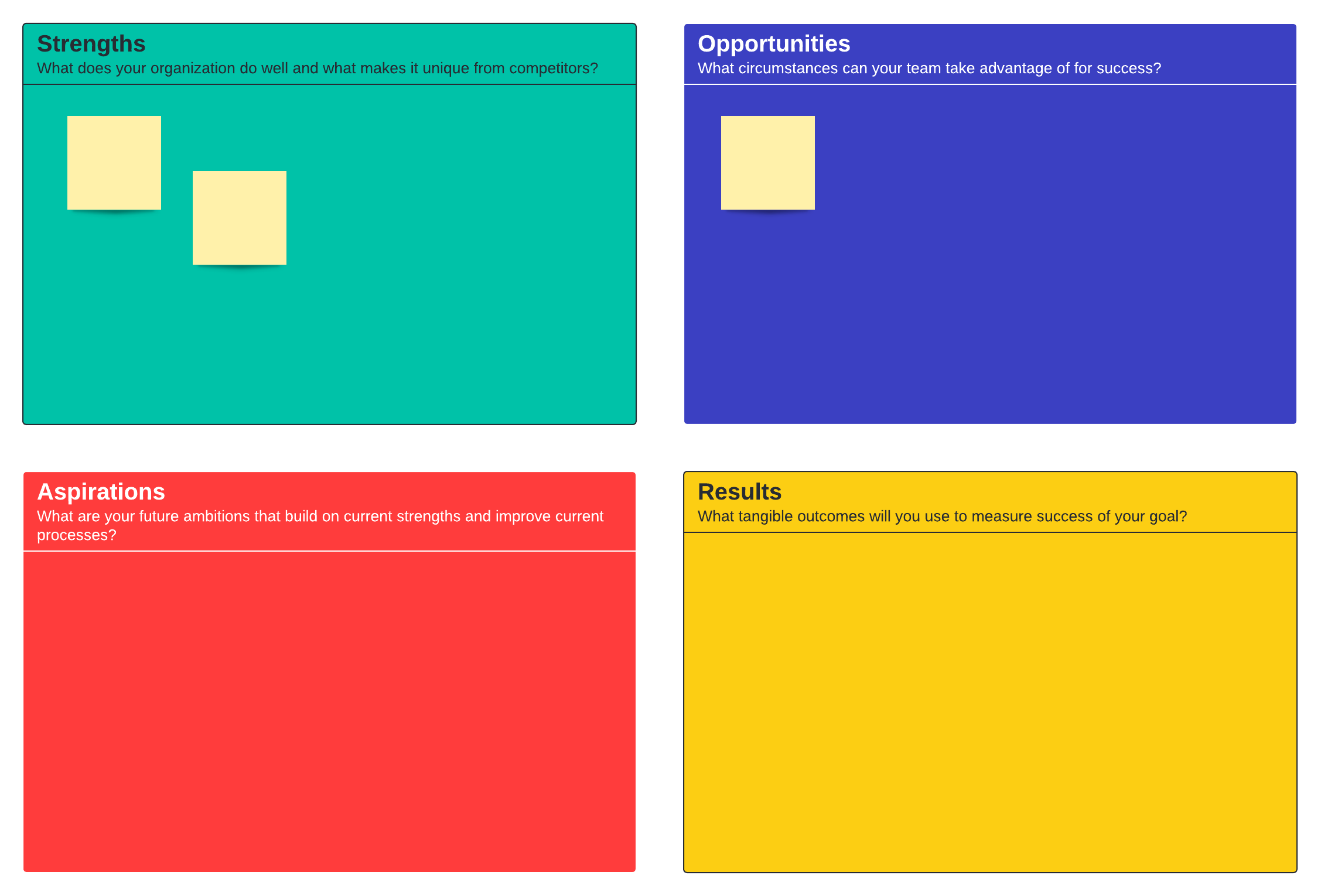
SOAR analysis helps business teams understand their strengths, opportunities, aspirations, and results. For strategic planners, this framework focuses on the organization’s vision and the means available to achieve goals. The SOAR method makes it easier to brainstorm and visualize how your company's strengths can help you achieve your goals and objectives.
SOAR diagrams generally have four quadrants—one for each category or aspect of your SOAR analysis. You can complete your SOAR analysis by answering a series of questions about each of these quadrants, or you can simply gather your team together and think about how your company’s characteristics and unique situation fit into SOAR.
SOAR vs. SWOT analysis
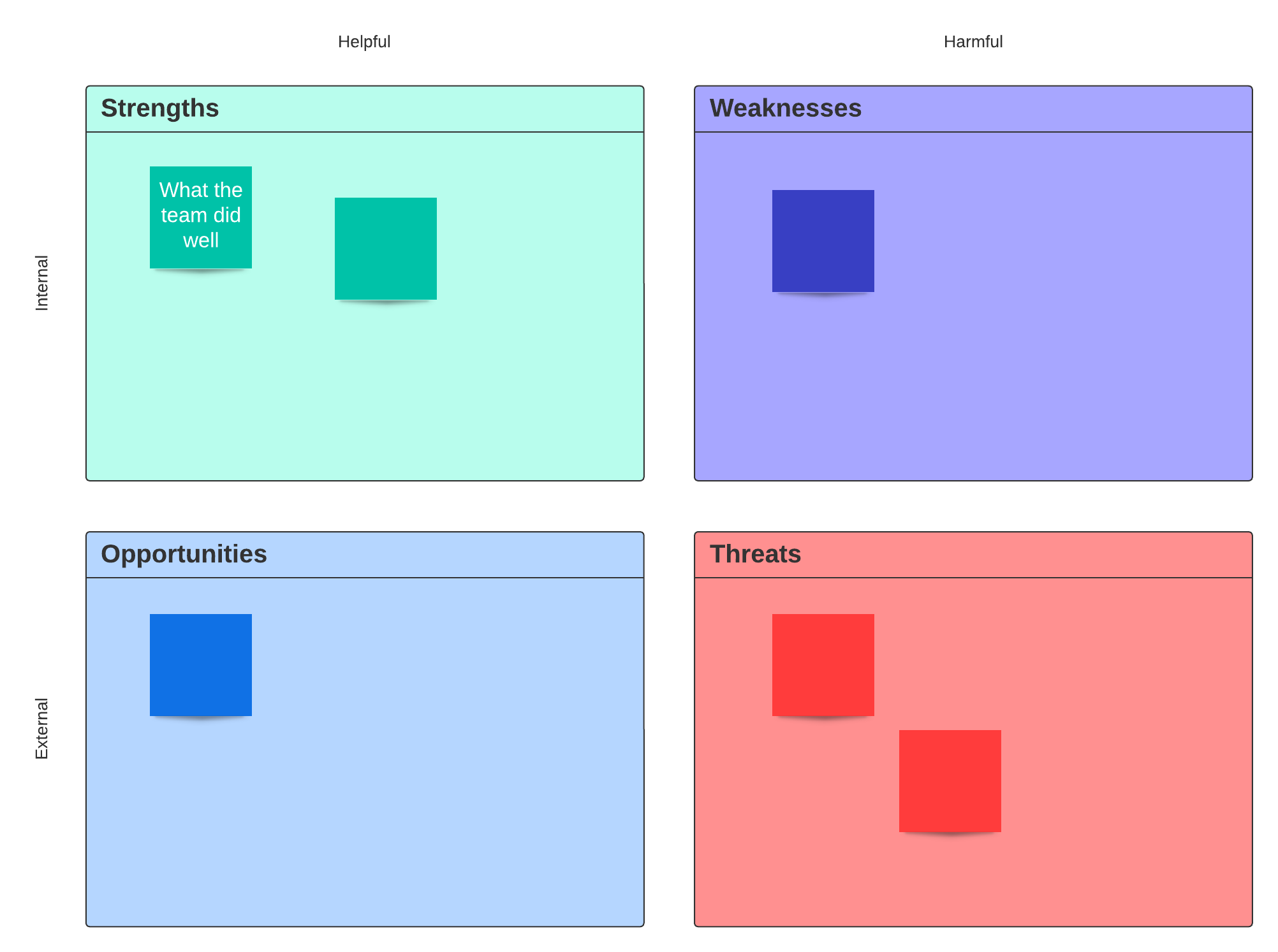
Superficially, SOAR and SWOT (strengths, weaknesses, opportunities, threats) appear to be two versions of the same analysis, but there are actually some key differences. You could even use both forms of analysis together as part of your strategic planning process, gaining different insights from each exercise.
The questions your team would ask, the target of your analysis, and how you would likely use the results of your analysis are all distinct. The more questions you ask, the more you will learn about your team.
How SOAR and SWOT analysis are similar
SOAR and SWOT are both helpful introspective frameworks for examining your organization’s current standing and potential. Managers might use SOAR and SWOT right before making a significant decision about the direction of their company, or a team might even use these forms of analysis during the earliest phases of project planning.
Also, these frameworks are helpful for communication. Everyone on your team may assume certain features or truths about your organization are obvious, but unless they’re openly communicated, that’s not actually true. Collaborating on SWOT or SOAR can bring clarity and reveal places where your team isn’t aligned. For example, you might see your company culture as a strength, while someone else might classify it as an opportunity that’s still unrealized.
SOAR and SWOT can both be used interchangeably for many of the same use cases, and some of their usages may depend on personal preferences. With that in mind, each analysis has particular strengths.
When to use a SOAR analysis
SOAR has many uses. Individual use cases you may find SOAR helpful for include:
- Crafting a new vision. Whether you’re a company founder with a new startup or revisiting your corporate vision, SOAR is a helpful tool for revealing your potential as an organization.
- Building an annual plan. You can use SOAR analysis at regular intervals to create plans for the upcoming period and define baselines for future comparisons. Running a SOAR analysis every year or every five years might make sense as part of your strategic planning process.
- Starting a project. SOAR could be applied to a team or an individual project as a brainstorming technique as the project begins.
- Managing change. If your organization is planning extensive change, SOAR may be helpful for providing direction. Bringing your team together, you can use SOAR to show what your vision looks like for the company or department while maintaining a positive outlook.
Because it emphasizes strengths, goals, and improving what you’re already doing well, SOAR might be more effective for team building than SWOT. Some team members might be more willing to participate in SOAR and may be more eager to share information and ideas. If you plan to do both a SOAR and a SWOT, you may find it helpful to start with SOAR and get your team thinking and collaborating on the vision before moving into SWOT.
When to use a SWOT analysis
Perhaps better-known than SOAR among many business managers, SWOT is a go-to framework for understanding the business environment and a company’s unique position within it at a high level. SWOT’s uses include:
- Understanding change in the business environment. How your company is situated in the marketplace can change rapidly. Companies face real threats and weaknesses they must first understand before they can transform problems into opportunities. SWOT is an analytical tool that helps teams uncover these areas fast.
- Entering a new market or launching a product. Direct experience in the marketplace with real customers is the best learning experience for entering a new market. Still, arguably the next best thing is a thorough analysis of potential users. SWOT can help you uncover information you otherwise wouldn’t have by pointing out the upsides and downsides you’ll soon be dealing with directly.
- Performing risk-benefit analysis. SWOT can help you start a risk benefit analysis and weigh all possible bad outcomes against any potential for your organization.
In contrast with SOAR, SWOT doesn’t filter negative information through an opportunity lens. This approach, by removing any filters or reframing, can be counterproductive in some situations but enormously beneficial in others. If SWOT’s use of weaknesses and threats breaks down discussion in your team, then you could be better off with SOAR. If your team needs to brainstorm in a raw, unchanged context, then SWOT could be more meaningful.
Benefits of SOAR analysis
With SOAR analysis, threats and weaknesses are viewed as opportunities. This can encourage a growth mindset, helping teams see what is wrong right now or what could go wrong as potential sources of leverage or growth.
- Build buy-in. When you’re trying to get the team on board with your vision, SOAR encourages buy-in by showing everyone what could be gained with the right strategy and use of resources.
- Stop fixing the past. Instead of focusing on past disappointments or failures–which aren’t always as fixable as hindsight suggests anyway–your team can focus on where they want to go in the future.
- Identifies potential. Sometimes problems really do serve as opportunities, and SOAR allows you to recognize the potential in your organization and environment.
For these reasons, SOAR offers value and deserves to be in your strategic planning toolkit.
Steps of a SOAR analysis
To begin a SOAR analysis, prepare by thinking about how extensive the process should be and who should be involved. From there:
- Choose your stakeholders and agenda. Determine who needs to be involved and what the agenda will look like. Schedule meetings, as appropriate, and decide how you’ll plan together.
- Prepare your questions. Get a list of questions together to help guide the SOAR conversation and process. These could be questions directed to the group as a whole, or to specific teams or individuals. You could categorize these questions by quadrant.
- Bring the group together. Kick off the discussion by asking questions about your greatest success as a team.
- Return to SOAR (as needed). If the discussion doesn’t fit with the purposes of SOAR, feel free to redirect the conversation or seed it with more questions. Keep the focus positive and avoid emphasizing past problems too much.
- Find your strengths. Explore your organization’s unique strengths and resources.
- Choose results and aspirations. Together, talk about ideal results and your aspirations for the future.
- Identify opportunities. Look for opportunities, prioritizing them according to your goals and how well they fit with your strengths.
- Develop your plan. Craft your plan based on your conversations and findings. Build action items from your preliminary planning.
One of the best ways to build a SOAR analysis is with a template. The Lucidspark SOAR analysis template helps you visualize your SOAR with sticky notes, collaborative tagging, polls to vote on favorite ideas, and color-coding for organization.
Building your SOAR analysis can be as complex or simple as you like. You can adapt SOAR to any industry and use it in a variety of different contexts. This means you’re only limited by your creativity.

Get started with your own SOAR analysis with this Lucidspark template.
Try now
